切换至版画销售渠道
 展开全文
展开全文







































 对于任何边长超过 105 厘米(约 41 英寸)的艺术品或复制品,画框将以拆解后的组件形式发货。此方法可确保安全送达并防止运输过程中的损坏。


A Moment Frozen in Stone: Exploring Henri Gaudier-Brzeska’s “L”
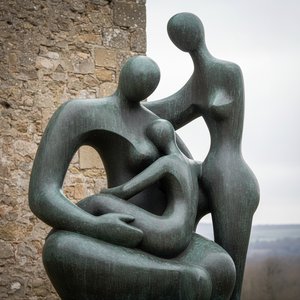
The sculpture "L," created by Henri Gaudier-Brzeska in 1912, stands as a testament to the burgeoning avant-garde movement of early modernism and embodies a profound exploration of human intimacy. Crafted from dark stone—likely alabaster or limestone—the piece depicts two male figures engaged in an intimate embrace, capturing a fleeting gesture of connection against a stark white backdrop that serves to amplify its sculptural impact. This photograph, meticulously documented by MoMA (Museum of Modern Art), offers us not merely a visual representation but a glimpse into the artistic spirit of its time and Gaudier-Brzeska’s singular vision.The Influence of Epstein and “Direct Carving”
Gaudier's artistic trajectory was decisively shaped by his collaboration with sculptor Jacob Epstein, who championed the revolutionary technique of "direct carving." Unlike traditional methods that involved preparatory sketches and maquettes, Epstein encouraged Gaudier to sculpt directly from the stone itself—a process demanding unwavering concentration and a profound understanding of material properties. This approach prioritized immediacy and responsiveness to the inherent qualities of the medium, rejecting academic conventions in favor of an expressive idiom rooted in primal form.Stylistic Echoes of Cubism and Expressionism
“L” resonates with stylistic influences from both Cubism and Expressionism. Gaudier’s simplification of forms—evident in the stylized musculature of the figures and the flattened planes of their bodies—mirrors the geometric fragmentation characteristic of Cubist explorations. Simultaneously, the sculpture conveys a palpable emotional intensity through its dramatic interplay of light and shadow, mirroring the expressive distortions found in Expressionist art. This duality underscores Gaudier’s ambition to transcend mere representation and communicate deeper psychological truths.Symbolism Beyond Physical Form
The sculpture's symbolism extends beyond its depiction of physical intimacy. The stark white background serves as a visual counterpoint to the dark stone, highlighting the contours of the figures and emphasizing their vulnerability. The intertwined poses suggest a merging of identities—a desire for unity amidst individual experience—reflecting broader anxieties about masculinity and relationships prevalent in the early 20th century. Gaudier’s deliberate choice of material—stone—symbolizes permanence and resilience, hinting at an enduring fascination with the human condition.A Legacy of Bold Experimentation
Henri Gaudier-Brzeska tragically perished in 1915 during World War I, leaving behind a remarkably prolific body of work that continues to inspire artists today. “L,” alongside other sculptures produced during his brief but impactful career, exemplifies his unwavering commitment to artistic innovation and his refusal to compromise on his vision. Its enduring appeal lies not only in its masterful execution—the meticulous attention to detail and the skillful manipulation of light—but also in its ability to provoke contemplation about fundamental questions concerning human connection and artistic expression. The photograph’s documentation ensures that this seminal piece remains accessible to future generations, preserving Gaudier-Brzeska's legacy as a pioneer of modern sculpture.常见问题与解答
亨利·高迪埃-布热斯卡 的《L》 属于哪种艺术流派?
“L”是一件Early Modernism时期的作品。该艺术流派体现了作品所属的艺术传统。
在哪里可以购买到 亨利·高迪埃-布热斯卡 的《L》 的数字图像?
若想获取 亨利·高迪埃-布热斯卡 的《L》 的数字版文件,请前往其 高分辨率数字图像 页面进行 高分辨率数字图像下载。
"L" 的主题与 亨利·高迪埃-布热斯卡 常有的创作主题有何关联?
在亨利·高迪埃-布热斯卡已记录的主题——rodin influence, sexual expression, direct carving technique, london art scene, sculptural exploration——之中,"L" 则将焦点转向了sculpture, intimacy, sexuality, modernism, stone, abstraction, human form。
 分享
分享 分享
分享
 详情
详情 指南
指南

 下载作品
下载作品
 相似作品
相似作品 幻灯片播放
幻灯片播放 问答
问答 统计数据
统计数据