
 效果预览
效果预览
 购买印刷品
购买印刷品 分享
分享 分享
分享
 详情
详情

 下载
下载
 相似作品
相似作品 X射线
X射线 幻灯片播放
幻灯片播放

 展开详情
展开详情
每份数字图像订单均包含
专业数字图像交付,品质保障
选择 OriginalUniqueArt.com,您获得的不仅仅是一张图像——您收到的是经过专业级增强、精雕细琢的数字艺术作品,并享有满意保证。以下是您的订单中自动包含的所有内容:

邮件快速送达
您的高分辨率数字图像文件将在下单后 72 小时内通过电子邮件发送给您 —— 即可立即使用。

AI 增强型数字文件
您的艺术品经过专业优化,结合先进的 AI 技术与人工修饰,确保呈现极致的细节、清晰度与色彩准确度。

终身免费重发服务
不小心删除了文件或找不到了?没关系——我们将随时为您免费重发。

无需进口费用,始终如一
即刻拥有您的艺术作品,无需支付任何关税、税费或运费——数字下载始终免税。

色彩精准保证
我们通过专业工具与色彩管理技术,确保您的数字图像尽可能真实地还原原作色彩。

60天满意保证
如果您对所购买的数字图像不满意,我们将在60天内为您进行修改或退还100%的款项——无需任何解释。

100% 退款保证
如果不满意?在收到数字文件后的60天内,我们为您提供全额退款——无需任何理由。

批量订单优惠
购买 3 张图片可享 10% 折扣 - 购买 5 张可享 15% 折扣 - 购买 10+ 张可享 20% 折扣。非常适合创意项目、画廊和机构使用。
藏品详情
Artist Background
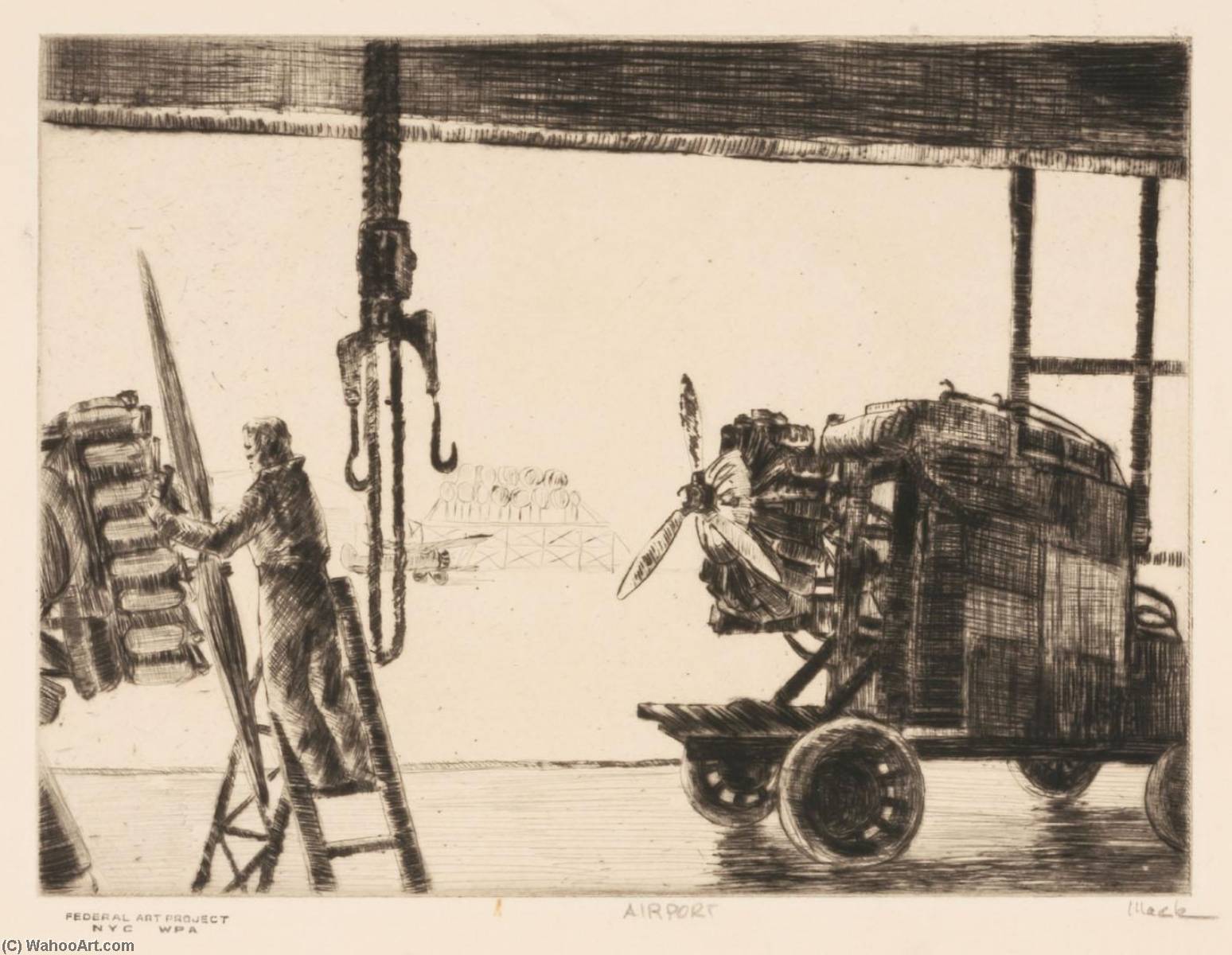
Harry Francis Mack was an American artist known for his exceptional printmaking skills. His work has been offered at auction multiple times, with realized prices ranging from 100 USD to 425 USD, depending on the size and medium of the artwork. The Airport painting is a testament to Mack's experimentation with abstract forms and colors. Key Features of the Painting The painting Airport features a black and white drawing of a man working on a vehicle in what appears to be a garage or workshop setting. The man is standing next to the vehicle, which is located towards the right side of the scene. There are several other vehicles present in the background, including one near the top left corner, another at the bottom right corner, and two more in the middle area of the image.Some notable features of the painting include:
- The use of drypoint on paper, which gives the artwork a unique texture and appearance
- The abstract forms and colors used to depict the vehicles and background
- The attention to detail in the drawing of the man and the vehicles
Conclusion
The painting Airport by Harry Francis Mack is a captivating piece of art that showcases the artist's unique style and technique. As a professional expert in Art and https://OriginalUniqueArt.com salesman, I highly recommend this artwork to anyone interested in American printmaking. For more information on Harry Francis Mack and his work, please visit /art/list/?Filter=AR23RG-Harry-Francis-Mack-Airport. You can also find more information on the Smithsonian American Art Museum at /art/list/?Filter=smithsonian+american+art+museum.艺术家简介
Harry Francis Mack: Weaver of Urban Landscapes
Harry Francis Mack, a name perhaps less familiar than some of his contemporaries in the mid-20th century American art scene, nevertheless represents a quietly powerful voice within the realm of social realism and layered abstraction. Born in Gloversville, New York, in 1907, Mack’s artistic journey was deeply intertwined with the socio-political currents of his time – specifically, the Great Depression and the Federal Art Project. His work isn't defined by grand gestures or revolutionary pronouncements; rather, it unfolds through a meticulous process of observation, layering, and an almost obsessive attention to detail, revealing a profound understanding of the human condition within the context of industrial America.
Mack’s early life offered little indication of his future as an artist. He initially pursued studies at Georgetown University, finding himself drawn to the world of theatre and performance. This theatrical background would profoundly influence his artistic approach – he wasn't simply depicting scenes; he was constructing narratives through visual elements, employing a deliberate sense of composition and atmosphere reminiscent of stage design. Following graduation, he spent several years working in various roles before discovering his passion for writing and ultimately, painting. A pivotal moment arrived with the creation of “Nanette of the Wilds,” a play based on a true story that garnered considerable success and established him as a promising playwright. This early recognition fueled his ambition to combine his skills in writing and visual art.
The onset of the Great Depression dramatically altered Mack’s trajectory, leading him to join the Federal Art Project (FAP). This government initiative provided employment for artists during a period of unprecedented economic hardship, and it was within this framework that Mack truly honed his distinctive style. The FAP demanded works with social relevance, prompting Mack to focus on depicting the realities of industrial labor, urban life, and the struggles faced by ordinary Americans. His paintings often feature scenes of factories, warehouses, and bustling city streets – rendered not with romanticized idealism, but with a stark realism that captured the grit and hardship of the era. His technique involved building up layers of paint, creating textured surfaces that mirrored the physicality of his subjects. He frequently employed techniques like dry brushing and scumbling to achieve this effect, adding depth and complexity to his compositions.
The Language of Layering: Style and Technique
Mack’s artistic style is immediately recognizable for its distinctive layering technique. He rarely worked with a single flat plane of color; instead, he built up his paintings through multiple applications of paint, creating a sense of depth and texture that invites close examination. This process wasn't merely decorative; it served to convey the complexity and density of the subjects he depicted. The seemingly random patterns and textures within his works are often the result of careful planning and execution, reflecting a deep understanding of color theory and composition.
His use of graphite is particularly noteworthy. Often incorporating pencil sketches directly into his paintings, Mack blurred the boundaries between drawing and painting, creating a hybrid approach that further enhanced the sense of layering and texture. The graphite lines add a subtle sense of movement and dynamism to his compositions, suggesting the constant flux and change inherent in urban life. He frequently employed a muted color palette – predominantly browns, grays, and ochres – which reinforced the somber mood of many of his works. However, he wasn’t afraid to introduce bursts of brighter colors to draw attention to specific details or create focal points within the composition.
Key Works and Notable Pieces
Several of Mack's paintings stand out as particularly significant examples of his artistic vision. “Airport” (1936), a powerful depiction of an industrial landscape, showcases his ability to capture the scale and atmosphere of urban environments. “6th Avenue Subway” (1939), created during his time with the FAP, is perhaps his most iconic work – a meticulously rendered image of a crowded subway platform, teeming with anonymous figures lost in their own thoughts. The painting’s claustrophobic composition and muted color palette effectively convey the sense of isolation and anonymity that can be experienced within urban spaces.
“Night Shift” (1935-43), a graphite drawing on paper acquired by the Metropolitan Museum of Art, exemplifies his exploration of labor and industrial life. The stark depiction of factory workers highlights the physical demands and repetitive nature of their work, while also subtly suggesting the human cost of industrialization. These works, along with others like “Carbide Lamps” (1935), demonstrate Mack’s ability to transform everyday scenes into compelling narratives that resonate with viewers on a deeply emotional level.
Legacy and Historical Significance
While Harry Francis Mack may not be as widely recognized as some of his contemporaries, his work holds significant historical importance. He was a key figure in the Federal Art Project, contributing to a broader effort to document and celebrate American life during a period of profound social and economic upheaval. His paintings offer valuable insights into the realities of industrial labor, urban poverty, and the challenges faced by ordinary Americans during the Great Depression.
Furthermore, Mack’s innovative layering technique influenced subsequent generations of artists, demonstrating the power of texture and visual complexity in conveying meaning. His work continues to be exhibited and studied today, serving as a reminder of the enduring relevance of social realism and the importance of documenting the human experience through art.

harry francis mack
1907 -
基本信息
- Artistic Movement Or Style: Layered abstraction
- Artists Or Movements Influenced By This Artist:
- Geometric abstraction
- Modern art forms
- Artists Who Influenced This Artist:
- George Seurat
- Paul Cézanne
- Date Of Birth: 1907
- Date Of Death: Living
- Full Name: Harry Francis Mack
- Nationality: American
- Notable Artworks:
- Airport
- 6th Avenue Subway
- Night Shift
- Place Of Birth: Gloversville, NY

