
 效果预览
效果预览
 购买手绘画作
 分享
分享 分享
分享
 详情
详情

 下载
下载
 相似作品
相似作品 X射线
X射线 幻灯片播放
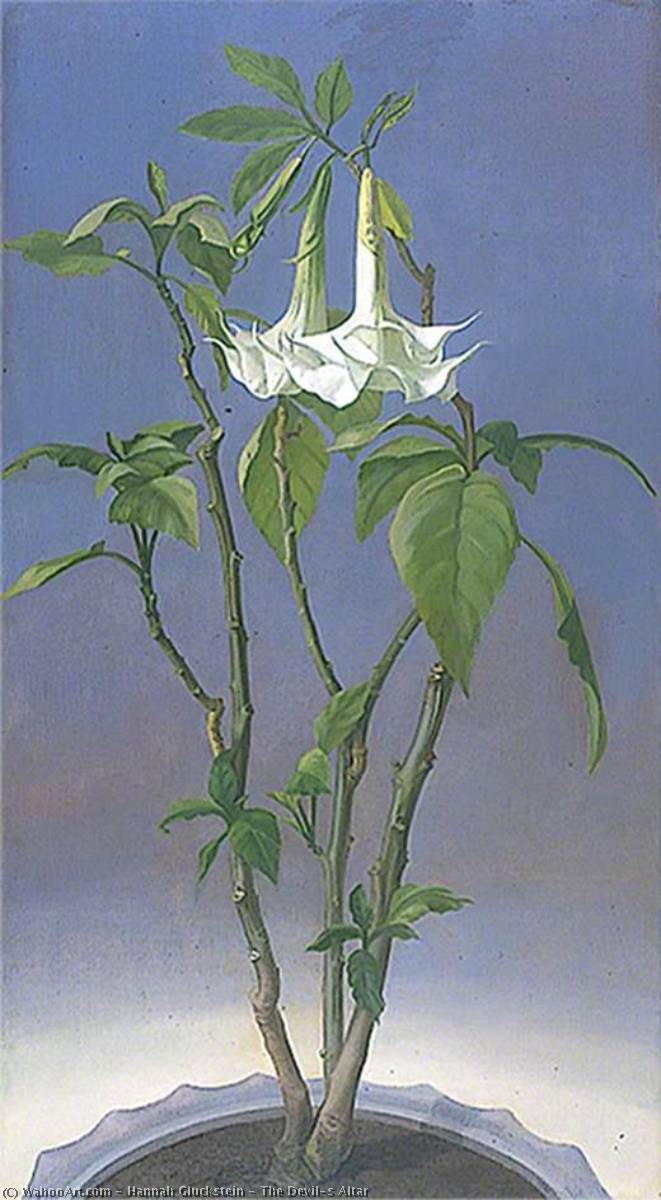
幻灯片播放The Devil's Altar
 1932
1932 137.0 x 76.0 cm
 展开详情
展开详情




































从与原作比例一致的预设尺寸中进行选择。

您可以输入自定义尺寸,以适配特定的画框或空间。如果您选择的尺寸与原图比例不符,我们将对作品进行裁剪,或通过镜像填充/纯色填充边缘的方式来扩展图像。在开始制作之前,我们会向您发送一份数字效果图供您确认。
请注意,屏幕上的预览并不能反映实际的裁剪或扩展效果。只有效果图才能准确展示最终的构图。
虽然我们提供定制尺寸,但为了保持原图比例,我们建议您从预设列表中选择尺寸。


 玻璃选项仅适用于110厘米以下的尺寸。

The Devil's Altar
艺术微喷/版画
复制品尺寸
-


最终总价
$ 80
艺术家简介
The Defiant Spirit of Gluck
In the annals of twentieth-century British art, few figures command as much quiet respect and intrigue as Hannah Gluckstein, known to the world simply as Gluck. Born in London in 1895 into a prosperous Jewish family, her life was a masterclass in the pursuit of authenticity over convention. From a young age, she possessed an intellectual rigor that led her through the halls of St Paul’s Girls' School and eventually to Lincoln College, Oxford. Yet, while her academic achievements were formidable, it was within the studios of the St John’s Wood School of Art that her true vocation took root. Under the guidance of masters such as Sir Edward Maufe, she began to develop a visual language that would eventually bridge the gap between meticulous realism and the burgeoning modernism of her era.
Perhaps most striking about Gluck was her deliberate rejection of societal labels. In an age where women were often defined by their relationships to men, she stripped away all formal honorifics, refusing to be addressed as Miss or Mrs. By adopting the mononym Glullstein—or more simply, Gluck—she asserted a singular identity that was entirely her own. This sense of independence was not merely a social stance but a fundamental component of her artistic psyche, informing the psychological depth and unflinching gaze found in her most celebrated portraits.
Luminosity and the Cornish Light
The trajectory of Gluck’s career was profoundly altered in 1916 when she sought refuge and inspiration in the Lamorna Colony in Cornwall. Joining a circle of luminaries including Frank Cormack and William Nicholson, she became immersed in an environment where the landscape itself seemed to dictate the brushstroke. The rugged, atmospheric beauty of the Cornish coast provided her with a new palette of light and shadow, fostering a fascination with the interplay between nature and emotion. It was during this period that her work began to exhibit its signature luminous color palettes and an almost tactile sense of detail.
Beyond the sweeping vistas of the coast, Gluck found profound meaning in the smaller, more intimate corners of the natural world. She developed a deep, recurring affection for floral subjects, most notably poppies, which became much more than mere decorative elements in her compositions. To Gluck, these flowers were vessels of symbolism, their vibrant petals and delicate structures serving as metaphors for the fleeting nature of beauty and the resilience of life. Her ability to render these botanical subjects with both breathtaking accuracy and atmospheric subtlety allowed her to elevate still life into a realm of profound poetic expression.
A Legacy of Psychological Depth
As her career matured, Gluck’s reputation as one of the foremost portraitists of her generation was solidified. Her approach to portraiture went far beyond the superficial recording of features; she sought to capture the very essence, the psychological interiority, of her subjects. Whether painting prominent figures like Sir James Crichton Browne or more intimate acquaintances, her work was characterized by a masterful use of light and shadow that lent her subjects an incredible sense of dimensionality and presence. Her style, often touched by the clean lines and geometric elegance of the Art Deco movement, allowed her to present her subjects with a dignified, modern clarity.
The historical significance of Gluck lies in her ability to navigate the transition from traditional Victorian sensibilities to the complexities of the modern age. She remained a steadfast practitioner of craft, yet her spirit was undeniably revolutionary. Her life and work stand as a testament to the power of self-definition, proving that through the disciplined application of talent and an unwavering commitment to one's vision, an artist can transcend the limitations of their time to achieve a timeless, enduring resonance.

艺术家简介
- Artistic Movement Or Style: Impressionist painting
- Artists Or Movements Influenced By This Artist: ["Lamorna artists' colony"]
- Artists Who Influenced This Artist: ['James Crichton Browne']
- Date Of Birth: 13 August 1895
- Full Name: Hannah Gluckstein
- Nationality: British
- Notable Artworks: ['Sir Edward Maufe']
- Place Of Birth: London, England

