 实景预览
实景预览
 分享
分享 分享
分享
 详情
详情 指南
指南

 下载作品
下载作品
 相似作品
相似作品 X射线
X射线 幻灯片播放
幻灯片播放 问答
问答 统计数据
统计数据Thorn Tree

- 127.0 x 102.0 cm


 展开全文
展开全文
艺术微喷/版画
博物馆级艺术微喷或帆布版画,制作高效,并提供多种饰面选择。 ( 订购纯手工绘制画作 切换至数字图像销售渠道)




P118B ¥10

P118H ¥10

P118W ¥10

P438Z ¥10

P508JH ¥12

P508YH ¥12

P805H ¥10

P805Z ¥10

P919BZ ¥10

P919G ¥10

P919XJ ¥10

P959ZH ¥10

P968JZ ¥12

W106C ¥8

W218G ¥10

W218JH ¥8

W218Y ¥10

W307PJ ¥10

W316G ¥10

W316PJ ¥8

W316Y ¥10

W398PJ ¥8

W4111J ¥10

W500HY ¥15

W500JH ¥15

W692G ¥12

W849H ¥8

W940BG ¥15

W953PJ ¥8




您可以从与原作比例一致的预设尺寸中进行选择。

请输入您所需的宽度和高度,以适配您的画框或墙面。由于印刷品只能进行裁剪,无法超出原图尺寸,因此若比例不一致,画面的一部分将会被裁切。在正式印刷之前,我们会为您发送一份数字效果图供您确认。本页面显示的图片并非最终裁剪后的效果——只有效果图才能展示真实的裁剪情况。


 玻璃选项仅适用于110厘米以下的尺寸。

Thorn Tree
艺术微喷/版画
复刻品尺寸
-


最终结算价
¥ 544
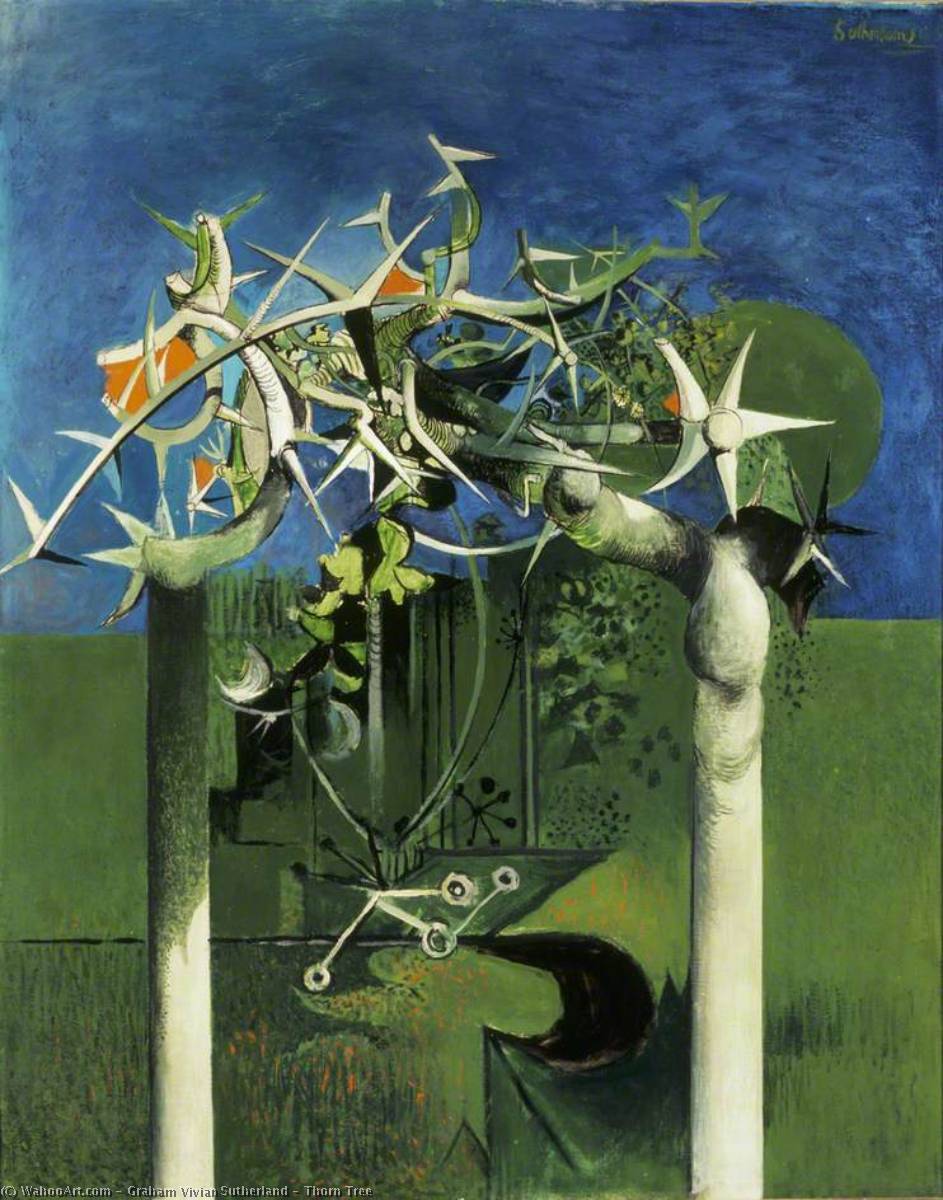
A Vision of Verdant Mystery: Graham Vivian Sutherland’s “Thorn Tree”
Graham Vivian Sutherland's "Thorn Tree," painted in 1946, isn’t merely a landscape; it’s an immersion into the heart of Pembrokeshire’s rugged beauty, filtered through the uniquely perceptive eye of one of Britain’s most significant modern artists. This oil on canvas work transcends simple representation, offering instead a deeply layered exploration of nature's inherent strangeness and the quiet drama of the natural world. Sutherland, a master of Neo-Romanticism, skillfully blends the traditional English landscape tradition with the subtle influences of Surrealism and Expressionism – a combination that resulted in powerfully evocative and often unsettling images.
The painting immediately draws the viewer into a dense, almost claustrophobic woodland scene. Towering trees dominate the composition, their branches intertwining to create a complex network of shadows and light. The leaves themselves are rendered with meticulous detail, yet they possess an unnerving quality – not quite realistic, but hinting at something beyond the purely botanical. Birds, perched precariously amongst the foliage, add to the sense of unease and suggest a hidden life within this seemingly still landscape. Sutherland’s use of color is particularly striking; predominantly greens—ranging from deep emerald to muted olive—create an atmosphere of both lushness and melancholy. Subtle hints of brown and grey ground the scene, anchoring it in the earth while simultaneously emphasizing its isolation.
The Painter's Process: Technique and Style
Sutherland’s technique is characterized by a remarkable sensitivity to light and texture. He employed a broken brushstroke method, layering thin washes of paint to build up form and create a shimmering effect that captures the dappled sunlight filtering through the trees. The canvas itself appears almost alive with movement – not in a frenetic way, but rather through the careful manipulation of color and tone. The painting’s surface is rich with impasto—thickly applied paint—particularly around the branches and leaves, giving them a tangible presence. This tactile quality invites the viewer to reach out and touch the scene, blurring the line between observation and participation.
Notably, Sutherland's work during this period reflects his deep connection to Pembrokeshire, a region he revisited repeatedly throughout his career. He wasn’t simply documenting the landscape; he was attempting to capture its essence—its mood, its mystery, and its inherent sense of solitude. The painting embodies a shift in artistic focus away from purely representational art towards a more subjective interpretation of reality.
Symbolism and Interpretation
“Thorn Tree” is rich with symbolic potential. The thorns themselves are a potent motif—representing both defense and pain, beauty and danger. They suggest a world where nature isn’t always benevolent, but rather holds its own secrets and challenges. The birds, often associated with freedom and spirituality, seem trapped within the dense foliage, hinting at a longing for escape. The overall composition can be interpreted as an allegory of the human condition—a struggle to find meaning and connection in a world that is both beautiful and unsettling.
Furthermore, the painting’s creation coincided with post-war Britain, a period marked by uncertainty and social upheaval. Sutherland's exploration of nature’s complexities can be seen as a reflection of this broader sense of disorientation—a search for stability and meaning amidst chaos. The painting’s enduring appeal lies in its ability to resonate with viewers on multiple levels, prompting contemplation about the relationship between humanity and the natural world.
A Timeless Masterpiece: Reproduction and Display
"Thorn Tree" is a captivating work that would be an exceptional addition to any art collection or interior space. Reproductions of this painting capture much of its original power, offering a way to bring Sutherland’s vision into your home. When selecting a reproduction, consider the quality of the print and the canvas material—a fine-art giclée on archival canvas will best preserve the artwork's colors and detail. The painting’s evocative atmosphere would complement a variety of interior styles, from modern minimalist spaces to more traditional settings. Its subtle color palette and complex composition create a focal point that invites contemplation and adds a touch of understated elegance to any room.
常见问题与解答
什么样的摆放方式最适合 格雷厄姆·维维安·萨瑟兰 的《Thorn Tree》 的画幅?
格雷厄姆·维维安·萨瑟兰 的《Thorn Tree》 的 Portrait 格式推荐用于 Living Room。画幅与空间的结合,将为您提供复制品摆放的指引。
在哪里可以找到关于“Thorn Tree”的指南?
"Thorn Tree" 的指南请参阅作品的 指南 页面 —— 这是一份可打印的信息单,包含了该作品的说明、署名以及详细信息表(艺术家、日期、媒介、原尺寸、馆藏)。
"Thorn Tree" 的版画推荐用于何处?
格雷厄姆·维维安·萨瑟兰 的《Thorn Tree》 的建议用途为 Statement,同时也适用于其他场景。
艺术家简介
格雷厄姆·维维安·萨瑟兰的远见风景
作为英国现代主义的巨擘,格雷厄姆·维维安·萨瑟兰拥有一种罕见的天赋,能够将自然界熟悉的轮廓转化为某种令人深感不安却又极具精神深度的意象。1903年出生于伦敦斯特雷瑟姆,萨瑟兰的艺术生涯是一场不断的蜕变之旅。尽管他在埃普索姆学院接受了古典教育,但他的真正天职却远非家族那法律界的圈子所能涵盖。最初,他在中部铁路机车厂从事学徒工作的技术经历,为他打下了严谨精准的基础,这种特质后来在他错综复杂的版画作品和富有肌理感的油画中得到了充分体现。随着进入伦敦金匠学院艺术学校,萨瑟的创作开始脱离传统的写实表现,转而沉醉于雕刻与蚀刻技法那极具感染力的力量之中。
这位艺术家的早期审美深受塞缪尔·帕尔默浪漫主义风格的影响,但他拒绝被过去所束缚。相反,萨瑟兰成为了英国田园传统与欧洲前卫运动激进能量之间的桥梁。通过吸收超现实主义的梦幻逻辑和表现主义的原始情感,他开发出一种既能捕捉物理景观又能传达心理状态的视觉语言。他的早期版画以神秘感和有机形态为特征,为他日后那以痴迷于自然“奇诡性”为主题的艺术生涯奠定了基石——而这一主题也成为了他最持久的艺术遗产。
自然的阴影与战争岁月
20世纪40年代是萨瑟兰艺术发展的关键时期,他的创作重心从细腻的版画媒介转向了极具张力的厚涂油画。正是在这一时期,彭布罗克郡那崎岖、狂风肆虐的景观成为了他的主要灵感缪斯。在诸如荆棘树等作品中,人们可以见证艺术家如何精妙地将植物的现实形态与超现实主义的扭曲感融合在一起。他不仅仅是在描绘树木,更是在描绘生命本身的张力、挣扎与骨架般的结构。这一时期,他的视角向更加抽象且富有象征意义的方向演变,荆棘、根须和扭曲的枝干成为了人类脆弱性与韧性的隐喻。
第二次世界大战为他的作品注入了另一种更为沉郁的维度。作为官方战争艺术家,萨瑟兰将目光转向了英国本土工业化且往往带有阴郁色彩的场景。他这一时期的绘画,例如飞行炸弹库:洞穴,堪称营造氛围的大师之作。通过厚重的肌理和一种唤起腐朽与恐惧感的色调,他捕捉到了战时室内空间那令人毛骨悚然的荒凉感。这些作品并非仅仅是历史记录,它们是那个充满焦虑与毁灭阴影时代的心理肖像,反映了战争中破碎不堪的世界现实。
象征主义与宏伟成就的传承
在战后岁月里,萨瑟兰的作品升华到了精神与公众意义的新高度。他开始将宗教象征意义与有机形态相结合,创造出神圣与自然之间强有力的融合。这在他最宏伟的成就之一中达到了顶峰:为新建的考文垂大教堂设计巨大的中央挂毯,题为四活物中的荣耀基督。这部作品利用了他在大尺度上操控形式与色彩的能力,见证了他在战后英国文化重建中所扮演的重要角色。
在极其丰沛的艺术生涯中,萨瑟兰的多才多艺使他在多个领域都留下了不可磨灭的印记:
- 肖像画:他捕捉公众人物心理深度的能力,例如他那庄重而忧郁的萨默塞特·毛姆。
- 版画:他对蚀刻与雕刻精准度的终身追求,塑造了他对线条与结构的敏锐感知。
- 装饰艺术:他在挂毯设计和玻璃艺术方面的贡献,将现代抽象主义引入了功能性美的领域。
最终,格雷厄姆·萨瑟兰之所以能成为20世纪艺术的基石,是因为他敢于窥探景观表象之下的深层含义。他在现实中发现了超现实,在有机生命中发现了神性。他的遗产不仅存在于博物馆中,更存在于我们感知周围世界那隐藏且往往嶙峋的美感的方式之中——在这个世界里,每一根荆棘都承载着一个故事,每一个阴影都蕴含着一个谜团。

格雷厄姆·维维安·萨瑟兰
1903 - 1980 , 英国
艺术家简介
- Artistic Movement Or Style: 超现实主义
- Artists Or Movements Influenced By This Artist: ['保罗·纳什']
- Artists Who Influenced This Artist:
- 塞缪尔·帕尔默
- F.L. 格里格斯
- Date Of Birth: 1903年8月24日
- Date Of Death: 1980年2月17日
- Full Name: 格雷厄姆·维维安·萨瑟兰
- Nationality: 英国
- Notable Artworks:
- 飞行炸弹库
- 小巷入口
- Place Of Birth: 英格兰,伦敦
相关文章
Arboreal Echoes: A Historical & Artistic Exploration of Trees in Painting
Explore the rich history of trees in painting! Discover symbolism, Romantic masterpieces by Caspar David Friedrich & beyond. A curated journey for art enthusiasts.

康斯塔布尔大师之作:25幅传世风景画赏析 | OriginalUniqueArt
探索康斯塔布尔的25幅传世杰作!沉浸于英国田园风光,感受浪漫主义绘画大师的光影与色彩。高清油画复制、艺术品购买尽在OriginalUniqueArt.com,为您的家居增添经典之美。立即在线探索完整系列!

浪漫主义画派的十部巨作:定义风景画的艺术传奇
探索浪漫主义风景画的巅峰!本文精选十部经典名作,带您领略莫奈、库尔贝等大师的艺术魅力。感受色彩与光影的诗意,重温自然风光的震撼。OriginalUniqueArt.com为您提供博物馆级别的艺术复制品和个性化家居装饰方案。尽在OriginalUniqueArt.com!

Evocations of Place: A Historical Journey Through Landscape Art
Explore the rich history of landscape art with OriginalUniqueArt. Discover renowned artists, movements like Impressionism & Romanticism, and expert guidance for collecting timeless pieces. Find your perfect serene escape today!

Arboreal Echoes: A Historical & Artistic Exploration of Trees in Painting
Explore the rich history of trees in painting! Discover symbolism, Romantic masterpieces by Caspar David Friedrich & beyond. A curated journey for art enthusiasts.
