切换至版画销售渠道
 展开全文
展开全文







































 对于任何边长超过 105 厘米(约 41 英寸)的艺术品或复制品,画框将以拆解后的组件形式发货。此方法可确保安全送达并防止运输过程中的损坏。


Giuseppe Arcimboldo’s “Self-Portrait on Paper”: A Renaissance Riddle
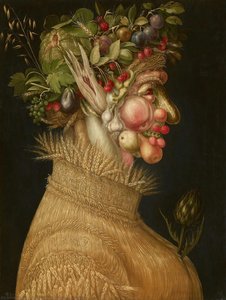
Giuseppe Arcimboldo (1527-1593), a Milanese Mannerist artist, stands apart from his contemporaries not merely for his innovative technique but for the sheer audacity of his artistic vision. While many painters of the era meticulously replicated classical ideals of beauty and proportion—a pursuit driven by humanist scholarship and papal patronage—Arcimboldo dared to challenge convention with a singular preoccupation: transforming recognizable human forms into fantastical assemblages of natural objects.
His “Self-Portrait on Paper,” created in 1587, exemplifies this approach perfectly. Executed in brown ink on paper, the drawing is deceptively simple at first glance. However, upon closer inspection, it reveals a masterful manipulation of perspective and detail that underscores Arcimboldo’s profound understanding of artistic principles.
- Style & Technique: Arcimboldo's style is undeniably Mannerist—characterized by exaggerated forms, stylized drapery, and an emphasis on decorative effects. He employs meticulous hatching and cross-hatching to create textures that convincingly mimic the surfaces of his chosen materials – fruits, vegetables, flowers, books, and musical instruments. The artist’s skill lies in seamlessly blending these disparate elements into a unified composition.
- Historical Context: Arcimboldo's work emerged during a period of intense intellectual debate concerning humanism versus scholasticism. He responded to this challenge by elevating the natural world—a cornerstone of Renaissance thought—to the forefront of artistic representation. The portrait served as a commentary on the artist’s own identity and, symbolically, on the broader humanist preoccupation with integrating disparate disciplines into a cohesive whole.
- Symbolism & Composition: The arrangement itself is laden with symbolic significance. Arcimboldo meticulously crafted each component to mirror facial features—the lips represented by cherries, the nose by apples, the eyes by plums, and the ear by a trumpet mouthpiece. The drapery of robes mimics folds of fabric, while rolled-up paper strips evoke the ruff worn by noblemen.
- Emotional Impact: Beyond its technical brilliance, “Self-Portrait on Paper” possesses an undeniable emotional resonance. Arcimboldo’s deliberate distortion of form invites contemplation about perception and illusion—forcing viewers to actively engage in decoding the visual language of his artwork. The resulting image is both unsettling and captivating, prompting reflection on themes of metamorphosis and self-awareness.
Displayed prominently in Palazzo Rosso (Genoa), Italy, Arcimboldo’s “Self-Portrait on Paper” continues to inspire admiration for its inventive artistry and intellectual depth. It stands as a testament to the Renaissance spirit—a willingness to embrace paradoxes and explore uncharted artistic territories.
常见问题与解答
在朱塞佩·阿尔钦博尔多 (Zhū Sèipèi Ā'Ěrqīnbó'Ěrduō)反复探讨的主题中,"Self-Portrait on Paper"处于怎样的地位?
在朱塞佩·阿尔钦博尔多 (Zhū Sèipèi Ā'Ěrqīnbó'Ěrduō)已记录的主题——botanical symbolism & illusion, human form transfiguration, renaissance intellectual debate, arcimboldo’s surreal vision, iconic portrait mastery——之中,"Self-Portrait on Paper" 则将焦点转向了composite head, fruit arrangement, renaissance art, portrait painting, symbolism, italian renaissance, arcimboldo style。
我能否更详细地查看“Self-Portrait on Paper”?
朱塞佩·阿尔钦博尔多 (Zhū Sèipèi Ā'Ěrqīnbó'Ěrduō) 的《Self-Portrait on Paper》 的 X射线透视 页面是一个交互式查看器,您可以逐层滑动浏览作品图像的十一层光学图层,其中还包含 X 光风格的视图。
朱塞佩·阿尔钦博尔多 (Zhū Sèipèi Ā'Ěrqīnbó'Ěrduō) 的《Self-Portrait on Paper》 是否属于公有领域?
朱塞佩·阿尔钦博尔多 (Zhū Sèipèi Ā'Ěrqīnbó'Ěrduō) 的《Self-Portrait on Paper》 的版权说明:该作品属于 属于公有领域 —— 其版权已过期。这决定了是否可以自由进行图像复制。
 实景预览
实景预览
 分享
分享 分享
分享
 详情
详情 指南
指南

 下载作品
下载作品
 相似作品
相似作品 X射线
X射线 幻灯片播放
幻灯片播放 Q&A
Q&A 统计数据
统计数据