切换至版画销售渠道
 展开全文
展开全文







































 对于任何边长超过 105 厘米(约 41 英寸)的艺术品或复制品,画框将以拆解后的组件形式发货。此方法可确保安全送达并防止运输过程中的损坏。


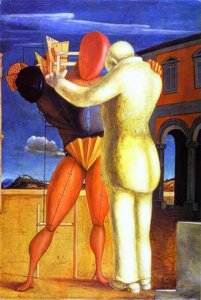
A Dreamscape of Surrealism: Exploring Giorgio de Chirico’s “Ariadne”
Giorgio de Chirico's "Ariadne," completed in 1913, stands as a cornerstone of Surrealist art and a testament to the artist’s profound engagement with philosophical ideas. More than just a depiction of myth—the tale of Ariadne abandoning Theseus on Naxos—it embodies a deeper exploration into the human psyche, mirroring de Chirico's own anxieties about isolation and displacement during his relocation to Paris following World War I. The painting resides within the Metropolitan Museum of Art’s collection, where its haunting beauty continues to captivate audiences worldwide.- Subject Matter & Narrative Context: De Chirico draws inspiration from Greek mythology, specifically the story of Ariadne—a princess abandoned by her lover Theseus—to convey a narrative of abandonment and vulnerability. However, unlike traditional depictions emphasizing heroic action, “Ariadne” presents a serene, almost melancholic scene of slumbering beauty within an unsettling urban space.
- Style & Technique: The artwork exemplifies Surrealist style, characterized by illogical perspective, dreamlike atmosphere, and juxtaposition of incongruous elements. De Chirico meticulously employs graphite alongside oil paint on canvas, layering textures to create a palpable sense of stillness punctuated by subtle distortions—a technique that deliberately disrupts conventional realism.
Symbolism: Echoes of Schopenhauer & Nietzsche’s Philosophy
De Chirico's artistic vision was heavily influenced by the existential philosophies of Arthur Schopenhauer and Friedrich Nietzsche. The desolate square—a recurring motif in his oeuvre—represents a void, mirroring Schopenhauer’s concept of “Will”—the relentless striving that underlies all existence—and highlighting the inherent loneliness of human consciousness. Similarly, Nietzsche's ideas about overcoming nihilism resonate within the painting’s stillness; Ariadne’s repose suggests an acceptance of fate and a confrontation with the abyss.- Spatial Illusion & Perspective: De Chirico masterfully manipulates spatial illusion, employing distorted perspective to heighten the unsettling atmosphere. The elongated shadows cast by unseen buildings contribute to this sense of disorientation, mirroring Nietzsche’s critique of Western metaphysics and its inability to grasp fundamental truths.
Emotional Impact & Artistic Legacy
“Ariadne” transcends mere visual representation; it evokes a profound emotional response—a palpable feeling of melancholy and contemplation. The painting's muted palette—dominated by earthy tones—underscores its contemplative mood, inviting viewers to confront existential questions about life, death, and the human condition. De Chirico’s influence extends far beyond Surrealism, shaping subsequent generations of artists who sought to explore the subconscious mind and challenge conventional artistic conventions. It remains a powerful emblem of the Surrealist movement's ambition to liberate art from rational constraints and unlock the mysteries of inner experience.- Concluding Remarks: Ultimately, “Ariadne” serves as an enduring reminder that art possesses the capacity to illuminate not only visual beauty but also the complexities of human thought and emotion—a legacy that continues to inspire artists and collectors alike.
常见问题与解答
乔治·德·基里科 的《untitled (8848)》 的构图以什么颜色为主导?
Espresso (#3c2825) 是 乔治·德·基里科 的《untitled (8848)》 的主导色。
"untitled (8848)" 是否体现了 乔治·德·基里科 一贯的创作风格?
"untitled (8848)" 描绘了 roman arcades, shadows, masks, surrealism, mythology, isolation, perspective,而 乔治·德·基里科 的创作主题则以 schopenhauer philosophy, surrealist style, mythological symbolism, artistic alienation, legacy exploration 见长。通过两者的对比,可以发现此作与艺术家惯用题材之间的内在联系。
哪种空间能与 乔治·德·基里科 的《untitled (8848)》 的色彩相得益彰?
凭借其Earthy的色调,乔治·德·基里科 的《untitled (8848)》非常适合布置在Living Room中。其色彩搭配正是这一推荐的核心原因。
 实景预览
实景预览
 分享
分享 分享
分享
 详情
详情 指南
指南

 下载作品
下载作品
 相似作品
相似作品 X射线
X射线 幻灯片播放
幻灯片播放 Q&A
Q&A 统计数据
统计数据