实景预览
实景预览
 发送
发送 分享
分享
 详情
详情 指南
指南

 下载图片
下载图片
 相似作品
相似作品 X射线
X射线 幻灯片播放
幻灯片播放 统计数据
统计数据Gladiatori

 阅读全文
阅读全文
艺术微喷/版画
博物馆级艺术微喷或帆布版画,制作高效,并提供多种饰面选择。 ( 订购此收藏品的纯手工复刻画作 切换至数字图像销售渠道)




P118B ¥10

P118H ¥10

P118W ¥10

P438Z ¥10

P508JH ¥12

P508YH ¥12

P805H ¥10

P805Z ¥10

P919BZ ¥10

P919G ¥10

P919XJ ¥10

P959ZH ¥10

P968JZ ¥12

W106C ¥8

W218G ¥10

W218JH ¥8

W218Y ¥10

W307PJ ¥10

W316G ¥10

W316PJ ¥8

W316Y ¥10

W398PJ ¥8

W4111J ¥10

W500HY ¥15

W500JH ¥15

W692G ¥12

W849H ¥8

W940BG ¥15

W953PJ ¥8




您可以从与原作比例一致的预设尺寸中进行选择。

请输入您所需的宽度和高度,以适配您的画框或墙面。由于印刷品只能进行裁剪,无法超出原图尺寸,因此若比例不一致,画面的一部分将会被裁切。在正式印刷之前,我们会为您发送一份数字效果图供您确认。本页面显示的图片并非最终裁剪后的效果——只有效果图才能展示真实的裁剪情况。


 玻璃选项仅适用于110厘米以下的尺寸。

Gladiatori
艺术微喷/版画
复刻品尺寸说明
-


总计金额
¥ 537
A Fragment of Dreamscape: De Chirico’s ‘Teste di Gladiatori’
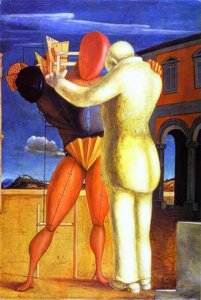
Giorgio de Chirico's “Teste di gladiatori” – literally "Gladiator Heads" – stands as a cornerstone of Metaphysical Art, an unsettling yet undeniably beautiful exploration of the subconscious mind and its confrontation with classical grandeur. Painted in 1916, this lithograph encapsulates the artist’s profound engagement with philosophical ideas championed by Schopenhauer and Nietzsche, mirroring their preoccupation with irrationality and the illusory nature of perception. The scene depicts two nude male figures positioned against a stark circular base bathed in diffused light—a deliberate echo of Roman arcades, instantly transporting viewers to a realm beyond mere realism.- Composition & Technique: De Chirico employs masterful hatching and cross-hatching techniques to sculpt the musculature of the gladiators’ heads, creating an illusion of depth and texture that defies conventional perspective. The geometric simplicity of the base—a circle—contrasts sharply with the organic contours of the figures, emphasizing their isolation within this stylized space. Lithography ensures exceptional tonal precision, allowing for nuanced shading and capturing the subtle interplay between light and shadow.
- Symbolism & Context: The gladiators themselves are not merely anatomical representations; they embody themes of confrontation and vulnerability. Their masks—a direct reference to classical portraiture—suggest a detachment from emotion and an awareness of being observed, mirroring the artist’s own intellectual anxieties about the role of art in representing reality. De Chirico's preoccupation with Schopenhauer’s concept of ‘will,’ which posits that all existence is driven by unconscious desires, finds expression in the unsettling stillness of the scene.
- Color Palette & Emotional Impact: The muted color palette—primarily shades of grey, brown, and ochre—contributes to the artwork's melancholic atmosphere. The subtle inclusion of red highlights—perhaps referencing blood or passion—adds a jarring element of tension, underscoring the psychological drama unfolding within the composition.
- Influence & Legacy: “Teste di gladiatori” profoundly impacted Surrealist artists like René Magritte and Salvador Dalí, who adopted de Chirico’s unsettling juxtapositions of familiar objects in unfamiliar contexts as a stylistic hallmark. It remains an enduring testament to the power of art to evoke emotion and provoke contemplation about the human condition—a dreamscape rendered with meticulous detail and imbued with intellectual rigor.
Exploring Metaphysical Art: De Chirico’s Vision
Giorgio de Chirico's artistic breakthrough occurred during a period marked by significant intellectual upheaval in Europe, fueled by thinkers like Nietzsche and Schopenhauer who questioned traditional beliefs about morality and metaphysics. Rejecting Impressionism’s focus on sensory experience, he sought to depict inner psychological states rather than external appearances—a radical departure from prevailing artistic conventions. This ambition led him to develop Metaphysical Art, characterized by dreamlike landscapes populated by enigmatic figures and objects rendered with unsettling precision.- Philosophical Roots: De Chirico’s fascination with Schopenhauer's pessimism – the belief that life is fundamentally meaningless and driven by irrational forces – profoundly shaped his artistic vision. He aimed to capture the elusive realm of subconscious thought, mirroring Nietzsche’s critique of Western philosophy and its reliance on reason alone.
- Formal Innovations: De Chirico experimented with unconventional perspectives and flattened spatial relationships, creating images that resemble architectural interiors or stage sets—a deliberate disruption of realistic representation. The use of mannequins – often positioned in desolate spaces – became a recurring motif, symbolizing the emptiness and alienation inherent in modern existence.
- Roman Echoes: Recurring references to Roman architecture—arcades, columns, statues—served as visual anchors for De Chirico’s dreamscapes, evoking memories of classical antiquity while simultaneously highlighting their decay and irrelevance.
A Lithograph's Delicate Precision
The execution of “Teste di gladiatori” exemplifies de Chirico’s mastery of lithography – a printing technique renowned for its ability to achieve exceptional tonal accuracy and detail. Unlike oil paints, which blend colors seamlessly, lithography relies on transferring ink onto stone, resulting in crisp lines and subtle gradations that capture the nuances of light and shadow with remarkable fidelity. This meticulous process underscores De Chirico’s commitment to conveying psychological states through visual form—a testament to his artistic ingenuity.- Material Considerations: The choice of paper – typically Japanese mulberry paper – contributes to the artwork's aesthetic qualities, enhancing its textural surface and complementing the artist’s expressive linework.
- Printing Process: Skilled craftsmen carefully apply ink to the stone matrix, transferring it onto paper through a series of rollers—a process that demands precision and patience.
- Resulting Image Quality: The resulting lithograph possesses an unparalleled level of tonal subtlety and textural richness – qualities that elevate it beyond mere reproduction into a powerful embodiment of De Chirico’s artistic vision.
问答详情
乔治·德·基里科 的《Gladiatori》 的主导色是什么?
乔治·德·基里科 的《Gladiatori》 的主色调为 Putty (#eceadb)。
哪里可以买到乔治·德·基里科 的《Gladiatori》的手绘复制品?
乔治·德·基里科 的《Gladiatori》 的手绘复制品正在 本网站 发售:您可以通过其 手工油画复刻 页面进行订购:亚麻画布手工绘制油画复制品。
“Gladiatori”背后的艺术家与艺术风格是哪些?
"Gladiatori" 由 乔治·德·基里科 以 Metaphysical Art 流派风格创作而成。艺术家与艺术流派共同定义了作品的传承。
艺术家简介
乔治奥·德·奇里科:梦境的建筑师
在希腊的沃洛斯(Volos)降生的乔治奥·德·奇里科(Giorgio de Chirico,1888-1978),是一位意大利画家、雕塑家和作家,他以其独特的“形而上绘画”(Metaphysical painting)风格而闻名于世。他的艺术生涯并非一帆风顺,而是充满了对传统技法的探索与对现代社会异化感的深刻反思。早年在雅典理工学院接受教育,为他日后的艺术创作奠定了基础。然而,真正点燃他创造力火花的是在慕尼黑的求学经历。在那里,他接触到了阿诺德·博克林(Arnold Böcklin)和马克斯·克林格(Max Klinger)的作品,这些艺术家以其象征性的景观和令人不安的意象深深地吸引了他。与此同时,弗里德里希·尼采(Friedrich Nietzsche)、阿图尔·叔本华(Arthur Schopenhauer)等哲学家的思想也对他的艺术创作产生了深远的影响,这些思想探讨了存在主义、人类欲望的不理性以及主观现实的本质。这些元素共同构成了奇里科绘画的核心——一种试图揭示日常生活中隐藏的真实,展现熟悉空间中潜藏的令人不安诗意的风格。形而上绘画的诞生与发展
1909年左右,奇里科开始探索一种独特的艺术风格,他将其命名为“形而上绘画”。这并非仅仅是一种风格上的创新,更是一次深刻的尝试,旨在捕捉表象之下的隐藏现实,揭示潜藏于日常空间中的不安感。一次前往佛罗伦萨的旅行以及在圣十字广场(Piazza Santa Croce)的经历成为了一个转折点,激发了他创作一系列标志性的“形而上城镇广场”作品。这些画作以其怪异的静谧、长长的戏剧性阴影、不合逻辑的透视以及古典建筑与无面人偶、高耸雕像等令人不安元素并置为特征。这种效果极具震撼力,唤起了一种怀旧、孤立和难以承受的失落感。奇里科创立了形而上绘画学校(Scuola Metafisica),对超现实主义产生了深远的影响,尽管他后来也与超现实主义的一些解读方式保持距离。他的画作并非梦境的简单描绘,而是试图展现一个超越可见世界的领域——一个时间和空间流动、意识和潜意识边界模糊的领域。《思想家的苦恼》(The Vexations of the Thinker)、《秋日下午之谜》(The Enigma of an Autumn Afternoon)以及《爱的歌》(The Song of Love)等作品,完美地体现了这种令人着迷的美学,邀请观者沉思存在的奥秘和人类感知的脆弱性。风格转变与持久的遗产
一战后,奇里科的艺术之路发生了一个意想不到的转折。他放弃了早期的形而上绘画风格,转而拥抱一种更为传统的古典主义或新巴洛克风格。这种转变受到了广泛批评;许多评论家认为这是质量下降的表现,指责他抛弃了定义其早期作品的创新精神。然而,奇里科始终坚持自己的艺术选择,重温过去的题材,但以不同的美学视角呈现它们。尽管饱受批评,他的影响力和后世艺术家是不可估量的。他对空间、透视和象征主义的创新运用挑战了传统的艺术规范,为新的表达形式开辟了道路。影响与艺术传承
奇里科的作品是19世纪末的象征主义运动与20世纪初超现实主义兴起的关键桥梁。他深受阿诺德·博克林和马克斯·克林格的影响,他们的富有表现力的意象与他对神话和潜意识的迷恋产生了共鸣。尼采和叔本华等哲学家的思想为他提供了一个框架,以探索存在焦虑、异化以及在看似毫无意义的世界中寻找意义的主题。然而,奇里科的影响远不止于超现实主义。勒内·马格利特(René Magritte)和萨尔瓦多·达利(Salvador Dalí)等艺术家深受他的形而上绘画的启发,借鉴了他的并置、不合逻辑透视和象征性意象来创造他们自己的梦幻世界。他的作品也影响了后来的魔幻现实主义运动,该运动旨在以一种增强的神秘感和心理深度来描绘日常现实。如今,奇里科的画作在世界各地的主要博物馆中展出,包括罗马西班牙广场附近的专门为他设立的博物馆,确保了他作为20世纪最重要的艺术家之一的遗产得以延续。他留下的不仅仅是一系列艺术作品,更是一种新的视角——一种看待世界的方式,将它视为一个充满隐藏含义、令人不安的美丽和持久神秘的地方。关键影响与艺术传承
- 受到影响:阿诺德·博克林(Arnold Böcklin)、马克斯·克林格(Max Klinger)、弗里德里希·尼采(Friedrich Nietzsche)、阿图尔·叔本华(Arthur Schopenhauer)。
- 影响:超现实主义,特别是勒内·马格利特(René Magritte)和萨尔瓦多·达利(Salvador Dalí)。他的作品也影响了后来的魔幻现实主义。

乔治·德·基里科
1888 - 1978 , 希腊
快速概览
- 全名: 乔治奥·德·奇里科
- 出生地点: 希腊沃洛斯
- 出生日期: 1888年7月10日
- 受影响的艺术家或运动:
- 勒内·马格利特
- 萨尔瓦多·达利
- 国籍: 意大利
- 影响艺术家:
- 阿诺德·博克林
- 马克斯·克linger
- 弗里德里希·尼采
- 艺术运动或风格: 超现实主义,形而上绘画
- 著名作品:
- 思想家的苦恼
- 秋日下午之谜
- 爱的旋律
相关文章
Beyond Reality: Unveiling the Enigmatic Essence of Metaphysical Art
Explore the profound mystery of Metaphysical Art. From Giorgio de Chirico’s haunting dreamscapes to the deep symbolism of the movement, discover how this enigmatic style transcends reality through expert art history analysis and timeless aesthetic beauty.
Giorgio de Chirico: Metaphysical Realities & the Poetics of Absence
Explore the captivating world of Giorgio de Chirico and his groundbreaking Metaphysical painting movement. Discover the philosophical depths & surreal imagery that influenced generations of artists. Learn more at OriginalUniqueArt.

形而上绘画的启示:乔治·德·基里科早期影响与现实之 Veil 之外的探索
深入探索乔治·德·基里科形而上绘画的起源、哲学影响与对超现实主义的深远启示。专业艺术解读,助您理解经典作品背后的神秘世界,提升艺术鉴赏力。

戈雅大师25幅杰作:西班牙灵魂的艺术之旅| OriginalUniqueArt
探索戈雅大师的25幅杰作!深入了解西班牙绘画巨匠Francisco Goya的艺术世界,从洛可可到浪漫主义风格,感受黑加仑时代的情感力量。OriginalUniqueArt.com提供高品质油画复制品和家居装饰灵感。立即在线发现所有名画!
Beyond Reality: Discover the Haunting Beauty and Philosophical Depth of Metaphysical Art
Explore the haunting beauty of Metaphysical Art. Delve into Giorgio de Chirico’s dreamlike landscapes, the movement's profound connection to Surrealism, and the philosophical mysteries hidden within its eerie, silent piazzas.