

 效果预览
效果预览
 购买印刷品
购买印刷品 分享
分享 分享
分享
 详情
详情

 下载
下载
 相似作品
相似作品 X射线
X射线 幻灯片播放
幻灯片播放Landscape with a Ruined Tower
 Oil On Canvas
- WallArt
- Romantic Pastoral
 100.0 x 125.0 cm
 National Trust
 展开详情
展开详情




P118B $10

P118H $10

P118W $10

P438Z $10

P508JH $12

P508YH $12

P805H $10

P805Z $10

P919BZ $10

P919G $10

P919XJ $10

P959ZH $10

P968JZ $12

W106C $8

W218G $10

W218JH $8

W218Y $10

W307PJ $10

W316G $10

W316PJ $8

W316Y $10

W398PJ $8

W4111J $10

W500HY $15

W500JH $15

W692G $12

W849H $8

W940BG $15

W953PJ $8




从与原作比例一致的预设尺寸中进行选择。

您可以输入自定义尺寸,以适配特定的画框或空间。如果所选尺寸与原图比例不符,我们将通过裁剪作品或添加手绘元素来扩展画面。数字样稿将在制作开始前发送给您确认。
请注意,屏幕预览无法准确反映实际的裁剪或扩展效果,只有样稿才能真实呈现最终的构图。
虽然我们提供定制尺寸服务,但为了保留原作比例,建议您从预设列表中选择尺寸。
下单后,OriginalUniqueArt.com 团队将通过电子邮件联系客户获取具体要求,并提供效果预览图。


 玻璃选项仅适用于110厘米以下的尺寸。

Landscape with a Ruined Tower
复制材质
复制品尺寸
-


最终总价
$ 300
作品详情
George Barret the Elder’s “Landscape with a Ruined Tower”: A Vision of English Pastoral
“Landscape with a Ruined Tower,” painted circa 1762-1784 by George Barret the Elder, is more than just a depiction of a rural scene; it's a carefully constructed meditation on time, memory, and the fading grandeur of the English countryside. Barret, an Irish artist who established himself as a leading figure in London’s art world, masterfully captures a moment suspended between decay and enduring beauty, reflecting the philosophical currents of his era – particularly the influence of Edmund Burke's exploration of the sublime.
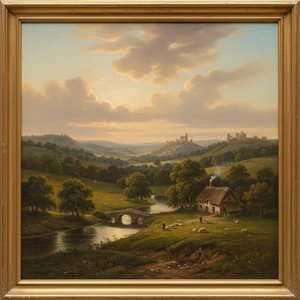
The painting immediately draws the eye to the imposing ruin itself: a weathered tower rising from a gently sloping hillside, partially obscured by a dense copse of trees. Its stones, rendered in muted ochres and browns, speak of centuries spent exposed to the elements, hinting at forgotten histories and lost power. The tower isn’t merely a structural element; it's a potent symbol – a visual representation of decline, yet simultaneously imbued with an undeniable sense of solemn dignity. This deliberate juxtaposition is central to Barret’s artistic vision.
A Painterly Echo of Burke’s Sublime
Barret’s approach to landscape painting was profoundly shaped by Edmund Burke's philosophical treatise, *A Philosophical Enquiry into the Origin of Our Ideas of the Sublime and Beautiful*. Burke argued that experiences of awe and terror – what he termed the “sublime” – could be found not just in dramatic events but also in the contemplation of vastness, decay, and solitude. Barret translates this philosophical concept onto canvas with remarkable skill.
Notice how the artist employs atmospheric perspective—the subtle blurring of distant elements to create a sense of depth and recession. The hazy blue sky, punctuated by wisps of cloud, contributes to the painting’s overall mood of melancholy and contemplation. The careful use of light and shadow further emphasizes the tower's weathered state, highlighting its vulnerability against the backdrop of the seemingly eternal landscape. This isn’t a vibrant celebration of nature; it’s an exploration of its quieter, more profound aspects.
Details of Technique and Composition
Barret was initially influenced by engravings of classical Italianate scenes, reworking them with his own distinctive style. The composition is carefully balanced, drawing the eye towards the tower while simultaneously establishing a sense of spaciousness. The placement of the trees, the gentle curve of the hillside, and the distant body of water all contribute to this harmonious arrangement.
The artist’s brushwork is remarkably controlled, particularly in rendering the textures of stone and foliage. He employs a delicate layering technique—thin glazes of paint applied over dry underlayers—to achieve a luminous quality that captures the subtle nuances of light and shadow. The details are meticulously observed, from the individual stones of the tower to the leaves rustling in the breeze. This attention to detail elevates the painting beyond mere representation, transforming it into a carefully considered work of art.
Symbolism and Emotional Resonance
Beyond its technical merits, “Landscape with a Ruined Tower” resonates deeply on an emotional level. The ruined tower evokes a sense of loss—the passing of time, the decline of empires, and the inevitable decay of all things. Yet, it also possesses a certain beauty in its weathered state, suggesting that even in ruin, there is still value to be found.
The painting invites us to contemplate our own mortality and the fleeting nature of existence. It’s a poignant reminder that beauty can be discovered not only in moments of triumph but also in the quiet contemplation of decay. It's a timeless image, speaking to universal themes of memory, loss, and the enduring power of the natural world – making it a compelling subject for collectors and interior designers seeking pieces with depth and emotional resonance.
艺术家简介
乔治·巴雷特:生平与遗产
1732年左右,乔治·巴雷特出生于爱尔兰利伯蒂维尔的一个布商家庭。他的艺术生涯并非一帆风顺,最初他被学为一名束腰工匠,但很快便展现出对绘画的热情和天赋。大约在1747年前后,在皇家都柏林学会的赞助下,巴雷特开始在罗伯特·韦斯特学院接受正规的绘画训练。在那里,他不仅学习了绘画技巧,还展现出卓越的天赋,很快便成为学院的教师,教授素描课程。这段早期的教育经历为他日后的艺术发展奠定了坚实的基础。值得一提的是,巴雷特与埃德蒙·伯克的友谊,始于伯克在都柏林三一学院求学期间,这份深厚的友谊将在他后来的职业生涯中发挥至关重要的作用。
早期艺术探索与影响
巴雷特的早期绘画作品多以古典风景和神话人物为主题。他的创作深受埃德蒙·伯克的哲学思想的影响,特别是《论崇高与美妙的起源》一书,这本著作深刻地影响了他的风景画创作理念和方法。起初,他主要通过临摹意大利古典风景画家的作品来提升自己的绘画技巧,例如克劳德·洛林的作品。尽管他的画作描绘的是意大利风光,但并没有证据表明他本人曾到过意大利。巴雷特对古典艺术的借鉴并非简单的复制,而是在理解的基础上进行创新和发展,逐渐形成了自己独特的风格。
移居伦敦与声名鹊起
1762年,为了寻求更广阔的艺术发展空间,巴雷特移居伦敦。他很快便在英国艺术界崭露头角,成为当时一位杰出的风景画家。他的作品在英国艺术家协会展出,并受到众多艺术收藏家的青睐。1768年,巴雷特与其他艺术家一起离开了英国艺术家协会,共同创立了皇家学院,这是一个对英国艺术史具有里程碑意义的事件。作为皇家学院的创始人之一,巴雷特为英国艺术的发展做出了重要贡献。
艺术风格与主题
巴雷特的绘画风格逐渐从理想化的意大利风景画转向更自然主义的英格兰和爱尔兰风景画。他周游英格兰、威尔士、苏格兰和爱尔兰,接受委托并捕捉不同地区的壮丽景色。他的作品中常见的题材包括田园风光、如诗如画的乡村、瀑布(例如他著名的《鲍斯考特瀑布》)以及庄园和房产的写实描绘。在他的画作中,常常出现人物形象,这不仅增加了画面的空间感,也赋予了作品更丰富的叙事性。
晚年生活与赞助
巴雷特患有哮喘,为了改善健康状况,他于1772年搬到韦斯伯恩格林居住。尽管他的收入颇丰,但他被描述为“挥霍无度”,有时会面临经济困难。值得庆幸的是,埃德蒙·伯克始终是他忠实的挚友,在经济和职业上给予了他大力支持。1782年,伯克推荐巴雷特担任切尔西医院的首席画家,他一直担任这个职位直到1784年去世。
遗产与历史意义
尽管巴雷特去世后,他的遗孀和孩子们陷入贫困,但皇家学院为他们提供了一笔微薄的养老金。巴雷特的绘画作品代表着英国风景画的重要转型,从古典模仿走向更具民族特色的风格。他的画作为我们了解18世纪的风景和贵族生活提供了宝贵的见解。如今,他的许多作品被收藏在著名的艺术机构中,包括爱尔兰国家美术馆和耶鲁中心。

乔治·巴雷特 (Qiáo Zhì Bāléi Tè)
1732 - 1784 , 爱尔兰
艺术家简介
- Artistic Movement Or Style: 浪漫主义风格
- Artists Or Movements Influenced By This Artist: 英国风景画发展
- Artists Who Influenced This Artist:
- 埃德蒙·伯克
- 克劳德·洛林
- Date Of Birth: 1732年左右
- Date Of Death: 1784年
- Full Name: 乔治·巴雷特(长者)
- Nationality: 爱尔兰国籍
- Notable Artworks (List Of Titles):
- 鲍沃特瀑布
- 南威克公园景观
- 楠特莱湖
- 丹森庄园北侧
- Place Of Birth (City And Country): 爱尔兰利伯蒂维尔
相关文章

乔治·布拉克:25幅大师杰作,重塑现代艺术与家居美学 | OriginalUniqueArt
探索乔治·布拉克25幅大师杰作,领略立体主义的魅力与现代艺术的精髓。从早期作品到经典油画,OriginalUniqueArt为您呈现法式优雅与家居装饰灵感。高清艺术复制品,点亮您的空间!立即在OriginalUniqueArt.com发现更多。
George Barret the Elder: Pioneering British Pastoral Painting & Landscape's Rise
Explore the life & art of George Barret Sr., a pioneer of British pastoral painting. Discover his influence on Romantic landscape art, patronage, and collecting tips from OriginalUniqueArt.

乔治·修拉25幅杰作:点彩主义大师的艺术之旅 | OriginalUniqueArt
探索乔治·修拉25幅传世杰作!深入了解点彩画法、后印象派的艺术魅力,感受光与色彩的奇妙。OriginalUniqueArt.com提供高品质修拉作品复制品,为您的家居空间增添经典艺术气息。立即在线探索完整系列!

Idyllic Visions: Exploring the Pastoral Scene in Art History – From Arcadia to Modern Interpretations
Explore the captivating history of pastoral art from classical Arcadia to modern masterpieces. Discover key artists like Millet & Cole at OriginalUniqueArt. Find serene landscape paintings for your home.
Idyllic Visions: Exploring the Pastoral Tradition in Western Art – Themes, Techniques & Enduring Appeal
Explore the rich history of pastoral art from classical Arcadia to contemporary interpretations. Discover key artists, themes & collecting tips at OriginalUniqueArt.



