

 效果预览
效果预览
 购买手绘画作
 分享
分享 分享
分享
 详情
详情

 下载
下载
 相似作品
相似作品 X射线
X射线 幻灯片播放
幻灯片播放On the Conway


 展开详情
展开详情




































从与原作比例一致的预设尺寸中进行选择。

您可以输入自定义尺寸,以适配特定的画框或空间。如果您选择的尺寸与原图比例不符,我们将对作品进行裁剪,或通过镜像填充/纯色填充边缘的方式来扩展图像。在开始制作之前,我们会向您发送一份数字效果图供您确认。
请注意,屏幕上的预览并不能反映实际的裁剪或扩展效果。只有效果图才能准确展示最终的构图。
虽然我们提供定制尺寸,但为了保持原图比例,我们建议您从预设列表中选择尺寸。


 玻璃选项仅适用于110厘米以下的尺寸。

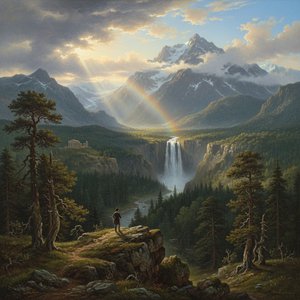
On the Conway
艺术微喷/版画
复制品尺寸
-


最终总价
$ 80
Artistic Style and Influences
George Arthur Hickin's work is characterized by his attention to detail and ability to capture the serene beauty of nature. His style is reminiscent of the Realist movement, which emphasized the depiction of everyday life and landscapes. The Musée Girodet in Montargis, France, is another notable institution that showcases an impressive collection of artworks from various French and foreign schools, including pieces by artists like Gustave Courbet, who was a prominent figure in the Realist movement.Similar Works and Artists
Other notable works by George Arthur Hickin include Mountain Solitude, a Scene on the Conway and The Cottager's Home. These paintings demonstrate the artist's ability to capture the essence of rural life and landscapes. For more information on these pieces, visit /art/list/?Filter=ARAFJQ-George-Arthur-Hickin-Mountain-Solitude-a-Scene-on-the-Conway and /art/list/?Filter=ARAFJG-George-Arthur-Hickin-The-Cottager-s-Home.- Some of the key features of On the Conway include its use of color and light to create a sense of depth and atmosphere.
- The painting's composition, with the man standing near the water's edge, adds a sense of tranquility to the scene.
- The presence of cows and horses in the foreground creates a sense of movement and energy, balancing out the serene atmosphere.
The Wolverhampton Art Gallery is also home to other notable works, including pieces by artists like Gerardus Terlaak, who was known for his oil on canvas paintings. For more information on Gerardus Terlaak, visit https://OriginalUniqueArt.com/@/Gerardus-Terlaak.
艺术家简介
The Soul of the English Countryside: The Life and Art of George Arthur Hickin
In the heart of the Victorian era, a period defined by rapid industrial expansion and the soot-stained growth of urban centers, there existed a profound longing for the untouched serenity of the natural world. It was within this cultural tension that George Arthur Hickin emerged as a vital chronicler of the British landscape. Born around 1830 in Wolverhampton, Staffordshire, Hickin’s early life was far removed from the prestigious ateliers of London. Before he ever picked up a brush to capture the flight of a bird or the stillness of a meadow, he served an apprenticeship as a printer. This early immersion in the precision of typography and the mechanics of reproduction likely instilled in him a foundational respect for detail and clarity—traits that would later become the hallmarks of his painterly style.
Though Hickin lacked the formal academic pedigree of his contemporaries, never attending the renowned Slade School of Fine Art, his talent possessed an undeniable, self-taught magnetism. He did not merely observe nature; he sought to translate its very essence onto canvas. His artistic vision was deeply anchored in the traditions of Realism, yet it was infused with a romantic sensibility inherited from the masters who preceded him. One can trace the lineage of his technique directly to the atmospheric brilliance of J.M.W. Turner and the grounded, pastoral honesty of John Constable. From Turner, Hickin learned to manipulate light and color to evoke the shifting moods of a stormy sky; from Constable, he adopted a devotion to the authentic character of the English countryside, ensuring that every leaf and feather felt rooted in reality.
A Mastery of Motion and Wildlife
While his landscapes provided the stage, it was Hickin’s profound intimacy with wildlife that secured his enduring legacy. He possessed a rare, almost scientific ability to document the species inhabiting the lush terrains of Worcestershire and Staffordshire. His canvases are far more than mere biological records; they are vibrant, breathing moments frozen in time. In works such as "A Pair of Lapwings," exhibited at the prestigious Royal Academy in 1864, the viewer is thrust into a moment of high drama, where the birds are captured mid-flight against an unpredictable, tempestuous sky. This ability to convey movement and immediacy—the frantic beat of a wing or the sudden descent of a predator—demonstrates a technical brilliance that resonated deeply with Victorian audiences.
Beyond the kinetic energy of flight, Hickin also mastered the art of stillness. His depictions of larger fauna and pastoral life offered a sense of profound tranquility. In "Landscape and Cattle," painted in 1847, he presents a serene vision of cows grazing near a quiet water source, a scene that celebrates the harmony between animals and their environment. Even his more monumental compositions, such as "The Rookery," showcase a sophisticated command of tonal gradation and complex arrangement, allowing him to portray the sheer grandeur of a rook colony with remarkable anatomical and environmental accuracy.
Legacy and Historical Significance
As the nineteenth century drew to a close, Hickin’s work stood as a testament to a vanishing way of life. His paintings served as a visual sanctuary for an era increasingly preoccupied with the machine. By focusing on the delicate textures of plumage and the soft light of rural afternoons, he preserved the dignity of the English pastoral tradition. His passing in 1916 in Stoke Newington marked the end of a prolific career that bridged the gap between the ruggedness of early Romanticism and the meticulous observation of late Victorian naturalism.
Today, the significance of George Arthur Hickin lies in his role as an artist-observer. His contributions to the art world can be summarized through several key achievements:
- Technical Versatility: The ability to transition seamlessly between the dramatic, atmospheric effects of sky and storm and the quiet, detailed study of small woodland creatures.
- Documentary Value: Providing a rich, visual record of the flora and fauna of the English Midlands during a period of significant ecological change.
- Cultural Resonance: Capturing the Victorian zeitgeist—a period marked by a deep-seated nostalgia for the pastoral and an intense fascination with the natural sciences.
Through his dedicated brushwork, Hickin ensured that the fleeting beauty of a bird in flight or the quiet majesty of a mountain scene would remain eternally preserved, inviting every generation to rediscover the timeless splendor of the natural world.

艺术家简介
- Artistic Movement Or Style: Realism
- Date Of Birth: Living
- Full Name: George Arthur Hickin
- Nationality: British
- Notable Artworks: ['On the Conway']
- Place Of Birth: Wolverhampton
相关文章

乔治·布拉克:25幅大师杰作,重塑现代艺术与家居美学 | OriginalUniqueArt
探索乔治·布拉克25幅大师杰作,领略立体主义的魅力与现代艺术的精髓。从早期作品到经典油画,OriginalUniqueArt为您呈现法式优雅与家居装饰灵感。高清艺术复制品,点亮您的空间!立即在OriginalUniqueArt.com发现更多。

乔治·修拉25幅杰作:点彩主义大师的艺术之旅 | OriginalUniqueArt
探索乔治·修拉25幅传世杰作!深入了解点彩画法、后印象派的艺术魅力,感受光与色彩的奇妙。OriginalUniqueArt.com提供高品质修拉作品复制品,为您的家居空间增添经典艺术气息。立即在线探索完整系列!
Evoking Nature's Sublime: A Comprehensive Exploration of 19th-Century Landscape Painting
Explore the captivating world of 19th-century landscape painting! Discover renowned artists like Friedrich & Monet, key movements, and find the perfect artwork to bring nature's serenity into your home. Expert insights at OriginalUniqueArt.

浪漫主义画派的十部巨作:定义风景画的艺术传奇
探索浪漫主义风景画的巅峰!本文精选十部经典名作,带您领略莫奈、库尔贝等大师的艺术魅力。感受色彩与光影的诗意,重温自然风光的震撼。OriginalUniqueArt.com为您提供博物馆级别的艺术复制品和个性化家居装饰方案。尽在OriginalUniqueArt.com!

Evocations of Place: A Historical Journey Through Landscape Art
Explore the rich history of landscape art with OriginalUniqueArt. Discover renowned artists, movements like Impressionism & Romanticism, and expert guidance for collecting timeless pieces. Find your perfect serene escape today!

