

 效果预览
效果预览
 分享
分享 分享
分享
 详情
详情

 下载
下载
 相似作品
相似作品 X射线
X射线 幻灯片播放
幻灯片播放 统计数据
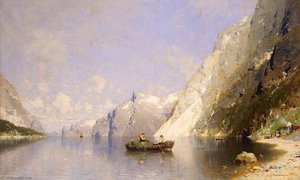
统计数据Untitled (AQVJ9F)
 1914
1914 87.0 x 635.0 cm
 展开详情
展开详情
艺术微喷/版画
博物馆级艺术微喷或帆布版画,制作高效,并提供多种饰面选择。 ( 购买手绘画作 切换至数字图像销售渠道)




































从与原作比例一致的预设尺寸中进行选择。

您可以输入自定义尺寸,以适配特定的画框或空间。如果您选择的尺寸与原图比例不符,我们将对作品进行裁剪,或通过镜像填充/纯色填充边缘的方式来扩展图像。在开始制作之前,我们会向您发送一份数字效果图供您确认。
请注意,屏幕上的预览并不能反映实际的裁剪或扩展效果。只有效果图才能准确展示最终的构图。
虽然我们提供定制尺寸,但为了保持原图比例,我们建议您从预设列表中选择尺寸。


 玻璃选项仅适用于110厘米以下的尺寸。

Untitled (AQVJ9F)
艺术微喷/版画
复制品尺寸
-


最终总价
$ 80
艺术家简介
A Brush with the Nordic Soul: The Life and Art of Georg Anton Rasmussen
Georg Anton Rasmussen, born in 1842 and passing in 1914, remains a captivating figure within the landscape tradition of 19th-century German painting. Though not as widely celebrated as some of his contemporaries, Rasmussen’s evocative depictions of Norwegian fjords and coastal scenes possess a unique atmospheric quality that continues to resonate with art lovers today. His life, while relatively undocumented, appears deeply intertwined with the landscapes he so passionately portrayed – a dedication born perhaps from an early connection to the natural world. While biographical details are scarce, it is known that Rasmussen spent significant time in Norway, absorbing its dramatic beauty and translating it onto canvas with a distinctive palette knife technique. He wasn’t merely *recording* scenery; he was interpreting it through a lens of personal feeling, imbuing his works with a sense of quiet contemplation and the sublime power of nature.The Norwegian Influence: A Palette of Light and Shadow
Rasmussen's artistic journey was profoundly shaped by Norway’s breathtaking vistas. The country’s majestic fjords – deep inlets carved by glaciers, flanked by towering cliffs and cascading waterfalls – became his primary subject matter. Unlike the meticulous detail favored by some landscape artists, Rasmussen embraced a more impressionistic approach, prioritizing atmosphere and emotional impact over precise representation. His paintings are characterized by bold brushstrokes, often applied with a palette knife to create a textured surface that mimics the ruggedness of the Norwegian terrain. This technique lends his works a sense of immediacy and physicality; one can almost feel the chill of the Nordic air and hear the roar of the waves crashing against the shore. The light in Rasmussen’s paintings is particularly noteworthy – he masterfully captured the subtle nuances of the northern sky, from the soft glow of twilight to the dramatic contrasts of sunlight and shadow. He wasn't simply painting *what* he saw, but rather *how* it felt to be immersed within that environment.Technique and Style: Beyond Realism
Rasmussen’s distinctive style sets him apart from many of his contemporaries. While rooted in the realist tradition, his work transcends mere imitation of nature. The heavy impasto created by his palette knife technique is central to this effect. This wasn't a matter of simply applying paint; it was a deliberate attempt to capture the very *essence* of the landscape – its texture, its weight, its energy. The thick layers of pigment create a three-dimensional quality that draws the viewer into the scene. He often employed a limited color palette, focusing on blues, greens, grays, and browns to evoke the somber beauty of the Nordic environment. However, within this restrained range, he achieved remarkable depth and luminosity through subtle variations in tone and value. His paintings are not about vibrant spectacle; they’re about quiet power and enduring presence. This approach aligns him with a broader movement towards atmospheric realism that was gaining momentum in Europe during the late 19th century, though his focus on Norwegian landscapes remained uniquely personal.Legacy and Historical Context
Though Rasmussen did not achieve widespread fame during his lifetime, his work has experienced a resurgence of interest in recent years. His paintings offer a compelling glimpse into the artistic sensibilities of the 19th century – a period marked by both a fascination with realism and a growing desire to capture subjective experience. He stands as an important example of artists who sought to move beyond mere representation and explore the emotional power of landscape.- His work reflects the Romantic tradition’s emphasis on nature's sublime beauty.
- He contributed to the development of atmospheric realism in German painting.
- Rasmussen’s paintings provide valuable insights into the cultural and artistic exchange between Germany and Norway during the 19th century.
georg anton rasmussen
1842 - 1914