

 实景预览
实景预览
 发送
发送 分享
分享
 详情
详情 指南
指南

 下载图片
下载图片
 相似作品
相似作品 X射线
X射线 幻灯片播放
幻灯片播放 统计数据
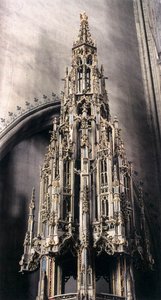
统计数据Tabernacle (detail)


 阅读全文
阅读全文
艺术微喷/版画
博物馆级艺术微喷或帆布版画,制作高效,并提供多种饰面选择。 ( 订购此收藏品的纯手工复刻画作 切换至数字图像销售渠道)




































您可以从与原作比例一致的预设尺寸中进行选择。

请输入您所需的宽度和高度,以适配您的画框或墙面。由于印刷品只能进行裁剪,无法超出原图尺寸,因此若比例不一致,画面的一部分将会被裁切。在正式印刷之前,我们会为您发送一份数字效果图供您确认。本页面显示的图片并非最终裁剪后的效果——只有效果图才能展示真实的裁剪情况。


 玻璃选项仅适用于110厘米以下的尺寸。

Tabernacle (detail)
艺术微喷/版画
复刻品尺寸说明
-


总计金额
¥ 538
艺术家简介
The Architect of Devotion: The Life and Legacy of Gabriel van den Bruyne
In the heart of the Northern Renaissance, amidst the burgeoning intellectual and artistic fervor of Flanders, lived a creator whose work bridged the gap between structural precision and spiritual transcendence. Gabriel van den Bruyne (circa 1500 – 1561) was not merely an artist in the traditional sense, but a master of form who operated at the intersection of architecture and fine art. Born in the historic city of Leuven, his life unfolded during a period of profound transformation in Europe, where the rigid lines of Gothic tradition were beginning to soften under the influence of humanist inquiry and the luminous realism of the Netherlandish masters.
To understand Van den Bruyn’s aesthetic, one must look to his formative years at Saint John's College in Leuven. This prestigious institution provided him with a foundation in classical learning and humanism, an education that would later imbue his architectural designs and artistic compositions with a deep sense of proportion and symbolic weight. While the precise details of his early apprenticeship remain shrouded in the mists of time, the echoes of giants like Jan van Eyck and Rogier van der Weyden are unmistakable in his approach to detail and light. He inherited the Flemish obsession with meticulous realism—the ability to render the texture of marble, the weight of fabric, and the subtle gradations of shadow—and applied it to the very bones of sacred spaces.
A Masterpiece in Marble and Faith
The zenith of Van den Bruyne’s career is inextricably linked to the Sint-Jacobskerk in Leuven. It was here that his dual identity as an architect and artist converged to produce works of enduring spiritual power. His most celebrated contribution, the Tabernacle (completed between 1536 and 1538), stands as a testament to his ability to manipulate physical medium to evoke divine presence. Working primarily in marble, Van den Bruyne achieved a level of sculptural finesse that transformed cold stone into a vessel for liturgical devotion.
This period of his work represents a sophisticated synthesis of several key artistic elements:
- Architectural Rigor: The use of structural geometry to create a sense of permanence and stability within the sacred space.
- Luminous Detail: A mastery of light and shadow, likely influenced by the oil painting techniques of his contemporaries, applied to the relief and surface of stone.
- Theological Narrative: The integration of complex religious symbolism that invited the faithful to contemplate deeper truths through visual beauty.
His monumental Saint James Altarpiece, completed in 1549, further solidified his reputation as a visionary. This work was not simply an object of decoration but a profound theological statement, commissioned by the clergy of St. James' Cathedral to push the boundaries of what an altarpiece could communicate to the masses. Through this ambitious undertaking, Van den Bruyne demonstrated that architecture and art were not separate disciplines, but rather two languages used to tell the same story of faith.
Historical Significance and the Flemish Spirit
Though history often favors the flamboyant brushstrokes of Rubens or the panoramic landscapes of Bruegel, the significance of Gabriel van den Bruyne lies in his role as a foundational pillar of the Northern Renaissance. He belonged to that vital generation of creators who navigated the transition from the medieval mindset to the modern era. His work reflects the intellectual currents of Antwerp and the wider Flemish territories during the reign of Philip II, a time when art was becoming increasingly sophisticated, driven by both religious fervor and the rising influence of wealthy merchant patrons.
Van den Bruyne’s legacy is found in the enduring presence of his structures within the sacred landscapes of Belgium. He remains a pivotal figure for scholars studying the evolution of Northern European art, reminding us that the beauty of the Renaissance was built not just on canvas, but on the very foundations of the cathedrals themselves. His ability to marry the structural logic of an architect with the emotive soul of an artist ensures that his name continues to resonate within the halls of art history.
Gabriel Van Den Bruyne
1500 - 1561 , Belgium
快速概览
- Full Name: Gabriel Belgeonne
- Nationality: Belgian
- Date Of Birth: 1500
- Date Of Death: 1561
- Place Of Birth: Leuven, Belgium
- Notable Artworks:
- Mai nouveau II
- Complicite trouble
- Artistic Movement Or Style: Engraving
- Artists Who Influenced This Artist: ['Gustave Marchoul']
- Artists Or Movements Influenced By This Artist: ['Far Eastern philosophy']