Academic Art · 1915
Kit Carson (Frederick William Macmonnies, 1915)
Frederick William Macmonnies (1863–1937) 创作了《Kit Carson》。 创作于 1915 年。 它属于 Academic Art 运动。 由 Bronze 创作。 现藏于牡蛎湾, 美利坚合众国的萨加莫尔山国家历史遗址。
- 1915
- Bronze
- 萨加莫尔山国家历史遗址, 牡蛎湾

 手工油画复制品
 分享
 分享
 详情页


 下载作品
 相似作品
 幻灯片播放
 问答

 统计数据
Kit Carson简介
- 标题
- Kit Carson
- 艺术家
- Frederick William Macmonnies (1863–1937)
- 艺术家出生于
- Brooklyn Heights, United States
- 日期
- 1915
- 媒介
- Bronze
- 观赏地点
- 萨加莫尔山国家历史遗址, 牡蛎湾, 美利坚合众国
- 主题
- man, horse, rifle, rock, foliage, bronze
Kit Carson 描绘了什么内容?
The Depiction of Kit Carson by Macmonnies
In this bronze work, Frederick William Macmonnies captures Kit Carson on horseback. The sculpture portrays the frontiersman as a significant figure from American history, presented in a moment of action. It was unveiled in 1911 as a large public sculpture celebrating the pioneers of the American Old West. Macmonnies, a sculptor known for his ability to imbue bronze with a sense of vitality, focuses here on the physical presence of the rider and his mount.
The subject, Kit Carson, is depicted with a sense of determination. He sits poised upon the horse, his form integrated into the rugged landscape of the base. This piece reflects the artist's interest in capturing the essence of movement and the spirit of the American frontier. By focusing on the tension within the figure, Macmonnies provides a study of a man defined by the landscape he navigated.
Composition and Visual Elements of the Sculpture
The composition is inherently dynamic, capturing a fleeting moment of action. The rider is poised with a focused intensity, appearing as if he is in the very act of aiming a rifle. This sense of movement is anchored by an elaborate base, where sculpted rocks and foliage provide a rugged foundation for the scene. The perspective is slightly low, looking up at the statue to lend the figure an imposing presence.
Visual rhythm is achieved through a careful balance of lines. Strong, defined lines delineate the musculature of both the horse and the rider, emphasizing the physical tension of the moment. These angular elements contrast with the curved lines that define the contours of the horse's body and the flowing mane. Depth is achieved through the use of overlapping forms, such as the rider positioned in front of the horse’s head, which creates a sense of three-dimensional space within the bronze.
Technique and Materials of the Bronze Work
The sculpture is cast in bronze, a choice that allows for the intricate rendering of the rider and his mount. The execution suggests the use of the lost-wax casting method, or cire perdue, which has enabled the artist to capture fine details within the musculature and the folds of the clothing. This technique provides a level of precision necessary for such a dynamic, active pose.
The surface of the bronze is not perfectly smooth; instead, it possesses a granular quality. This texture lends a sense of realism to the piece, mimicking the ruggedness of the frontier setting. The color palette remains quiet, dominated by muted tones of brown and grey. These hues shift subtly where light meets the metal, creating highlights and shadows that emphasize the three-dimensional form of the horse and rider.
The work rests upon an elaborate base composed of sculpted rocks and foliage. While the sculpture itself is bronze, the base is likely fashioned from stone or plaster to provide a stable, grounded foundation for the equestrian figure. The interplay between the heavy, textured base and the detailed bronze figure creates a sense of weight and presence.
Related Works by Frederick William Macmonnies
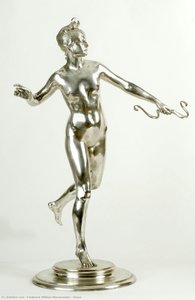
To understand the breadth of Macmonnies's sculptural language, one might look toward his earlier explorations of form and movement. His ability to capture a sense of rhythmic vitality is evident in works such as Bacchante and Infant Faun and his depiction of Diana. These pieces demonstrate a particular sensitivity to the human figure in motion, a quality that defined much of his celebrated output during the Beaux-Arts era. He possessed a rare capacity to imbue bronze and marble with a sense of breath, moving beyond static representation to capture fleeting gestures.
His reach extended from intimate mythological studies to significant civic commissions. He designed the Pan fountain sculpture for Rohallion in New Jersey, a work that reflects his ability to integrate sculpture into functional, decorative environments. This skill for public engagement is further seen in the colossal group Civic Virtue, a fountain created for New York City Hall. Such large-scale projects required a mastery of both monumental scale and intricate detail, balancing the requirements of urban architecture with a refined aesthetic sensibility.
The artist also achieved significant recognition through his portraiture and historical depictions. His 8' tall Nathan Hale statue remains a notable example of his ability to imbue historical figures with profound dignity. Through these diverse subjects—from the mythological to the patriotic—Macmonnies established a presence that bridged classical traditions with a modern, energetic approach to the medium of bronze.
哪家博物馆收藏有 Kit Carson?
萨加莫尔山国家历史遗址
牡蛎湾, 美利坚合众国
政治家精神的圣殿:探索萨加莫尔山 萨加莫尔山国家历史遗址不仅仅是一座宅邸,它是一部沉浸式的美国领导力编年史,是连接美国历史上最具影响力的一位总统成长岁月的实物纽带。这座典型的“木瓦风格”豪宅坐落在长岛 83 英亩令人屏息的美景之中——那里有起伏的草坪、低语的松林,以及若隐若现的大西洋海景——它见证了西奥多·罗斯福那永不停歇的精神以及对国家产生的深远影响。萨加莫尔山不仅是一处居所,更承载着一段复杂的叙事:它是私人避风港,是外交舞台,最终,它成为了窥探那位塑造了 2层世纪的人物灵魂的窗口。该遗址的地理位置极具战略意义,其选址兼顾了隐秘与便捷,充分体现了罗斯福既渴望成为国家事务中的显赫人物,又希望作为社区的一员深植于土地之中的愿望。 建筑本身是萨加莫尔山故事的核心元素。这座由著名的 Lamb & Rich 设计事务所设计的房屋,堪称“木瓦风格”的典范——这是对英国安妮女王风格的一种美国化改良,强调与周围环境的和谐共生。这座完成于 1885 年的建筑,其不对称的外立面覆盖着木瓦,瞬间唤起一种低调的优雅感以及与自然世界的紧密联系。罗斯福对这种建筑风格的刻意选择并非偶然;它反映了他的信念,即真正的领导力需要力量与谦逊的并存——这种平衡在房屋的设计中得到了完美的体现。宽阔的窗户让光线充盈室内,营造出一种开放且引人沉思的氛围,而精心修整的园林景观则强化了置身于充满活力的生态系统之中的感觉。这座建筑历经岁月而不衰,足以证明其最初建造者的精湛技艺以及这种简约而不失高雅的设计所具有的持久魅力。 收藏家的编年史:馆藏珍宝 步入萨加莫尔山,仿佛走进了一部精心策划的自传。北厅(The North Room)或许是这座宅邸中最具标志性的空间,其丰富的文物规模足以令人震撼——这里陈列着罗斯福传奇狩猎远征的战利品(那颗壮丽的驼鹿头标本尤为夺目)、他在担任总统和外交官期间各国领导人赠予的礼物,以及反映其博学才识的海量藏书。这些物品并非仅仅是财产,它们是罗斯规追求知识、冒险与影响力的真实见证。在北厅之外,游客可以通过精心保存的文件、照片和私人信件,追溯罗斯福的政治生涯。总统纪念品展区则提供了对其领导力的深刻洞察——从亲笔撰写的立法草案到记录历史关键时刻的电报,无不令人动容。这里的藏品并非静止不动,它们在往昔的对话、做出的决策以及经历过的战斗回声中,依然鲜活地呼吸着。 然而,萨加莫尔山的收藏远不止于政治领域。伊迪丝·罗斯福的影响力微妙地交织在房屋的每一个角落,这体现在她引以为傲的精美刺绣,以及体现高雅审美情趣的精心布置的花卉中。家族的私人生活——西奥多与伊迪丝五个孩子中有三个是在这些墙壁内诞生的——为这段叙事增添了一层亲密感,揭示了罗斯福在公众形象背后鲜为人知的一面。房屋里充满了动人的细节——角落里藏着的一个孩子玩具,或是来自挚爱的一封手写信——这些细节使这位总统变得人性化,让我们得以窥见他作为丈夫、父亲和朋友的真实生活。 外交舞台:和平谈判与全球影响力 萨加莫尔山的意义超越了其私人住宅的角色。在西奥多·罗斯福总统任期内,这里曾作为“夏季白宫”,接待过无数显贵政要,并影响了国际关系的走向。最著名的或许是 1905 年,促成日俄战争结束的关键性和平谈判便在此举行——正是凭借这一成就,罗斯福荣获了诺贝尔和平奖。进行这些谈判的房间至今仍回荡着清晰的历史感,提醒着访客,这座看似朴素的长岛庄园曾肩负过如此深重的责任与重大决策。园林景观的设计兼顾了美学与安全性——反映了罗斯福对审美与实用主义的双重追求。长岛这一战略性的地理位置为这些外交交流提供了一个既隐秘又易于抵达的环境,使罗斯福在保持私人隐私的同时,能够与华盛顿特区保持紧密联系。 往昔的回响:建筑与遗产 1905 年由 Lamb & Rich 设计扩建的北厅,极大地扩展了萨加莫尔山的规模,也反映了罗斯福不断演变的品味及其对保护历史文物的执着。这次扩建不仅增加了房屋的使用面积,更展示了他日益丰富的收藏。其木瓦风格建筑至今仍保持得异常完好,见证了最初建造者的技艺以及这种简约优雅设计的持久生命力。除了建筑学上的重要意义,萨加莫尔山还代表了美国历史上至关重要的篇章——那是一个由进步改革、自然保护运动以及美国在全球舞台上角色扩张所定义的时代。1962 年该遗址被指定为国家历史遗迹,确保了其能够为后代所保存,不仅守护了房屋的物理结构,更守护了蕴含在墙壁之内的丰富遗产。时至今日,萨加莫尔山依然在不断激励着人们去思考领导力、外交艺术以及美国精神那永恒的力量。


Kit Carson 的高分辨率图像

Frederick William Macmonnies, Kit Carson (1915), 萨加莫尔山国家历史遗址. 公有领域
关于 Kit Carson 的常见问题解答
哪家博物馆收藏了《Kit Carson》的原作?
您可以在 萨加莫尔山国家历史遗址, 牡蛎湾, 美利坚合众国 欣赏到原件《Kit Carson》。
Frederick William Macmonnies 的《Kit Carson》 的创作年份是哪一年?
Frederick William Macmonnies 的《Kit Carson》创作于1915年。
Frederick William Macmonnies 的《Kit Carson》 采用了什么技法?
Frederick William Macmonnies 的《Kit Carson》 的媒介为 Bronze。复制品旨在呈现该技法的视觉效果。
Frederick William Macmonnies 的《Kit Carson》 中呈现了哪些主题?
Frederick William Macmonnies 的《Kit Carson》 描绘了:man, horse, rifle, rock, foliage, bronze, hat。
Frederick William Macmonnies 的《Kit Carson》 是否属于公有领域?
Frederick William Macmonnies 的《Kit Carson》 属于 属于公有领域 —— 其版权已过期。此版权状态决定了该作品图像的复制方式。
“Kit Carson”的作者是谁?
"Kit Carson" 的创作者是 Frederick William Macmonnies。该作品以 Frederick William Macmonnies 的名义编入目录。
"Kit Carson" 属于哪种艺术风格?
Frederick William Macmonnies 的《Kit Carson》 属于 Academic Art 流派,该流派为这件作品提供了风格背景。
“Kit Carson”代表了Frederick William Macmonnies艺术生涯的哪个阶段?
"Kit Carson" 展现了 Frederick William Macmonnies 在 Mature Period 时期的艺术风格。
Frederick William Macmonnies 创作《Kit Carson》时是多少岁?
当"Kit Carson"于1915创作时,出生于1863的Frederick William Macmonnies正值52岁。
关于艺术家 Frederick William Macmonnies

1863–1937, United States
Frederick William Macmonnies
The Sculptor of Light and Bronze: The Life of Frederick William MacMonnies In the vibrant intersection of American ambition and European refinement, the name Frederick William MacMonnies resonates as a symbol of the Beaux-Arts era. Born in Brooklyn Heights in 1863, MacMonnies was a child prodigy of stone carving, possessing an innate ability to breathe life into cold medium from a remarkably young age. His journey was not merely one of personal growth but a transatlantic odyssey that would eventually see him become the most celebrated expatriate sculptor of his generation. He possessed a rare, dual mastery over both the fluid strokes of painting and the structural permanence of sculpture, allowing him to approach form with a unique sensitivity to light and movement that few of his contemporaries could replicate.
关于 Frederick William Macmonnies Frederick William Macmonnies 的代表作
Frederick William Macmonnies 的其他作品
 Diana1890
 Young Chevalier1898
 May Suydam Palmer1903
 Stephen S. Palmer, Trustee 1908-1913, Donor of Palmer Hall (1853-1913)1915

关于 Kit Carson 的论文集
 American artworks of the 1900sIconic American works by Winslow Homer and Frederic Remington define this era. Explore the full collection online at OriginalUniqueArt.com.
 Capturing Motion: The Timeless Beauty of Sir Alfred James Munnings' Equestrian MasterpiecesDiscover the breathtaking equestrian mastery of Sir Alfred James Munnings. Explore an art-history journey through his impressionistic captu…
 American artworks of the 1910s1910s American art by Childe Hassam, George Bellows, and Robert Henri. View the complete collection of iconic US works online at OriginalUn…