切换至版画销售渠道
 展开全文
展开全文







































 对于任何边长超过 105 厘米(约 41 英寸)的艺术品或复制品,画框将以拆解后的组件形式发货。此方法可确保安全送达并防止运输过程中的损坏。


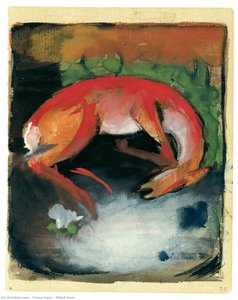
A Moment of Tranquility Captured in Color: Exploring Franz Marc’s “Sleeping Deer”
Franz Marc’s “Sleeping Deer,” painted in 1913, stands as a cornerstone of German Expressionism—a movement that sought to convey inner emotions and spiritual truths through bold artistic expression. More than just a depiction of an animal resting peacefully, this artwork embodies Marc's profound belief that art could serve as a conduit for accessing the sacred, reflecting his formative engagement with theology alongside his burgeoning fascination with the natural world.
The Style of Cubism – A Revolutionary Approach
- Cubist Influence: Marc’s stylistic choices align closely with the principles of Cubism, pioneered by Pablo Picasso and Georges Braque. Unlike traditional representational art that strives for accurate depiction, Cubism fragments objects into geometric planes, presenting multiple perspectives simultaneously.
- Simplified Forms: Observe how Marc reduces the deer's form to simplified shapes—primarily rectangular and triangular—emphasizing its essence rather than meticulous detail. This deliberate distortion contributes to the artwork’s expressive power.
Technique and Color Palette – Expressions of Emotion
Marc employed a tempera technique, known for its luminosity and durability. The vibrant hues he utilized—primarily reds, yellows, and blues—were not merely decorative; they functioned as symbolic representations of inner states. Red signifies passion and vitality, yellow embodies optimism and enlightenment, while blue evokes serenity and contemplation. These colors intertwine to create a harmonious yet dynamic visual experience.
Historical Context – The Blaue Reiter Circle and Spiritual Quest
“Sleeping Deer” emerged from the influential Blaue Reiter (“Blue Rider”) circle—a group of artists who championed abstraction as a means of conveying spiritual ideas. Marc, along with Wassily Kandinsky and Alexej von Jawlensky, believed that art could transcend materialism and connect directly to the divine. This conviction fueled their experimentation with color and form, aiming for an emotional resonance that surpassed mere visual representation.
Symbolism – Deer as Embodiment of Innocence and Spiritual Harmony
The deer itself holds significant symbolic weight within Marc’s oeuvre. Often interpreted as representing innocence, purity, and spiritual harmony—themes central to Christian iconography—the animal embodies Marc's desire to depict the sublime beauty of nature imbued with divine presence. Its posture—resting calmly on its paws—further reinforces this notion of tranquility and repose.
Emotional Impact – A Window into Inner Reflection
"Sleeping Deer" invites viewers into a meditative state, prompting contemplation on themes of peace, vulnerability, and the interconnectedness of life. Marc’s masterful use of color and form transcends mere visual observation, tapping into deeper emotional currents—a testament to his enduring legacy as one of Expressionism's most visionary artists.
常见问题与解答
"Sleeping Deer"创作于哪一年,属于哪种艺术流派?
马克·弗朗茨 的《Sleeping Deer》创作于1912年,属于German Expressionism流派。
马克·弗朗茨 的《Sleeping Deer》 的色彩特征是什么?
马克·弗朗茨 的《Sleeping Deer》 采用了 Earthy 色调,并以 Rosy Brown (#cdb286) 作为主导色。
是否有关于 马克·弗朗茨 的《Sleeping Deer》 的导览页?
马克·弗朗茨 的《Sleeping Deer》 的 指南 页面提供了一份可打印的两页式学生资料单:包含作品及其基本信息表、将其置于艺术家生平中的年代轴、艺术家的其他作品、经测量的色板,以及四种格式的即用型引用文献。
 实景预览
实景预览
 分享
分享 分享
分享
 详情
详情 指南
指南

 下载作品
下载作品
 相似作品
相似作品 X射线
X射线 幻灯片播放
幻灯片播放 Q&A
Q&A 统计数据
统计数据