切换至版画销售渠道
 展开全文
展开全文







































 对于任何边长超过 105 厘米(约 41 英寸)的艺术品或复制品,画框将以拆解后的组件形式发货。此方法可确保安全送达并防止运输过程中的损坏。


A Moment of Serene Intensity: Franz Marc’s “Lying Bull”
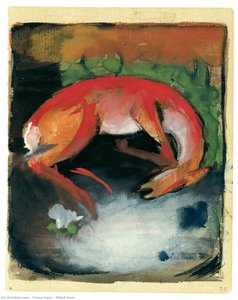
Franz Marc's "Lying Bull," painted in 1913, isn’t merely a depiction of an animal; it’s a profound distillation of the Expressionist spirit—a yearning for connection with nature and a glimpse into the soul. This arresting work, rendered in vibrant blues and reds, immediately commands attention, drawing the viewer into a world where form and color coalesce to evoke a powerful emotional response. Marc, deeply influenced by his spiritual explorations and his fascination with the animal kingdom as symbols of primal instinct and innocence, sought to capture not just what he *saw*, but what he *felt*—a sentiment powerfully realized in this iconic piece.
The Language of Color and Form: Expressionist Technique
“Lying Bull” exemplifies Marc’s signature style. He abandoned traditional representational techniques, opting instead for a bold simplification of shapes and an intense use of color to convey emotion. The bull itself is rendered with broad, almost childlike strokes, its form dissolving into the surrounding space. The checkered pattern in the background isn't merely decorative; it creates a sense of disorientation and movement, mirroring the internal turmoil often associated with the Expressionist movement. Marc’s deliberate flattening of perspective and his rejection of realistic detail were revolutionary for his time, prioritizing the expression of inner experience over objective observation. Notice how the blue dominates, suggesting tranquility and perhaps even melancholy, while the strategic bursts of red inject a vital energy into the composition – a life force struggling to be expressed.
Symbolism in the Primal Image: The Bull’s Significance
The bull holds immense symbolic weight within Marc's oeuvre and, more broadly, within Western art. Often associated with strength, fertility, and virility, it also represents a connection to the earth and the ancient world. Here, however, the bull is not depicted as a powerful predator but rather in a state of repose—lying down, almost vulnerable. This posture suggests introspection, contemplation, or perhaps even surrender. The two apples nestled within the composition further amplify this symbolism. Apples are universally associated with knowledge, temptation, and the fall from grace – elements that resonate deeply within Marc’s spiritual quest for understanding. They introduce a layer of complexity to the scene, hinting at the duality inherent in human existence.
A Window into 1913: Context and Emotional Resonance
“Lying Bull” was created during a period of immense social and political upheaval—the cusp of World War I. The Expressionist movement, with its focus on subjective experience and emotional intensity, served as a powerful response to the anxieties and uncertainties of the era. Marc’s work reflects this climate, capturing a sense of unease and longing for something beyond the immediate reality. The painting's quietude, despite the vibrant colors, speaks volumes about the artist’s desire for peace and spiritual renewal—a sentiment tragically cut short by his untimely death in 1916. The reproduction offered by OriginalUniqueArt.com allows you to bring this powerful piece into your own space, experiencing its emotional depth firsthand.
- Artist: Franz Marc
- Year: 1913
- Style: Expressionism
- Medium: Oil on Canvas (Hand-Painted Reproduction Available)
- Dimensions: (Available in various sizes – inquire for details)
Explore the captivating world of Franz Marc and acquire a stunning, hand-painted reproduction of “Lying Bull” today. Browse our collection now.
常见问题与解答
German Expressionism 流派的作品 "Lying Bull" 源自哪个国家?
通过创作者的出生地,《Lying Bull》将German Expressionism运动与德国紧密联系在了一起。
马克·弗朗茨 还有哪些别名?
马克·弗朗茨 也以 弗朗斯·马尔克, 马尔斯·弗兰兹 等其他名称为人所知。
“Lying Bull”中的色彩呈现出多少光泽感?
"Lying Bull" 的色彩呈现出 Gentle Luminance 的亮度。
 实景预览
实景预览
 分享
分享 分享
分享
 详情
详情 指南
指南

 下载作品
下载作品
 相似作品
相似作品 X射线
X射线 幻灯片播放
幻灯片播放 问答
问答 统计数据
统计数据