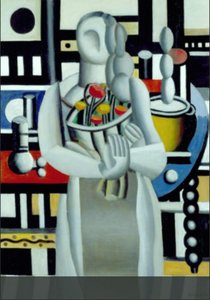
油画原件
 关于 The dance 的一切







































 对于任何边长超过 105 厘米(约 41 英寸)的艺术品或复制品,画框将以拆解后的组件形式发货。此方法可确保安全送达并防止运输过程中的损坏。


A Rhythmic Convergence of Form and Motion
Fernand Léger’s 1932 masterpiece, The Dance, serves as a breathtaking window into the heart of the modern era. At first glance, the viewer is swept up in a whirlwind of activity, where figures are caught in various states of repose and exuberant movement. It is not merely a depiction of a gathering; it is a carefully orchestrated symphony of geometric shapes. Léger, often celebrated as a Geometric Surrealist, eschews traditional anatomical precision in favor of cylinders, cubes, and bold lines. This reduction of the human form into architectural elements creates a mesmerizing rhythm that mirrors the very pulse of life itself. The composition vibrates with an energy that feels both primal and profoundly modern, inviting the observer to lose themselves in the swirling patterns of the dancers.The Tactile Brilliance of Faceted Painting
Beyond the striking composition lies a technical mastery that demands close inspection. Léger utilized a technique known as faceted painting, applying thick, deliberate layers of pigment to create a surface that possesses its own physical presence. The palette is unapologetically bold, dominated by primary reds, yellows, and blues that clash and harmonize with startling intensity. These vibrant hues are set against cooler, more muted backgrounds, creating a sense of depth despite the intentional flattening of perspective. For the collector or interior designer, this texture offers a captivating sensory experience; when captured in a high-quality reproduction, the interplay of light across these simulated thick strokes brings a dynamic, sculptural quality to any wall, making it a centerpiece of modern decor.Echoes of the Machine Age
To understand The Dance is to understand the tension of the early twentieth century. Amidst the swirling figures, Léger integrates objects that speak to the burgeoning industrial landscape—clocks, sports equipment, and mechanical shapes that suggest a world increasingly defined by technology. This juxtaposition of organic human movement with rigid, man-made objects reflects the artist's fascination with the Machine Age. There is a profound symbolism in how the figures seem both part of and distinct from their mechanical surroundings, capturing the era's struggle to find humanity within an increasingly automated reality. It is this complex emotional layer—the balance between chaos and order, nature and industry—that gives the painting its enduring power, making it an essential piece for those who appreciate art that challenges the intellect while stirring the soul.常见问题与解答
The dance是手绘的还是印刷的?
手工绘制:由受过专业训练的画家在亚麻画布上,以油画形式临摹 The dance。
The dance 我该选择什么尺寸?
尺寸范围从 34.8 x 28.7 cm (¥1337) 到 242.0 x 199.7 cm (¥11847);本页表格列出了主要步骤及其价格。
物流需要多长时间?
送货时间为 4 至 5 周,并提供全球免费快递服务;本页面还提供加急制作选项。您可以在 100 天内无条件退货并获得全额退款。
费尔南·莱热 在创作《The dance》时使用了什么媒介?
Oil On Canvas
 实景预览

 分享
 分享
 详情
 详情页


 下载作品
 相似作品
 X射线
 幻灯片播放
 问答

 统计数据