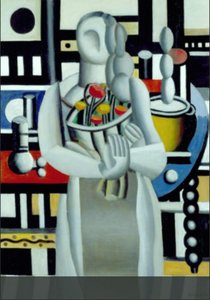
油画原件
 关于 The Builders 的一切







































 对于任何边长超过 105 厘米(约 41 英寸)的艺术品或复制品,画框将以拆解后的组件形式发货。此方法可确保安全送达并防止运输过程中的损坏。


A Monument to Industrial Progress: Léger's Bold Exploration of Form
Fernand Léger’s “The Builders,” completed in 1920, stands as a cornerstone of Cubist aesthetics and embodies the fervent optimism surrounding technological advancement during the tumultuous years of World War I. More than just a depiction of laborers engaged in manual labor—though undeniably present—the painting transcends mere observation to become an impassioned manifesto for Léger’s belief that art could actively engage with the transformative forces reshaping human existence.
Born Joseph Fernand Henri Léger in Argentan, Normandy, 1881, Léger’s artistic trajectory began with a fascination for architecture but swiftly pivoted toward painting after relocating to Paris around 1900. Unlike many of his contemporaries who sought refuge in abstraction as an escape from representational concerns, Léger deliberately confronted the burgeoning machine age head-on. He wasn't interested in simply mirroring reality; he aimed to distill its essence—its geometric precision and rhythmic dynamism—into a new visual language.
Cubism’s Embrace of Fragmented Reality
Léger’s stylistic breakthrough arrived with Cubism, spearheaded by Picasso and Braque. Rejecting traditional perspective and illusionistic depth, Cubists shattered objects into interlocking planes, presenting multiple viewpoints simultaneously. Léger brilliantly adapted this technique to portray figures—specifically three workers—whose bodies are rendered as fragmented assemblages of industrial parts: cylinders, spheres, and cubes. This deliberate simplification wasn’t merely stylistic; it served a profound conceptual purpose.
"The Builders" isn't simply illustrating physical activity; it’s conveying an intellectual understanding of how the machine is reshaping human anatomy and environment. Léger famously articulated this concern in 1922, stating that “the contemporary environment is clearly the manufactured and ‘mechanical’ object; this is slowly subjugating the breasts and curves of women, fruit, the soft landscape.” This quote encapsulates Léger's conviction that art should actively engage with the anxieties and aspirations inherent in modernity.
Symbolism Within Geometric Precision
Beyond its formal innovation, “The Builders” resonates with symbolic significance. The tennis rackets held by the figures represent leisure and recreation—a deliberate contrast to the grueling realities of wartime labor. However, Léger’s meticulous attention to detail—the carefully positioned sports balls, the clock on the wall—suggests a broader commentary on time and progress. These elements underscore Léger's belief that art could capture not only the present moment but also its trajectory toward an uncertain future.
A Legacy of Bold Vision
Fernand Léger’s “The Builders” remains a testament to his unwavering artistic conviction—a bold declaration that art could embrace complexity while simultaneously distilling it into powerful geometric forms. It foreshadowed the stylistic developments of Pop Art and cemented Léger's place as one of the most influential artists of the 20th century, continuing to inspire collectors and interior designers alike with its striking visual language and enduring message about humanity’s relationship with technology.
常见问题与解答
The Builders是手绘的还是印刷的?
手工绘制:由受过专业训练的画家在亚麻画布上,以油画形式临摹 The Builders。
The Builders 我该选择什么尺寸?
原作尺寸为 65 x 92 cm。 尺寸范围从 26.7 x 37.4 cm (¥1336) 到 177.9 x 249.2 cm (¥10959);本页表格列出了主要步骤及其价格。
物流需要多长时间?
送货时间为 4 至 5 周,并提供全球免费快递服务;本页面还提供加急制作选项。您可以在 100 天内无条件退货并获得全额退款。
《The Builders》的原作在哪里?
原作收藏于纽约的大都会艺术博物馆。
费尔南·莱热 在创作《The Builders》时使用了什么媒介?
Acrylic On Canvas
 实景预览

 分享
 分享
 详情
 详情页


 下载作品
 相似作品
 X射线
 幻灯片播放
 问答

 统计数据