切换至版画销售渠道
 展开全文
展开全文







































 对于任何边长超过 105 厘米(约 41 英寸)的艺术品或复制品,画框将以拆解后的组件形式发货。此方法可确保安全送达并防止运输过程中的损坏。


Fernand Léger’s Still Life: A Tubist Vision of Modernity
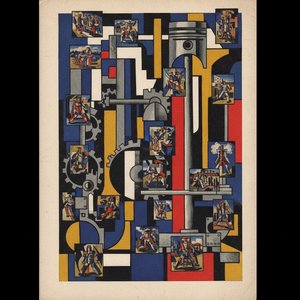
Fernand Léger's 1914 “Still Life” is not merely a depiction of inanimate objects; it’s a vibrant, pulsating embodiment of the burgeoning spirit of modernity. Painted during a pivotal period in his artistic development – a time when he was forging his distinctive Tubism style – this work transcends the traditional constraints of still life painting, offering instead a glimpse into a world increasingly shaped by industrialization and geometric abstraction. Léger wasn’t interested in faithfully rendering reality; he sought to distill its essence, particularly the dynamism and mechanical rhythms inherent in the burgeoning machine age, and translate them onto canvas with bold color and simplified forms.
The composition itself is immediately arresting. A collection of bottles – rendered in a striking palette of yellows, reds, greens, blues, and whites – dominates the scene, arranged with an almost playful disregard for conventional perspective. Alongside these are cups, bowls, and books, each treated with Léger’s signature geometric reduction. Notice how the forms aren't smoothly blended; instead, they’re defined by sharp angles, overlapping planes, and a deliberate lack of detail. This technique, central to Tubism, aimed to capture the underlying structure of objects – their essential shapes – rather than their superficial appearance. The arrangement isn’t random; it feels deliberately constructed, mirroring the ordered logic of machinery.
The Genesis of Tubism
To understand “Still Life,” one must delve into Léger's development of Tubism. Emerging in the early 1910s, this movement represented a radical departure from prevailing artistic trends. Influenced by Cubism’s fragmentation of form and Cézanne’s emphasis on geometric construction, Léger sought to move beyond mere representation. He envisioned a new visual language that could capture the essence of modern life – its speed, efficiency, and mechanical nature. The term “Tubism” itself derives from the tubular shapes that became a defining characteristic of his work, echoing the forms of pipes, gears, and other industrial components.
This period was profoundly shaped by Léger’s own experiences. Having grown up on a farm in Normandy, he possessed an intimate understanding of the physicality of labor and the rhythms of rural life. This grounding contrasted sharply with the increasingly mechanized world he now sought to depict. His early work often featured depictions of agricultural scenes, but as he moved towards Tubism, these subjects were transformed into stylized representations of industrial processes – a deliberate attempt to bridge his past with his present.
Symbolic Resonance and Emotional Impact
While ostensibly a study in form and color, “Still Life” carries a subtle symbolic weight. The abundance of bottles, for instance, can be interpreted as representing the consumer culture that was rapidly emerging in early 20th-century Europe. The books suggest knowledge and learning, yet their simplified forms hint at a world increasingly dominated by practical concerns. Léger’s use of bright, primary colors – yellows, reds, blues – injects a sense of energy and optimism into the scene, reflecting his belief that modernity held the potential for progress and innovation.
Despite its abstract qualities, “Still Life” evokes a surprisingly emotional response. The bold colors and dynamic composition create a feeling of movement and vitality. There’s an underlying tension between the ordered geometry of the forms and their vibrant hues, suggesting a world both exciting and unsettling. It's a painting that invites contemplation – prompting us to consider how art can reflect and shape our understanding of the modern world. The work speaks to a time of rapid change, technological advancement, and a fundamental shift in human experience.
A Reproduction for Your Space
OriginalUniqueArt offers meticulously hand-painted reproductions of Fernand Léger’s “Still Life,” capturing the essence of this iconic artwork with exceptional detail and fidelity. Each reproduction is created by skilled artists using archival-quality materials, ensuring that it will retain its vibrancy and beauty for generations to come. Whether you're an art collector, a design enthusiast, or simply seeking a striking piece for your home or office, our “Still Life” reproduction provides a beautiful and meaningful way to experience the genius of Fernand Léger.
常见问题与解答
费尔南·莱热 的《Still life》 的创作媒介和创作日期是什么?
"Still life"创作于1914年,采用Acrylic On Canvas技法。
费尔南·莱热 的《Still life》中的主导色调是什么?
费尔南·莱热 的《Still life》 的主导色调为 Green to Violet Spectrum,这一色调构成了整个色板的基调。
费尔南·莱热 的《Still life》 是否属于备受追捧的 Tubism 流派作品之一?
在Tubism运动中,"Still life"具有Recognized的知名度。
 实景预览
实景预览
 分享
分享 分享
分享
 详情
详情 指南
指南

 下载作品
下载作品
 相似作品
相似作品 X射线
X射线 幻灯片播放
幻灯片播放 Q&A
Q&A 统计数据
统计数据