切换至版画销售渠道
 展开全文







































 对于任何边长超过 105 厘米(约 41 英寸)的艺术品或复制品,画框将以拆解后的组件形式发货。此方法可确保安全送达并防止运输过程中的损坏。


A Symphony of Geometry and Progress
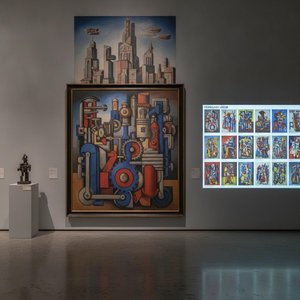
In the vast landscape of twentieth-century modernism, few works capture the rhythmic pulse of the machine age as vibrantly as Fernand Léger’s "Project for a mural." Completed in 1952, this monumental canvas serves as an arresting testament to Orphism, a movement that sought to bridge the gap between pure abstraction and the tangible, mechanical realities of industrial life. To gaze upon this work is to step into a world where the boundaries between organic harmony and industrial efficiency dissolve into a singular, dynamic vision. The painting presents an expansive geometric landscape, a meticulously constructed universe dominated by interlocking circles, squares, and triangles that seem to vibrate with an internal energy.
Léger’s mastery lies in his ability to transform cold, geometric forms into a breathing, emotive experience. Through a palette of striking blues and whites, punctuated by sudden, energetic accents of red, the artist creates a visual dialogue that is both structured and spontaneous. At the upper right corner, a subtly positioned stylized clock face acts as a silent protagonist, symbolizing time’s relentless march forward and mirroring the pervasive influence of industrial precision on the modern human condition. This interplay of shapes does not merely sit upon the canvas; it engineers a visual experience that celebrates the strength and the unapologetic beauty of a world in motion.
The Soul of the Machine Age
The technique employed in this masterpiece is as robust as the subject matter itself. Rooted in the Orphist tradition, Léger eschewed the delicate shadows of traditional representational art in favor of bold outlines and thick, textured brushstrokes. This approach conveys a profound sense of solidity and weight, capturing the essence of heavy machinery while simultaneously evoking an organic, almost musical harmony. The artist’s background—moving from the pastoral, rhythmic landscapes of his youth in Normandy to the high-voltage hum of the Parisian avant-garde—is etched into every stroke. He does not merely depict progress; he embodies it through a technique that feels both architectural and fluid.
For the discerning collector or interior designer, "Project for a mural" offers more than just aesthetic appeal; it provides a profound historical resonance. Emerging from the shadows of the post-war period, Léger’s work reflects a period of intense societal change and the reconstruction of a fractured world. By rejecting the chaotic tendencies of Surrealism in favor of structured abstraction, he offered a vision of hope through order and dynamism. The painting serves as an anchor for any sophisticated space, bringing with it an intellectual depth and a sense of monumental scale that can transform a room into a gallery of modern thought.
Whether viewed as a study of industrial evolution or a celebration of geometric purity, this artwork remains a timeless icon. It invites the viewer to abandon the familiar and embrace a landscape where the grace of the human spirit meets the precision of the machine. Owning a high-quality reproduction of such a pivotal work allows one to inhabit this bold vision of progress every day, surrounding oneself with the enduring energy of Léger’s transformative legacy.
常见问题与解答
费尔南·莱热 的《Project for a mural》 属于哪种艺术流派?
费尔南·莱热 的《Project for a mural》 属于 Cubist Orphism 流派,该流派为这件作品提供了风格背景。
是否有面向学生的 费尔南·莱热 的《Project for a mural》 详情页?
费尔南·莱热 的《Project for a mural》 的 指南 页面提供了一份可打印的两页式学生资料单:包含作品及其基本信息表、将其置于艺术家生平中的年代轴、艺术家的其他作品、经测量的色板,以及四种格式的即用型引用文献。
费尔南·莱热 的《Project for a mural》 的主导色是什么?
费尔南·莱热 的《Project for a mural》 的主色调为 Bronze (#b86928)。
 实景预览

 分享
 分享
 详情
 指南


 下载作品
 相似作品
 X射线
 幻灯片播放
 问答
 统计数据