订购纯手工绘制画作
 展开全文







































 对于任何边长超过 105 厘米(约 41 英寸)的艺术品或复制品,画框将以拆解后的组件形式发货。此方法可确保安全送达并防止运输过程中的损坏。


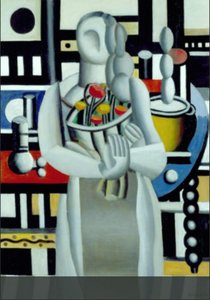
A Mechanical Vision: Decoding Fernand Léger’s ‘Composition’
Created in 1924, this striking work by French artist Fernand Léger is a powerful example of his distinctive “Tubism” – a unique offshoot of Cubism. The artwork presents a tightly cropped and detailed depiction of complex machinery, rendered with meticulous precision in sepia tones. It’s an image that immediately draws the eye, inviting contemplation on themes of industry, modernity, and the beauty found within mechanical structures.Style & Technique: The Essence of Tubism
Léger's style is instantly recognizable for its emphasis on cylindrical forms and geometric shapes – hence the term “Tubism.” ‘Composition’ exemplifies this approach perfectly. Notice how circles, rectangles, and angled planes interlock to create a sense of depth and complexity. The artist masterfully employs hatching and cross-hatching techniques to build form and texture, giving the impression of solidity and weight despite the two-dimensional surface. This isn't simply a drawing; it’s an exploration of volume and space achieved through line work alone. The monochromatic palette further emphasizes the focus on structure and form, reminiscent of technical illustrations or blueprints.Historical Context: Post-War Modernity
Fernand Léger’s artistic development was profoundly impacted by his experiences during World War I. Witnessing the power and precision of machinery in wartime led him to embrace industrial motifs as subjects for his art. ‘Composition’ reflects this shift, moving away from traditional representational painting towards a celebration of the modern, machine age. The 1920s were a period of rapid technological advancement and social change, and Léger's work captures the spirit of optimism and dynamism that characterized this era. He was part of the Puteaux Group (Section d’Or), exploring new ways to represent reality in a post-Cubist world.Symbolism & Interpretation: Beyond the Gears
While seemingly abstract, ‘Composition’ is rich with symbolic potential. The intricate machinery can be interpreted as representing the interconnectedness of modern life, the power of industry, or even the human body itself – reduced to its essential mechanical components. The absence of any human figures encourages viewers to focus on the machine as an entity in its own right. It prompts questions about humanity’s relationship with technology and the impact of industrialization on society.Emotional Impact & Aesthetic Appeal
Despite its subject matter, ‘Composition’ isn't cold or sterile. The meticulous detail and dynamic arrangement of forms create a visually engaging experience. The artwork evokes a sense of awe at human ingenuity and the elegance of engineering. Its neutral color palette makes it incredibly versatile for interior design – complementing both modern and traditional spaces. A reproduction of this piece would serve as a striking focal point in a study, living room, or office, sparking conversation and inspiring contemplation.Key Features
- Artist: Fernand Léger
- Date: 1924
- Medium: Graphite or Charcoal on Paper
- Dimensions: 25 x 23 cm
- Style: Tubism, Cubism, Technical Illustration
常见问题与解答
Composition是手绘的还是印刷的?
手工绘制:由受过专业训练的画家在亚麻画布上,以油画形式临摹 Composition。
Composition 我该选择什么尺寸?
原作尺寸为 25 x 23 cm。 尺寸范围从 30.3 x 33.0 cm (¥1332) 到 229.8 x 249.9 cm (¥13795);本页表格列出了主要步骤及其价格。
物流需要多长时间?
送货时间为 4 至 5 周,并提供全球免费快递服务;本页面还提供加急制作选项。您可以在 100 天内无条件退货并获得全额退款。
费尔南·莱热 在创作《Composition》时使用了什么媒介?
Acrylic On Canvas
 实景预览

 分享
 分享
 详情
 指南


 下载作品
 相似作品
 X射线
 幻灯片播放
 问答

 统计数据