
 效果预览
效果预览
 购买印刷品
购买印刷品 分享
分享 分享
分享
 详情
详情

 下载
下载
 相似作品
相似作品 X射线
X射线 幻灯片播放
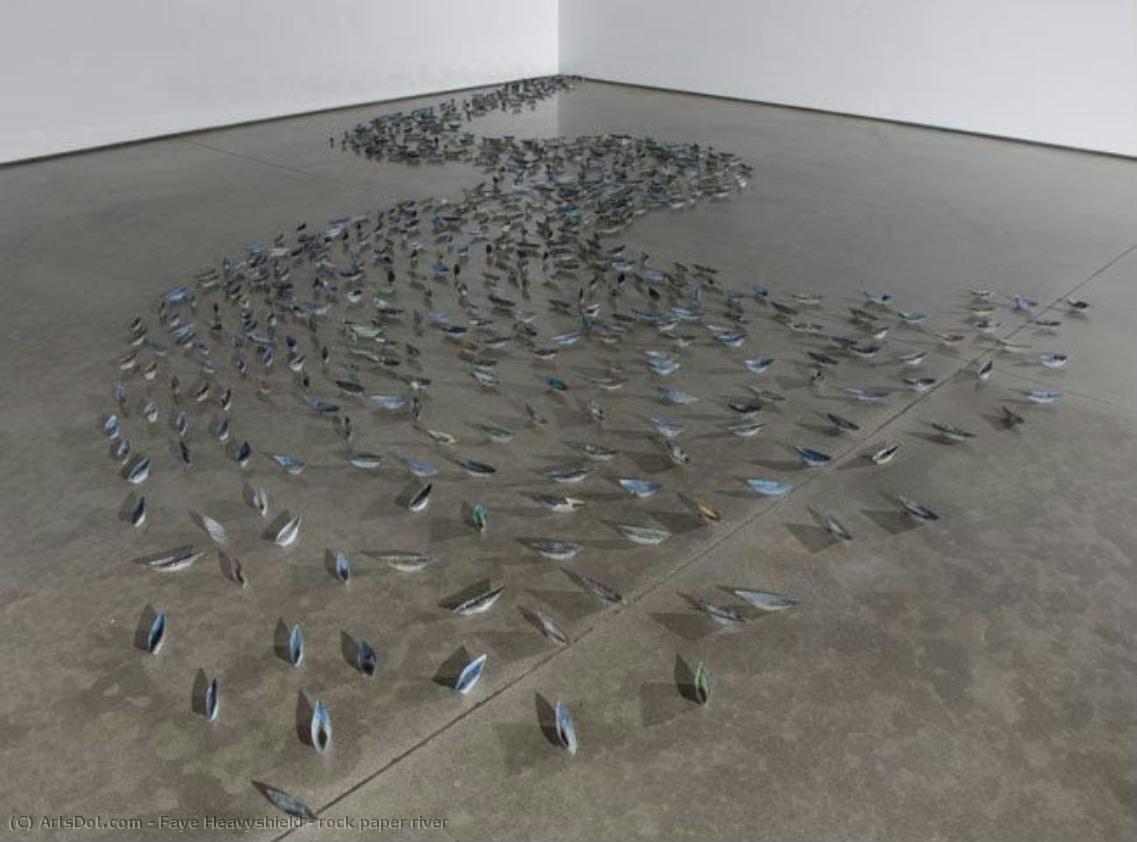
幻灯片播放rock paper river
 2005
2005 3.0 x 562.0 cm
 Alberta Foundation for the Arts
 展开详情
展开详情




































从与原作比例一致的预设尺寸中进行选择。

您可以输入自定义尺寸,以适配特定的画框或空间。如果所选尺寸与原图比例不符,我们将通过裁剪作品或添加手绘元素来扩展画面。数字样稿将在制作开始前发送给您确认。
请注意,屏幕预览无法准确反映实际的裁剪或扩展效果,只有样稿才能真实呈现最终的构图。
虽然我们提供定制尺寸服务,但为了保留原作比例,建议您从预设列表中选择尺寸。
下单后,OriginalUniqueArt.com 团队将通过电子邮件联系客户获取具体要求,并提供效果预览图。


 玻璃选项仅适用于110厘米以下的尺寸。

rock paper river
复制材质
复制品尺寸
-


最终总价
$ 300
艺术家简介
Early Life and Cultural Roots
Faye HeavyShield, a Kainai First Nations sculptor and installation artist born in 1953, embodies a profound connection to the land and history of Southern Alberta. Growing up on the North End of the Blood Reserve 148, her formative years were steeped in the traditions of the Blackfoot Confederacy. The duality of her upbringing – speaking both Blackfoot and English – fostered a unique perspective, bridging ancestral knowledge with contemporary experience. Her father’s role as a ranch manager instilled a deep respect for the physical landscape, while time spent with her grandmother proved pivotal, transmitting oral histories that would later become central to her artistic vision. This early immersion in storytelling, language, and the rhythms of prairie life laid the foundation for an art practice deeply rooted in relationality and memory. The experience of attending St. Mary’s Residential School also cast a long shadow, informing a complex exploration of identity, loss, and resilience that permeates much of her work.Artistic Development and Conceptual Framework
HeavyShield's artistic journey began with formal training at the Alberta College of Art and Design in 1980, culminating in a Bachelor of Fine Arts degree from the University of Calgary in 1986. However, it wasn’t merely technical skill she sought but a means to articulate the intangible—the weight of history, the spirit of place, and the enduring power of Blackfoot culture. She gravitated towards sculpture and large-scale installations, drawn by their capacity for immersive experience and symbolic resonance. Her work doesn't adhere strictly to conventional definitions; it exists in a space between conceptual art and deeply personal cultural expression. HeavyShield describes her art as “a reflection of my environment and personal history,” a vocabulary built from the past, present, and imagined realities of southern Alberta. This approach is characterized by repetition, meditative processes, and a deliberate humility that allows the materials themselves to speak.Recurring Themes and Symbolic Language
A defining characteristic of HeavyShield’s work is its use of multiples—hundreds of small, often hand-created objects arranged in expansive installations. Pieces like body of land (2002) feature countless paper conical tipi forms, their shades of red, pink, purple and brown derived from magnified images of human skin. These aren’t merely representations of shelter but embodiments of permanence—of community, language, and the enduring connection to the land. Similarly, kuto'iis (“blood,” 2004) comprises hundreds of knotted balls of cloth dyed in red ochre, each knot signifying a blood clot, a “re-collection of stories, the sounds of language and song, of home.” The repetitive act of creation itself becomes a ritual, a meditative process that echoes ancestral practices. HeavyShield’s exploration extends to beadwork, meticulously studied in museum collections, prompting reflections on classification systems, the anonymous women who created these objects, and their inherent cultural significance.Major Achievements and Recognition
HeavyShield's impact on contemporary Indigenous art is undeniable. Her work has been exhibited nationally and internationally, including significant shows at The Power Plant, National Gallery of Canada, Plug In Institute of Contemporary Art, Southern Alberta Art Gallery, Art Gallery of Ontario, Pulitzer Arts Foundation (St. Louis), MacKenzie Art Gallery, Minneapolis Institute of Art, and the Remai Modern. Beyond exhibitions, her narration and acting role in “Legends of Kainai: Stories from the Blackfoot People of Southern Alberta” (2007) demonstrated a commitment to preserving and sharing oral traditions. The recent retrospective, The Art of Faye HeavyShield, organized by the MacKenzie Art Gallery, stands as a testament to her four-decade-long career, solidifying her position as a major contributor to contemporary art and offering a powerful selection of drawings, paintings, sculptures, and installations grounded in prairie landscapes and personal experiences.Historical Significance and Enduring Legacy
Faye HeavyShield’s work transcends the boundaries of categorization, existing at the intersection of sculpture, installation, conceptual art, and Indigenous cultural expression. Her minimalist aesthetic is not an absence of meaning but a deliberate distillation—a poetic articulation of complex histories and enduring values. She has created a new artistic vocabulary that resonates deeply with Indigenous artists across Turtle Island, inspiring generations through her work as an artist, mentor, and writer. By centering relationality, embracing humility, and grounding her practice in the specific context of Kainai territory, HeavyShield offers a powerful counter-narrative to dominant art historical canons. Her legacy lies not only in the beauty and complexity of her individual pieces but also in her unwavering commitment to honoring ancestral knowledge, preserving cultural traditions, and fostering a deeper understanding of the land and its people.
Faye HeavyShield
1953 - , Canada
艺术家简介
- Artistic Movement Or Style: Minimalist Installation Art
- Date Of Birth: 1953
- Full Name: Faye HeavyShield
- Nationality: Canadian
- Notable Artworks: ['Rock Paper River']
- Place Of Birth: Canada

