

 实景预览
实景预览
 切换至版画销售渠道
 分享
分享 分享
分享
 详情
详情 指南
指南

 下载作品
下载作品
 相似作品
相似作品 X射线
X射线 幻灯片播放
幻灯片播放 Q&A
Q&A 统计数据
统计数据Three Figures
 74.0 x 44.0 cm
 University of Exeter
 展开全文
展开全文
获取远超网页预览效果的印刷级文件。我们销售的每一张数字图像均源自库存数据库中的高分辨率母版——宽度通常在 5,000 至 15,000 像素之间——因此您可以放心地进行大幅打印、局部裁剪或还原细腻的细节。
每一件作品在离开我们的工作室前都经过了精心的处理。数字影像专家会对照原作核对色彩,并在必要时进行校正,随后利用专业修图工具提升清晰度与细节表现——且始终忠实于艺术家的笔触与风格。最终呈现的图像宛如原作本身,而非仅仅是一张加了滤镜的扫描件。
您可以在最终定稿前进行审核:我们的专家将在 72 小时内通过电子邮件向您发送图像以供审阅。如果不满意?您可以要求改进或修正;若质量未达预期,亦可申请退款。
这也是出版商、设计工作室、画廊及印刷厂所信赖的品质。
每份数字图像订单均包含的内容
专业级数字交付,品质保障
选择 OriginalUniqueArt.com,您获得的不仅仅是一张图像——您收到的是经过专业级增强、精雕细琢的数字艺术作品,并享有满意保证。以下是您的订单中自动包含的所有内容:

邮件即时送达
您的高分辨率数字图像文件将在下单后 72 小时内通过电子邮件发送给您 —— 即可立即使用。

AI 增强型数字文件
您的艺术品经过专业优化,结合先进的 AI 技术与人工修饰,确保呈现极致的细节、清晰度与色彩准确度。

终身免费重发服务
不小心删除了文件或找不到了?没关系——我们将随时为您免费重发。

无需进口税费,始终如一
即刻拥有您的艺术作品,无需支付任何关税、税费或运费——数字下载始终免税。

色彩精准保障
我们通过专业工具与色彩管理技术,确保您的数字图像尽可能真实地还原原作色彩。

100天满意保证
如果您对所购数字图像不满意,我们将在100天内为您进行修改或提供100%的全额退款——无需任何理由。

100% 退款保证
不满意?在收到数字文件后的100天内,您可以申请全额退款——无需任何理由。

批量订购优惠
购买 3 张享 10% 折扣 - 购买 5 张享 15% 折扣 - 购买 10 张以上享 20% 折扣。非常适合创意项目、画廊及机构使用。
艺术家简介
Early Life and Artistic Foundations
Ewart Johns, born in Barry, Glamorgan, Wales in 1923 and passing away in 2013, was a British artist whose prolific career spanned over six decades. His journey began at Cardiff College of Art, where he received formative training under the guidance of Ceri Richards—a pivotal figure in Welsh modernism known for his expressive style and bold use of color. This early exposure instilled in Johns a deep appreciation for artistic experimentation and a willingness to push boundaries. However, Johns’ intellectual curiosity extended beyond the purely visual realm; he pursued further studies at St John’s College, Cambridge, earning a First-Class Honours degree in Geography. This seemingly disparate academic pursuit would prove profoundly influential on his later work, particularly his explorations of urban design and landscape painting. The grounding in geography provided a unique lens through which to view and interpret the world, shaping his artistic vision with an understanding of spatial relationships and environmental context.A Dual Path: Academia and Artistic Practice
Johns uniquely balanced a distinguished academic career with a vibrant life as a freelance artist. From 1948 until 1971, he lectured in the Department of Geography at Exeter University, specializing in urban design—a field where his artistic sensibility and geographical knowledge converged seamlessly. He published extensively on British townscapes, demonstrating a keen analytical mind alongside his creative talents. In 1972, Johns took on the role of founding head of the Department of Visual Arts at Lancaster University, an endeavor that allowed him to nurture and shape arts education in Britain for many years. Despite these demanding academic commitments, he maintained a consistent artistic output, exhibiting widely across the UK and internationally. Solo shows at the Grabowski Gallery in London, beginning in 1961, and a major retrospective in 1981—held jointly at the University College of Wales, Cardiff, and Lancaster University—provided significant platforms for showcasing his evolving style and deepening critical engagement with his work.Evolution of Style: From Cubism to Luminous Abstraction
Johns’ artistic development was marked by a continuous process of exploration and refinement. His early works often reflected the influence of Cubism, characterized by structural concerns and a subdued palette. These pieces reveal a fascination with form and fragmentation, hinting at an underlying desire to deconstruct and reimagine reality. Over time, however, Johns moved away from these rigid structures, embracing freer compositions and a more vibrant use of color. His work became increasingly focused on the expressive potential of the human figure and landscape, imbued with a sense of energy and emotional depth. A period spent in the United States in 1969-70 further broadened his artistic horizons, exposing him to contemporary movements that he skillfully integrated into his own practice. In his later years, as his eyesight began to deteriorate, Johns turned to wood sculpture—a medium that allowed him to continue exploring visual concepts through tactile means and a renewed focus on form.Themes and Influences
Throughout his career, Ewart Johns’ work was characterized by a strong emphasis on line and color, often delving into the complexities of human experience and the natural world. His paintings frequently feature figures—often women—depicted in evocative settings, suggesting narratives that are open to interpretation. The landscapes he created were not merely representations of physical places but rather emotional responses to them, imbued with a sense of atmosphere and personal meaning. While Johns drew inspiration from various 20th-century artistic movements, his work resisted easy categorization. He possessed a distinctive voice—a unique blend of intellectual rigor, artistic sensitivity, and emotional depth—that set him apart from his contemporaries. His collaborative spirit was also evident in projects like the video documentation of his creative process undertaken with Exeter University’s Psychology Department, revealing a desire to understand the psychological underpinnings of artistic creation.Legacy and Historical Significance
Ewart Johns' contribution to British art extends beyond his own prolific output. As an educator, he played a vital role in shaping generations of artists, fostering creativity and critical thinking at Lancaster University and beyond. His work continues to be exhibited and studied today, offering valuable insights into the development of modern British painting. The preservation of his legacy is largely thanks to the dedication of his family—his son Nick Johns and grandson Philip Johns maintain his website and archive, ensuring that his art remains accessible to a wider audience. While specific details regarding close artistic peers are less documented, Johns’ influence on the broader art scene is undeniable. He was a versatile artist who seamlessly blended academic inquiry with creative expression, leaving behind a body of work that is both intellectually stimulating and emotionally resonant—a testament to his enduring fascination with form, color, and the human condition. His paintings offer a captivating glimpse into the mind of an artist deeply engaged with the world around him, making him a significant figure in the history of modern British art.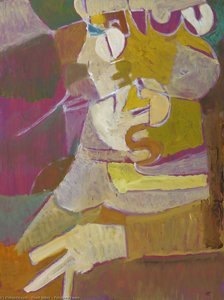
基本信息
- Full Name: ewart johns
- Notable Artworks:
- Sophia
- Patterned Figure
- Sun Worship 1989 (Sandra)
- Artistic Movement Or Style: Abstract Expressionism