切换至版画销售渠道
 展开全文
展开全文







































 对于任何边长超过 105 厘米(约 41 英寸)的艺术品或复制品,画框将以拆解后的组件形式发货。此方法可确保安全送达并防止运输过程中的损坏。


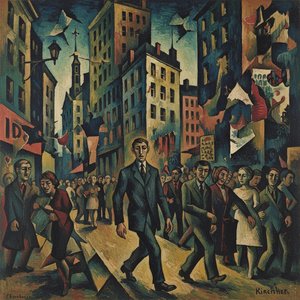
Street, Dresden – A Window Into Expressionist Anxiety
Ernst Ludwig Kirchner’s “Street Scene, Dresden,” painted in 1908 and reworked in 1919, stands as a cornerstone of German Expressionism. More than just a depiction of urban life—though undeniably capturing the dynamism of Dresden at the turn of the century—it's an intensely felt exploration of psychological unease and societal disillusionment, rendered with uncompromising visual language.
- Composition & Perspective: The painting abandons traditional perspective, compressing space into a claustrophobic tableau. Figures jostle for position, merging into amorphous masses that convey a palpable sense of disorientation. Kirchner deliberately avoids a focal point, directing the viewer’s gaze across the canvas with energetic brushstrokes and contrasting hues – a technique characteristic of Expressionist artists who prioritized emotional impact over realistic representation.
- Color Palette & Brushwork: Kirchner employs a jarring color palette dominated by pinks, greens, reds, blues, and yellows. These colors aren’t used to accurately portray the Dresden street; instead, they serve as conduits for emotion. Thick impasto brushstrokes—visible throughout the canvas—create a tactile surface and amplify the painting's expressive force. The use of complementary colors intensifies this visual drama.
- Symbolism & Emotional Resonance: Beyond its formal elements, “Street Scene” resonates with profound symbolic significance. The distorted figures embody anxieties about modernity and social fragmentation – themes prevalent in Expressionist thought. Kirchner’s aim wasn't to simply record what he saw but to convey the artist’s inner turmoil and capture the pervasive feeling of alienation that defined the era.
- Technique & Materials: Executed in oil paint on canvas, Kirchner’s method involved applying pigment with vigorous brushstrokes—a hallmark of Expressionist painting. This technique prioritizes texture and immediacy, mirroring the artists' desire to express raw emotion directly onto the surface of the artwork.
The influence of Impressionism is evident in Kirchner’s initial approach, yet he swiftly rejected academic conventions, embracing a style that prioritized subjective experience over objective observation. “Street Scene, Dresden” exemplifies this commitment, offering viewers a glimpse into the artist's psyche and cementing Kirchner’s place as one of Germany’s most important figures in modern art.
- Further Exploration: You can delve deeper into Kirchner’s artistic journey by visiting Smarthistory for a detailed analysis of the painting and its context. Alternatively, admire “Eisenbahnüberführung an der Löbtauer Straße in Dressen-Friedrichstadt” Smarthistory and “untitled (2500)” Smarthistory for similar stylistic explorations.
A reproduction of “Street Scene, Dresden” would bring Kirchner’s emotive vision into any interior space, serving as a powerful reminder of the anxieties and complexities inherent in the early 20th century – a timeless testament to artistic innovation and psychological depth.
常见问题与解答
恩斯特·路德维希·基尔希纳 的《Street, Dresden》 描绘了怎样的场景,又传达了怎样的意境?
恩斯特·路德维希·基尔希纳 的《Street, Dresden》 将 urban landscape, crowd, expressionism, color palette, distortion, impasto texture, psychological anxiety 与 Dramatic 的氛围完美融合。
建议为 恩斯特·路德维希·基尔希纳 的《Street, Dresden》 选择哪种复刻尺寸?
建议将“Street, Dresden”打印为 Large 尺寸。其他尺寸亦可按相同比例进行制作。
“Street, Dresden”的创作者是谁,属于什么风格?
"Street, Dresden" 由 恩斯特·路德维希·基尔希纳 以 Expressionist Style 流派风格创作而成。艺术家与艺术流派共同定义了作品的传承。
 实景预览
实景预览
 分享
分享 分享
分享
 详情
详情 指南
指南

 下载作品
下载作品
 相似作品
相似作品 X射线
X射线 幻灯片播放
幻灯片播放 问答
问答 统计数据
统计数据