

 效果预览
效果预览
 购买印刷品
购买印刷品 分享
分享 分享
分享
 详情
详情

 下载
下载
 相似作品
相似作品 X射线
X射线 幻灯片播放
幻灯片播放Untitled (197)
 展开详情
展开详情




































从与原作比例一致的预设尺寸中进行选择。

您可以输入自定义尺寸,以适配特定的画框或空间。如果所选尺寸与原图比例不符,我们将通过裁剪作品或添加手绘元素来扩展画面。数字样稿将在制作开始前发送给您确认。
请注意,屏幕预览无法准确反映实际的裁剪或扩展效果,只有样稿才能真实呈现最终的构图。
虽然我们提供定制尺寸服务,但为了保留原作比例,建议您从预设列表中选择尺寸。
下单后,OriginalUniqueArt.com 团队将通过电子邮件联系客户获取具体要求,并提供效果预览图。


 玻璃选项仅适用于110厘米以下的尺寸。

Untitled (197)
复制材质
复制品尺寸
-


最终总价
$ 300
艺术家简介
Enrico Prampolini: A Pioneer of Dynamic Abstract Landscape
Enrico Prampolini (20 April 1894, Modena – 17 June 1956, Rome) was an Italian Futurist painter, sculptor and scenographer whose distinctive approach to abstraction—characterized by bold colors and a fascination with movement—established him as a significant figure in the European avant-garde. Born into a family of artists, Prampolini’s early training instilled in him a passion for visual expression that would propel him through a prolific career spanning decades and encompassing diverse artistic mediums. ### Early Life and Artistic Formation Prampolini began his artistic journey studying with Tullio Cambellotti at the Accademia di Belle Arti di Roma, gaining foundational knowledge of classical art alongside exposure to emerging modernist ideas. This dual influence proved crucial in shaping his aesthetic sensibilities—a blend of tradition and innovation that would define his entire oeuvre. Notably, he was drawn to the Futurist movement spearheaded by Filippo Tommaso Marinetti, captivated by its radical rejection of academic conventions and its fervent embrace of speed, technology, and dynamism. ### The Futurist Years: Experimentation and Collaboration Joining the Futurists in 1913, Prampolini quickly became involved in disseminating the movement’s manifesto and actively participated in collaborative projects aimed at challenging artistic norms. His involvement extended beyond painting to encompass scenography for theatrical productions, notably the groundbreaking film *Thaïs* directed by Anton Giulio Bragaglia, where he crafted a visually arresting interior reflecting the film's themes of dreamlike disorientation and oppressive grandeur—a piece that profoundly impacted German Expressionist filmmaking. Furthermore, Prampolini founded the magazine *Noi* alongside Bino Sanminiatelli in 1917, furthering his engagement with artistic discourse and experimentation. ### Abstract Landscape and Aeropainting: Defining His Style Prampolini’s artistic style evolved throughout his career, but he is best remembered for his pioneering explorations of abstract landscape painting. Works like *Spatial Landscape* (1919) exemplify this approach—massive canvases dominated by flattened planes of color—primarily scarlet, tangerine, azure, and verdant green—that eschewed perspectival illusion in favor of conveying raw emotion and visual energy. Similarly, *Simultaneous Landscape* (1922) pushed abstraction even further, abandoning any semblance of depth or spatial representation altogether. This uncompromising commitment to pure chromatic expression aligned him with the core tenets of Futurism’s aesthetic principles. He was also instrumental in developing aeropainting—a technique utilizing aircraft sprayers to apply pigment onto large surfaces—demonstrating his willingness to embrace technological advancements as tools for artistic innovation. ### Cosmic Idealism and Later Developments By 1931, Prampolini had embraced “Cosmic Idealism,” a form of biomorphic abstraction that diverged significantly from the stylistic concerns of his earlier work. Paintings such as *Pilot of the Infinite* and *Biological Apparition* showcased organic shapes and pulsating colors—a deliberate departure from the geometric austerity favored by artists like Piet Mondrian—reflecting a profound interest in exploring the relationship between art, science, and spirituality. His depiction of Umbria in 1929 marked a return to figurative representation while retaining the dynamism characteristic of his earlier explorations. ### Legacy and Influence Enrico Prampolini’s contribution to European abstract art is undeniable. He stands apart as an artist who consistently pursued innovation without compromise, forging connections with influential figures like Pablo Picasso, Wassily Kandinsky, and Jean Cocteau—artists whose visions similarly challenged conventional artistic boundaries. His influence extended beyond his own paintings; he mentored Tullio Crali, shaping the trajectory of another prominent Futurist sculptor. Prampolini’s unwavering dedication to expressive abstraction cemented his place as a pivotal voice in the modernist movement and continues to inspire artists today.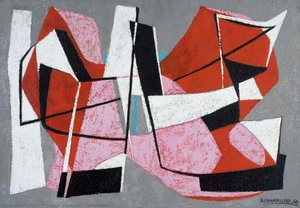
enrico prampolini
1894 - 1956
艺术家简介
- Artistic Movement Or Style: Futurist Painter
- Artists Or Movements Influenced By This Artist:
- Bauhaus
- De Stijl
- Artists Who Influenced This Artist: ['Dulio Cambellotti']
- Date Of Birth: 20 April 1894
- Date Of Death: 17 June 1956
- Full Name: Enrico Prampolini
- Nationality: Italian
- Notable Artworks:
- Composition
- Untitled (521)
- Scenografia
- Place Of Birth: Modena, Italy

