切换至版画销售渠道
 展开全文
展开全文







































 对于任何边长超过 105 厘米(约 41 英寸)的艺术品或复制品,画框将以拆解后的组件形式发货。此方法可确保安全送达并防止运输过程中的损坏。


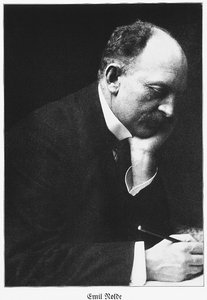
The Enigmatic Dance of Masks – A Study in Emil Nolde’s Expressionist Vision
Emil Nolde's "Masks," painted in 1911, isn’t merely a depiction of carnival revelry; it’s a profound exploration of identity, hidden desires, and the unsettling duality inherent within human nature. Created during his time as a key member of Die Brücke – “The Bridge” – a group pushing the boundaries of German Expressionism in Dresden and Berlin, the painting embodies the movement's core tenets: a rejection of academic realism in favor of raw emotion, bold color, and a focus on subjective experience. Nolde himself described his interest in "the grotesque expression of power" and “elemental force,” sentiments powerfully realized within this captivating composition.
The scene unfolds against a deceptively simple blue background, immediately drawing the viewer’s eye to the central figures – five distinct masks suspended in an ambiguous space. Each mask isn't simply a representation of a face; it’s a carefully constructed symbol, radiating a potent emotional charge. The leftmost mask, a dark red and toothy visage, hints at aggression and perhaps even menace. Nearby, an upside-down pink mask suggests vulnerability and a suppressed sadness. Nolde masterfully employs a technique reminiscent of primitive tribal art – particularly the masks of Solomon Islands and Yoruna Indians from Brazil – drawing inspiration from non-Western cultures to amplify the painting’s primal energy. These references weren't merely decorative; they represented a deliberate attempt to tap into fundamental human emotions, divorced from rational thought.
A Symphony of Color and Impasto
Nolde’s masterful use of color is central to the painting’s impact. He abandons subtle gradations in favor of vibrant, almost jarring hues – fiery oranges, deep blues, and stark reds – applied with a thick impasto technique. This layering of paint creates a tactile surface, inviting the viewer to reach out and feel the energy contained within each mask. The brushstrokes are visible, deliberate, and intensely expressive, mirroring the turbulent emotions conveyed by the figures. This physicality of the paint itself contributes significantly to the painting’s unsettling atmosphere; it feels as though the masks are not merely objects on a canvas but living entities, pulsating with hidden power.
The composition is deliberately unbalanced, further enhancing the sense of unease. The placement of the masks – some close to the viewer, others receding into the distance – creates a dynamic tension, suggesting a perpetual state of shifting identities and concealed motivations. Nolde’s decision to depict these masks in isolation amplifies their symbolic weight, forcing the viewer to confront each one individually and contemplate its hidden meaning.
Historical Context and Lasting Resonance
“Masks” was painted during a period of intense social and political upheaval in Germany – a time marked by rapid industrialization, growing anxieties about modernity, and the rise of nationalist ideologies. Die Brücke’s rejection of traditional artistic conventions reflected a broader cultural rebellion against established norms. Following World War I, Nolde's work became increasingly introspective and emotionally charged, often exploring themes of isolation, mortality, and the darker aspects of human experience.
Interestingly, the painting was confiscated by the Nazi regime in 1937 due to its perceived “degenerate” nature – a label applied to works deemed unsuitable for German culture. Despite this suppression, "Masks" endured, eventually finding its way into private collections and, ultimately, onto the walls of The Nelson-Atkins Museum of Art in Kansas City. Its continued presence speaks to the enduring power of Nolde’s vision and its ability to resonate with viewers across generations.
A Timeless Exploration of Identity
“Masks” remains a profoundly evocative work, inviting endless interpretation. It's not simply a depiction of carnival masks; it’s an allegory for the masks we all wear in our daily lives – the facades we present to the world, concealing our true selves beneath layers of social expectation and personal insecurity. Nolde’s bold colors, expressive brushwork, and unsettling imagery combine to create a timeless meditation on identity, illusion, and the hidden depths of the human psyche. Reproductions capture only a fraction of the painting's raw emotional power, but they offer a valuable opportunity to engage with this remarkable work of Expressionist art.
常见问题与解答
我能否更详细地查看“Masks”?
埃米尔·诺尔德 (Āi Mǐ'Ěr·Nuò'Ěrdé) 的《Masks》 的 X射线透视 页面是一个交互式查看器,您可以逐层滑动浏览作品图像的十一层光学图层,其中还包含 X 光风格的视图。
"Masks" 的创作艺术家是谁?
"Masks" 的创作者是 埃米尔·诺尔德 (Āi Mǐ'Ěr·Nuò'Ěrdé)。该作品以 埃米尔·诺尔德 (Āi Mǐ'Ěr·Nuò'Ěrdé) 的名义编入目录。
哪里可以买到埃米尔·诺尔德 (Āi Mǐ'Ěr·Nuò'Ěrdé) 的《Masks》的手绘复制品?
您可以在埃米尔·诺尔德 (Āi Mǐ'Ěr·Nuò'Ěrdé) 的《Masks》的手工油画复刻页面直接订购其手绘复制品:亚麻画布手工油画复制品,按需定制。
 实景预览
实景预览
 分享
分享 分享
分享
 详情
详情 指南
指南

 下载作品
下载作品
 相似作品
相似作品 X射线
X射线 幻灯片播放
幻灯片播放 问答
问答 统计数据
统计数据