

 实景预览
实景预览
 发送
发送 分享
分享
 详情
详情 指南
指南

 下载图片
下载图片
 相似作品
相似作品 X射线
X射线 幻灯片播放
幻灯片播放 统计数据
统计数据Aeroplane, called Avion no. 3


 阅读全文
阅读全文
艺术微喷/版画
博物馆级艺术微喷或帆布版画,制作高效,并提供多种饰面选择。 ( 订购此收藏品的纯手工复刻画作 切换至数字图像销售渠道)




































您可以从与原作比例一致的预设尺寸中进行选择。

您可以输入自定义尺寸,以适配特定的画框或空间。如果您选择的尺寸与原图比例不符,我们将对作品进行裁剪,或通过镜像填充/纯色填充边缘的方式来扩展图像。在开始制作之前,我们会向您发送一份数字效果图供您确认。
请注意,屏幕上的预览并不能反映实际的裁剪或扩展效果。只有效果图才能准确展示最终的构图。
虽然我们提供定制尺寸,但为了保持原图比例,我们建议您从预设列表中选择尺寸。


 玻璃选项仅适用于110厘米以下的尺寸。

Aeroplane, called Avion no. 3
艺术微喷/版画
复刻品尺寸说明
-


总计金额
$ 80
艺术家简介
The Visionary Architect of the Skies
Born in the quiet town of Muret, near Toulouse, on April 2, 1841, Clément Agnés Ader was a man whose intellect soared far beyond the terrestrial bounds of his era. While his father, a skilled carpenter, envisioned a future for his son within the steady traditions of woodworking, the young Ader possessed a restless, mathematical mind that could not be contained by timber and joinery. His early education in Toulouse, marked by an extraordinary aptitude for drawing and science, laid the foundation for a life defined by the pursuit of the impossible. By the age of twenty, he had emerged from the prestigious industrial schools of his time not merely as a graduate, but as a trained engineer equipped with the technical precision necessary to reshape the modern world.
Ader’s journey was never a linear path through a single discipline; rather, it was a brilliant, interconnected web of innovation. His early professional years were spent navigating the iron veins of France, working for the Compagnie des Chemins de Fer du Midi. It was within this industrial landscape that his curiosity began to manifest as tangible invention. He looked at the heavy, clattering machinery of the mid-19th century and saw opportunities for refinement and grace. From developing specialized devices for railway maintenance to reimagining the very mechanics of the velocipede, Ader applied a singular philosophy to all his endeavors: the reduction of weight and the enhancement of efficiency through ingenious design.
The Dawn of Aerial Ambition
The true soul of Clément Ader’s legacy, however, lies in his profound obsession with the mechanics of flight. Long before the world accepted the reality of heavier-than-air travel, Ader was studying the delicate balance of nature and machine. His childhood experiments with kites and even the erratic movements of insects served as a primitive laboratory for what would become his greatest contribution to humanity. He did not merely dream of flight; he engineered it. Through a meticulous process of trial and error, he sought to replicate the aerodynamic principles found in the natural world, blending the strength of metal with the lightness of thought.
In 1890, the world witnessed a moment of pure, unadulterated magic when his creation, the Éole, achieved what many deemed a scientific impossibility: the first self-propelled flight of a heavier-than-air machine. This achievement was not merely a technical milestone but a poetic triumph of the human spirit over gravity. Though the flight was brief, its impact was eternal, signaling the birth of an era where the sky was no longer a ceiling, but a frontier. It is this sense of breathtaking possibility that defines his work—a bridge between the heavy industrialism of the 19th century and the soaring technological optimism of the 20th.
A Legacy of Innovation and Artistry
Beyond the roar of engines and the clatter of rails, Ader was a master of communication and sound. His invention of the théâtrophone—a system that allowed listeners to experience the stereophonic magic of live theater through telephone lines—demonstrated his ability to capture the ephemeral essence of human experience and transmit it across distances. He understood that technology could be used to bridge the gap between presence and absence, much like a painter uses light to evoke a memory. His work in electrical engineering and telephony reflected a deep sensitivity to the invisible threads that connect us all.
To look upon the history of Clément Ader is to witness the evolution of modern thought. He remains a towering figure whose influence stretches from the early days of cycling to the very foundations of aeronautics. His life was a testament to the power of a disciplined mind paired with an untamed imagination. As we reflect on his contributions, we see more than just an engineer; we see a pioneer who looked at the horizon and saw not a limit, but an invitation. His spirit lives on in every wing that catches the wind and every innovation that dares to defy the status quo.

clément agnes ader
1841 - 1925 , France
快速概览
- Artistic Movement Or Style: Impressionism
- Artists Or Movements Influenced By This Artist: ['Renoir influenced Watteau and Rubens']
- Artists Who Influenced This Artist:
- Courbet
- Monet
- Bazille
- Date Of Birth: 1841
- Date Of Death: 1919
- Full Name: Auguste Renoir
- Nationality: French
- Notable Artworks:
- Peaches and Almonds
- Dance at Le Moulin de la Galette
- Place Of Birth: Limoges, France
相关文章

Neoclassical Portraiture: The Timeless Elegance of Order, Grace, and Academic Mastery
Explore the refined world of Neoclassical portraiture. Discover the mastery of line, light, and order through an expert exploration of academic art history, from Jacques-Louis David to Jean-Antoine Houdon. Immerse yourself in the timeless elegance of classical realism.

Francesco Clemente: Transcendent Narratives & the Alchemy of Identity
Explore the captivating world of Francesco Clemente, a Transavanguardia master blending Italian artistry with Indian spirituality. Discover his evocative paintings & symbolism – a valuable addition to any discerning collection.
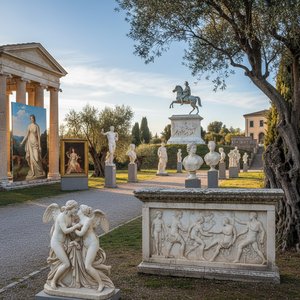
名家巨制:十幅定义新古典主义的艺术臻品
探索新古典主义艺术的巅峰!本文精选十幅定义该流派的杰作,从达维德像到马拉之死,揭秘大师背后的故事与技法。 提升您的家居品味,在OriginalUniqueArt.com发现更多博物馆级画作和定制装饰方案。
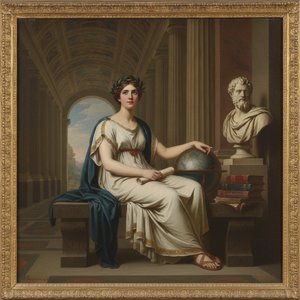
Timeless Elegance: The Grace, Order, and Intellectual Majesty of Neoclassical Portraiture
Explore the profound beauty of Neoclassical portraiture. Discover how masters used order, grace, and antiquity to transform portraits into timeless monuments of virtue and character through academic excellence.
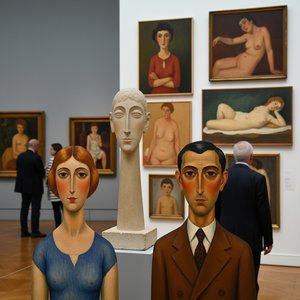
莫迪利亚尼25幅杰作:艺术、情感与家居装饰的完美融合
探索莫迪利亚尼25幅杰作:深入了解这位意大利艺术大师的经典人像、裸体画与波西米亚风格作品。感受优雅、情感与艺术史的完美融合,为您的家居增添画廊品质装饰。尽在OriginalUniqueArt.com!