

 效果预览
效果预览
 购买手绘画作
 分享
分享 分享
分享
 详情
详情

 下载
下载
 相似作品
相似作品 X射线
X射线 幻灯片播放
幻灯片播放Translokation II

 展开详情
展开详情




P118B $10

P118H $10

P118W $10

P438Z $10

P508JH $12

P508YH $12

P805H $10

P805Z $10

P919BZ $10

P919G $10

P919XJ $10

P959ZH $10

P968JZ $12

W106C $8

W218G $10

W218JH $8

W218Y $10

W307PJ $10

W316G $10

W316PJ $8

W316Y $10

W398PJ $8

W4111J $10

W500HY $15

W500JH $15

W692G $12

W849H $8

W940BG $15

W953PJ $8




从与原作比例一致的预设尺寸中进行选择。

您可以输入自定义尺寸,以适配特定的画框或空间。如果您选择的尺寸与原图比例不符,我们将对作品进行裁剪,或通过镜像填充/纯色填充边缘的方式来扩展图像。在开始制作之前,我们会向您发送一份数字效果图供您确认。
请注意,屏幕上的预览并不能反映实际的裁剪或扩展效果。只有效果图才能准确展示最终的构图。
虽然我们提供定制尺寸,但为了保持原图比例,我们建议您从预设列表中选择尺寸。


 玻璃选项仅适用于110厘米以下的尺寸。

Translokation II
艺术微喷/版画
复制品尺寸
-


最终总价
$ 80
艺术家简介
The Architect of Abstraction: The Life and Legacy of Camille Graeser
To encounter the work of Camille Graeser is to step into a world where geometry meets emotion, and where the rigid lines of structure dissolve into the profound textures of memory. Born on February 27, 1892, in Carouge, Switzerland, Graeser’s journey was one of constant movement—not just across borders, but through the very evolution of modern visual language. His early years were shaped by the artistic fervor of Stuttgart, Germany, where he first honed his sensibilities as a furniture designer. This foundational period in design instilled in him a lifelong respect for materiality and the structural integrity of form, a discipline that would later become the backbone of his most celebrated abstract compositions.
Graeser’s career was profoundly shaped by the turbulent winds of the twentieth century. As a member of the Deutsche Werkbund, he stood at the intersection of art and industry, participating in major exhibitions that championed the marriage of craftsmanship and modern utility. His talent caught the eye of the legendary architect Mies van der Rohe, who commissioned Graeser to design furniture for his groundbreaking architectural projects. However, the ascent of Nazism in 1933 forced a pivotal shift in his life; fleeing Germany, he sought refuge in Switzerland. This period of exile was not merely a geographical relocation but an artistic rebirth. In the quietude of Switzerland, Graeser turned his full attention toward the exploration of Concrete Art, finding a new voice within the Zurich avant-garde.
A Symphony of Form and Texture
As Graeser integrated into the Swiss art scene, becoming a prominent member of the Allianz group, his work underwent a remarkable transformation. He moved away from the functional constraints of design toward a more systematic, yet deeply expressive, form of geometric abstraction. His canvases became playgrounds for Concrete Art, where he utilized carefully manipulated geometric elements and strikingly bright colors to create a sense of rhythmic balance. Alongside luminaries such as Max Bill and Richard Paul Lohse, Graeser emerged as a leading figure in the Swiss movement, known for his ability to distill visual language into its purest, most essential essence.
What distinguishes Graeser’s oeuvre from the purely mathematical approach of some of his contemporaries is his profound engagement with texture and depth. His technique often involved layered textures—sometimes achieved through the use of encaustic—which imbued his works with a palpable physicality. These layers served as more than mere surface decoration; they acted as conduits for emotional resonance, capturing fleeting impressions of experience and the weight of history. In his hands, a simple geometric shape could carry the gravity of a landscape or the ephemeral quality of a memory, bridging the gap between the cerebral precision of constructivism and the visceral impact of abstract expressionism.
Historical Significance and Enduring Influence
The legacy of Camille Graeser is preserved not only in the museums that house his masterpieces but also through the dedicated stewardship of the Camille Graeser Foundation, established in 1981. His contribution to the trajectory of Swiss art remains immeasurable, particularly in how he bridged the gap between the decorative arts and high abstraction. His ability to navigate the transition from a designer of physical objects to a creator of purely visual experiences offers a profound lesson in artistic resilience and evolution.
Today, Graeser’s work continues to resonate with modern audiences who find beauty in the intersection of order and chaos. His achievements can be summarized through several key pillars of his career:
- Versatility of Medium: From furniture design for Mies van der Rohe to complex abstract paintings and reliefs.
- Pioneering Abstraction: A central figure in the development of Concrete Art in Switzerland.
- Material Mastery: The use of layered textures and encaustic to provide emotional depth to geometric forms.
- Cultural Resilience: Maintaining artistic integrity and contributing to the Swiss avant-garde despite the upheaval of political exile.
Ultimately, Graeser’s art remains a testament to the power of distillation—the ability to strip away the superfluous until only the most potent symbols of color, shape, and texture remain, speaking directly to the human spirit.

艺术家简介
- Artistic Movement Or Style: Zurich Concrete artists
- Date Of Birth: February 27, 1892
- Full Name: Camille Graeser
- Nationality: Swiss
- Notable Artworks:
- Translokation II
- AUS DER REIHE GELÖSTES GELB YELLOW DETACHED FROM THE ROW
- Komplementär Relation I
- Place Of Birth: Carouge, Switzerland
相关文章

几何抽象艺术十大杰作:定义现代家居装饰的经典之作
探索几何抽象艺术的十大杰作!康定斯基、蒙德里安等大师作品,色彩构成与非具象之美。OriginalUniqueArt.com提供博物馆级艺术复制品,为您的家居带来现代艺术灵感。立即在线探索完整系列!

Kandinsky's Masterpieces: 25 Paintings That Define Abstract Art | OriginalUniqueArt
Journey through Wassily Kandinsky's 25 most iconic abstract paintings. Explore his revolutionary use of color, form & spiritual expressionism. Find museum-quality Kandinsky reproductions and elevate your home decor with OriginalUniqueArt.com. Discover all masterpieces on OriginalUniqueArt.com!

Slate Blue Masterpieces: 10 Iconic Paintings & Timeless Home Decor Ideas
Immerse yourself in the captivating world of slate blue! Explore 10 iconic paintings by Monet, Van Gogh & Renoir. Discover their stories, techniques & find museum-quality art reproductions for your home at .

抽象表现主义:十幅定义艺术史的杰作
探索抽象表现主义的十幅经典杰作!波洛克、罗斯科等大师作品,揭秘艺术史上的重要瞬间。OriginalUniqueArt.com为您呈现高品质艺术品复制和精选家居装饰方案,感受现代艺术的力量与魅力。立即浏览全系列!
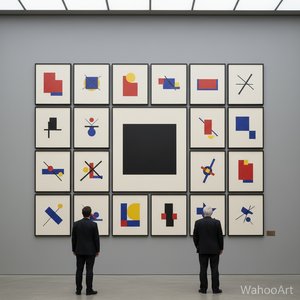
卡济米尔·马列维奇:25幅颠覆艺术认知的杰作 | OriginalUniqueArt
探索卡济米尔·马列维奇25幅至上主义杰作!深入了解抽象艺术的起源、黑色正方形背后的故事,以及如何用现代艺术提升您的家居装饰。OriginalUniqueArt.com提供博物馆级艺术复制品,点亮您的空间。立即在线探索完整系列!

