切换至版画销售渠道
 展开全文
展开全文







































 对于任何边长超过 105 厘米(约 41 英寸)的艺术品或复制品,画框将以拆解后的组件形式发货。此方法可确保安全送达并防止运输过程中的损坏。


The Genesis of a Fragmented World
Ben Nicholson’s ‘1934 (relief)’ isn't merely a painting; it’s a distilled moment, a carefully constructed fragment of a world viewed through the lens of geometric abstraction. Created in the tumultuous years following the 1934 Nepal–India earthquake – an event that profoundly impacted British artists and their perspectives – this small yet potent work embodies a shift towards pure form and a quiet contemplation of space. Nicholson, deeply influenced by European avant-garde movements like Cubism and Constructivism, sought to move beyond representational imagery, exploring the inherent beauty within simplified shapes and textures. The piece’s genesis lies in a period of intense experimentation, marked by visits to influential artists like Piet Mondrian and a growing fascination with the interplay between physical layering and abstract language.

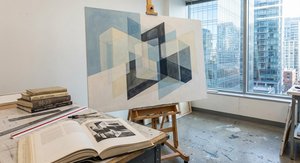
(Image of Ben Nicholson's '1934 (relief)')
A Symphony of Grey and White
The work itself is deceptively simple in its composition. Dominated by a palette of muted greys, punctuated by stark white circles and rectangles, ‘1934 (relief)’ immediately draws the eye into its carefully orchestrated arrangement. Nicholson employed oil paint on a composite board, layering it with deliberate roughness – visible scrapes and uneven surfaces speak to a process of controlled destruction and reconstruction. The lower third of the piece was deliberately cut away, revealing the underlying wood grain and creating an intriguing sense of depth. The two larger circles, painted white, are strategically placed to create visual balance against the darker, textured background, while the smaller circle in the upper left corner offers a subtle point of contrast and focalization.
- Technique: Layered oil paint on composite board.
- Color Palette: Primarily grey with stark white accents.
- Texture: Rough, layered, and deliberately distressed.
Echoes of Mondrian and the Poetics of Relief
Nicholson’s exploration of relief – a technique involving creating raised surfaces on a flat plane – was deeply influenced by his encounter with Piet Mondrian in Paris. Mondrian's emphasis on primary colors, straight lines, and geometric forms provided a crucial framework for Nicholson’s own abstract explorations. However, unlike Mondrian’s rigorously structured compositions, Nicholson embraced a more intuitive approach, allowing the inherent qualities of the materials – wood grain, paint texture – to contribute to the overall aesthetic. The work also reflects the influence of Alfred Wallis, a Cornish fisherman-painter whose simple, geometric forms resonated with Nicholson's desire to strip away unnecessary detail and focus on essential shapes.
A Moment of Quiet Contemplation
‘1934 (relief)’ is more than just an exercise in abstraction; it’s a meditation on form, space, and the relationship between the visible and the implied. The fragmented composition evokes a sense of instability and uncertainty, mirroring the emotional landscape of a nation grappling with the aftermath of a devastating earthquake. Yet, within this apparent chaos lies a profound sense of balance and harmony. The work invites viewers to slow down, to consider the subtle nuances of color and texture, and to find their own meaning within its carefully constructed geometry. It’s a testament to Nicholson's ability to transform personal experience – in this case, the seismic event of 1934 – into a timeless exploration of abstract form.
常见问题与解答
在哪里可以购买到 本·尼科尔森 的《1934 (relief)》 的数字图像?
您可以在 高分辨率数字图像 页面直接购买 “1934 (relief)” 的 高分辨率数字图像下载。
"1934 (relief)" 是何时以及使用什么材料创作的?
"1934 (relief)"创作于1934年,采用了Acrylic On Canvas技法。材质与日期说明了原作的创作方式及时间。
"1934 (relief)" 的整体色调有多明亮?
就视觉亮度而言,本·尼科尔森 的《1934 (relief)》 呈现出 brilliant 的效果。
 实景预览
实景预览
 分享
分享 分享
分享
 详情
详情 指南
指南

 下载作品
下载作品
 相似作品
相似作品 X射线
X射线 幻灯片播放
幻灯片播放 Q&A
Q&A 统计数据
统计数据