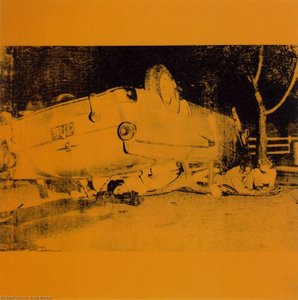
油画原件
 关于 Electric Chair 的详情







































 对于任何边长超过 105 厘米(约 41 英寸)的艺术品或复制品,画框将以拆解后的组件形式发货。此方法可确保安全送达并防止运输过程中的损坏。


A Haunting Presence in Pop Art
In the vast, vibrant landscape of twentieth-century art, few images possess the chilling, quiet intensity found in Andy Warhol’s Electric Chair. This work does not merely present a subject; it commands a presence that is both inescapable and deeply unsettling. At first glance, the viewer is confronted by the stark, mechanical silhouette of the chair itself, rendered with a deliberate simplicity that strips away any sense of comfort. While some interpretations might see traces of an industrial or even aeronautical form in its weathered textures, the true essence of the piece lies in its role as a cornerstone of Warhol’s celebrated Death and Disaster series. The composition avoids unnecessary detail, opting instead for a heavy, almost suffocating atmosphere that forces a direct confrontation between the observer and the instrument of capital punishment.
The technique employed is quintessentially Pop Art, utilizing the iconic silkscreen printing process that Warhol mastered to redefine modern aesthetics. Through this method, the artist achieves bold, flat planes of color and a distinctive, grainy texture that feels both mechanical and distressed. This stippled effect lends the work a sense of historical weight, as if the image itself has been weathered by time and repeated exposure. There is no traditional brushwork to admire here; instead, the beauty lies in the embrace of mass production. For the collector or designer, this technique offers a striking visual depth that works exceptionally well in contemporary spaces, providing a textured, monochromatic-leaning focal point that invites closer inspection of its layered, screen-printed surfaces.
The Echoes of American Anxiety
To understand the emotional gravity of Electric Chair, one must look back to the turbulent era of its creation. Emerging from the mid-1960s, a period defined by the Vietnam War and profound social upheaval, the work serves as a masterful distillation of American anxiety. Warhol was fascinated by the way mass media processes tragedy, turning moments of extreme violence into consumable spectacles. By isolating the electric chair—a symbol of state-sanctioned mortality—he captures the tension between the clinical, mechanical nature of modern society and the raw, human terror of death. The piece acts as a mirror to a culture increasingly desensitized by the repetitive imagery of newsreels and newspapers.
Beyond its historical weight, the artwork offers a profound symbolic resonance. It is not merely an object of grim utility; it is a meditation on the inescapable nature of our own mortality and the dehumanizing aspects of modern industrialization. The starkness of the image creates a vacuum of silence, a "silent scream" that resonates within the viewer. For those looking to integrate such a powerful piece into an interior, it serves as more than just decoration; it is a conversation starter, a piece of intellectual history that brings a sense of gravity and sophisticated tension to a curated collection. Whether viewed as a critique of media saturation or a somber reflection on justice, Warhol’s Electric Chair remains an enduring icon of the power of the image to haunt the collective consciousness.
常见问题与解答
Electric Chair是手绘的还是印刷的?
手工绘制:由专业画家在亚麻画布上,以油画形式临摹 Electric Chair。
Electric Chair 我该选择什么尺寸?
尺寸从 27.1 x 36.8 cm (¥1471) 到 180.7 x 245.3 cm (¥12086) 不等;本页表格列出了主要步骤及其价格。
物流配送需要多长时间?
送货时间为 4 至 5 周,并提供全球免费快递服务;本页面还提供加急制作选项。您可以在 100 天内无条件退货并获得全额退款。
安迪·沃荷 在创作《Electric Chair》时使用了什么媒介?
Silkscreen
 实景预览

 分享
 分享
 详情
 作品详情表


 下载作品
 相似作品
 X射线
 幻灯片播放
 问答

 统计数据