切换至版画销售渠道
 展开全文







































 对于任何边长超过 105 厘米(约 41 英寸)的艺术品或复制品,画框将以拆解后的组件形式发货。此方法可确保安全送达并防止运输过程中的损坏。


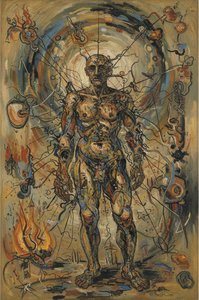
André Masson’s “The Earth”: A Descent Into Surrealist Automatism
André Masson's "The Earth," painted in 1939, stands as a quintessential example of Surrealist automatism—a technique championed by Masson and fellow artists to bypass conscious thought and tap into the subconscious realm. More than just an aesthetically striking composition, it’s a profound exploration of primal anxieties and a visual manifestation of the artist's confrontation with existential uncertainties during the turbulent years leading up to World War II.Composition and Visual Language
The artwork immediately captivates with its central oval form—a dominant presence that evokes imagery of amniotic sacs or embryonic beginnings. This organic shape isn’t merely decorative; it serves as a focal point for a dynamic network of radiating lines in shades of red, black, and white. These lines aren't meticulously drawn; rather, they erupt outwards from the center with an impulsive energy, creating a chaotic visual field that defies conventional perspective. The deliberate lack of spatial coherence underscores Masson’s rejection of rational representation, prioritizing instead the expressive power of gesture and emotion. It feels like witnessing a geological upheaval—a violent birth of form from amorphous darkness.Technique and Material Considerations
Masson employed oil paint on canvas – a medium chosen for its ability to capture subtle tonal variations and facilitate layering techniques. The artist’s approach leaned heavily into automatism, utilizing spontaneous brushstrokes and washes of color to generate the artwork's textural surface. Evidence suggests considerable reworking—a process characteristic of Surrealist practice where artists strive to liberate their creative impulses from intellectual constraints. The canvas itself appears to be lightly primed, allowing for a rich interplay between pigment and substrate, contributing to the overall impression of immediacy and visceral impact.Symbolism and Contextual Significance
Painted during the height of Surrealist fervor, “The Earth” reflects the movement’s preoccupation with Freudian psychoanalysis and its desire to delve into the unconscious mind. The oval form symbolizes fertility and rebirth—themes central to Surrealist mythology—but also carries a darker connotation of vulnerability and impending doom. The radiating lines represent forces of destruction and creation simultaneously, mirroring anxieties about societal upheaval and the looming threat of war. Masson’s work aligns with broader artistic explorations of primal instincts and fears, reflecting a collective apprehension regarding humanity's precarious position in the face of cosmic indifference.Emotional Resonance
Ultimately, “The Earth” succeeds in conveying a palpable sense of unease and mystery. The artwork doesn’t offer comforting illusions; instead, it confronts viewers with an unsettling depiction of chaos and ambiguity. It invites contemplation on themes of genesis, destruction, and the inherent instability of existence—questions that resonated deeply within Masson's own artistic vision and continue to captivate audiences today. Its raw energy and evocative imagery solidify its place as a cornerstone of Surrealist art history.常见问题与解答
如何下载 安德烈·马松 的《The Earth》 的图片?
"The Earth" 可供下载:您可以在该作品的 下载数字图像 页面进行 高分辨率数字图像下载。
"The Earth" 属于哪种艺术风格?
安德烈·马松 的《The Earth》 所属的艺术流派为 Surrealist。这一分类将该作品置于相关艺术家及艺术作品的语境之中。
"The Earth" 与 安德烈·马松 的其他作品有何共通之处?
"The Earth" 与 安德烈·马松 的其他作品一样,都体现了 Surrealist 风格以及其一贯的主题:cubist roots, automatism exploration, surrealist vision, nature symbolism, artistic expression。
 实景预览

 分享
 分享
 详情
 指南


 下载作品
 相似作品
 X射线
 幻灯片播放
 问答
 统计数据