 切换至版画销售渠道
 展开全文
展开全文







































 对于任何边长超过 105 厘米(约 41 英寸)的艺术品或复制品,画框将以拆解后的组件形式发货。此方法可确保安全送达并防止运输过程中的损坏。


Winter Night: A Study in Art Nouveau Reverie by Alphonse Mucha
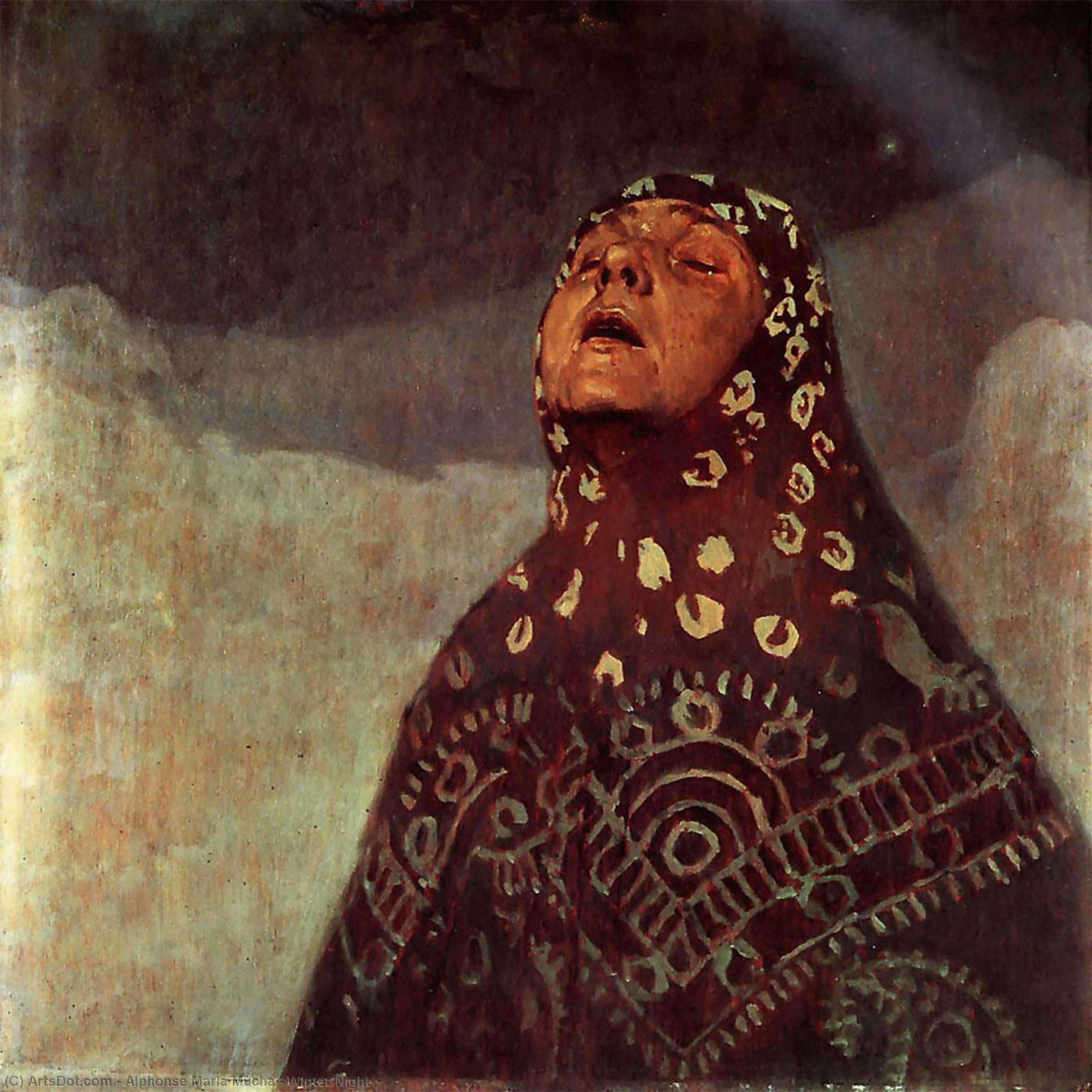
Alphonse Mucha’s “Winter Night” is more than just a depiction of a woman lost in contemplation; it's a masterful distillation of the Art Nouveau movement, a visual poem rendered in delicate lines and evocative color. The painting immediately draws the viewer into a world of serene beauty, dominated by the graceful curve of the figure and the subtle play of light against the snowy backdrop. Mucha’s signature style—characterized by flowing, organic forms and an almost dreamlike quality—is powerfully evident here, creating an image that feels both timeless and intensely modern.
The central subject, a woman with her mouth slightly open as if caught in a moment of quiet reflection or perhaps a gentle yawn, embodies the Art Nouveau fascination with idealized femininity. Her flowing dress, rendered with meticulous detail, seems to ripple and move even on the canvas, contributing to the overall sense of movement that is so crucial to Mucha’s aesthetic. The two birds – one on the left, another ascending towards the upper right corner – aren't merely decorative elements; they introduce a layer of symbolic richness, often associated with freedom, hope, and transformation within Mucha’s work. Their placement subtly directs the viewer’s eye across the composition, enhancing its dynamic balance.
The Art Nouveau Context: A Movement Defined
Created during a period of immense artistic innovation – the late 19th century – “Winter Night” is inextricably linked to the rise of Art Nouveau. Emerging as a reaction against the rigid formality of academic art, Art Nouveau sought to draw inspiration from nature, particularly flowing lines and organic forms. Mucha was at the forefront of this movement in Paris, alongside artists like Gustav Klimt and Émile Gallé. His work for Sarah Bernhardt – most notably the posters for “La Dame aux Camélias” – established his distinctive style, which quickly gained international recognition.
The influence of Japanese woodblock prints is readily apparent in Mucha’s compositions, a common trend among European artists at the time. The flattened perspective, decorative patterns, and emphasis on line quality all reflect this profound artistic exchange. Furthermore, Mucha's work was deeply rooted in Czech national identity, incorporating traditional motifs and symbolism into his designs – as seen powerfully in his monumental “Slav Epic” series.
Technique and Materials: A Delicate Masterpiece
“Winter Night,” like much of Mucha’s work, was executed using the lithographic technique. This process involved creating a stone matrix from which multiple prints could be produced – a crucial factor in Mucha's ability to create large-scale decorative panels for commercial clients. The artist meticulously applied color with delicate washes and subtle gradations, achieving a luminous effect that captures the ethereal quality of a winter night. The use of gold leaf, though not explicitly visible in reproductions, would have been a hallmark of Mucha’s opulent style, adding further depth and richness to the composition.
Symbolism and Emotional Resonance
Beyond its formal beauty, “Winter Night” possesses a profound emotional resonance. The solitary figure evokes feelings of introspection, tranquility, and perhaps even melancholy – fitting themes for a winter scene. The birds, symbols of aspiration and renewal, suggest the possibility of hope amidst the stillness. Mucha’s ability to imbue his work with such layered meaning is what continues to captivate viewers today. This painting isn't simply a beautiful image; it’s an invitation to contemplate the quiet beauty of nature and the depths of human emotion.
常见问题与解答
莫奈 (Mò Nèi) 的《Winter Night》 属于哪种艺术流派?
“Winter Night”是一件Art Nouveau时期的作品。该艺术流派体现了作品所属的艺术传统。
建议为 莫奈 (Mò Nèi) 的《Winter Night》 选择哪种复刻尺寸?
莫奈 (Mò Nèi) 的《Winter Night》 的建议打印尺寸为 Large。
莫奈 (Mò Nèi) 的《Winter Night》 适合作为什么场合的礼物?
莫奈 (Mò Nèi) 的《Winter Night》 是送给 Wedding 的理想礼赠之选。您也可以选择将该艺术品的复制品作为礼物赠予他人。
 实景预览
实景预览
 分享
分享 分享
分享
 详情
详情 指南
指南

 下载作品
下载作品
 相似作品
相似作品 X射线
X射线 幻灯片播放
幻灯片播放 问答
问答 统计数据
统计数据