切换至版画销售渠道
 展开全文
展开全文







































 对于任何边长超过 105 厘米(约 41 英寸)的艺术品或复制品,画框将以拆解后的组件形式发货。此方法可确保安全送达并防止运输过程中的损坏。


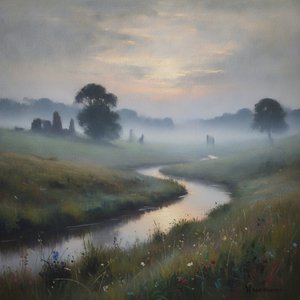
A Pastoral Reverie: Alphonse Legros’s “Hilly Landscape”
Alphonse Legros's "Hilly Landscape," painted in 1876, isn’t merely a depiction of a rural scene; it’s a carefully constructed meditation on light, atmosphere, and the quiet beauty of the English countryside. This evocative work, now housed within the Victoria and Albert Museum’s collection, offers a glimpse into the artist's evolving style—a synthesis of Realist observation with a subtle Impressionistic sensibility—and speaks volumes about his time as an expatriate in London. Legros, having moved from France to England in 1863, found himself immersed in a landscape that both mirrored and subtly diverged from his native French vistas, leading him to develop a unique perspective on the English pastoral.
The painting immediately draws the eye with its harmonious blend of greens and blues. The rolling hills, rendered with loose, confident brushstrokes, are bathed in a soft, diffused light—a characteristic of Legros’s approach that suggests an outdoor setting, painted *en plein air*. Notice how he avoids sharp outlines or dramatic contrasts; instead, he employs subtle gradations of color to create a sense of depth and atmospheric perspective. The distant spire of Hampstead church provides a grounding element, anchoring the scene within a recognizable location while simultaneously contributing to the overall feeling of serene distance.
The Influence of Realism and Impressionism
Legros’s artistic journey is defined by his engagement with two significant movements: Realism and Impressionism. Initially trained in traditional academic styles, he was profoundly influenced by Gustave Courbet's rejection of idealized representation and his commitment to depicting the world as it truly appeared. This influence is evident in Legros’s meticulous observation of natural details—the texture of the grass, the subtle variations in the foliage—and his avoidance of overtly sentimental or romanticized imagery. However, he also embraced the Impressionists' focus on capturing fleeting moments and the subjective experience of light and color. The loose brushwork and emphasis on atmospheric effects demonstrate this dual influence, creating a painting that is both grounded in observation and imbued with a sense of immediacy.
Furthermore, Legros’s background as a house decorator and wall-painter—a profession demanding an understanding of materials and spatial relationships—contributed to his ability to create convincing landscapes. He wasn't simply sketching from memory; he was translating three-dimensional space onto a two-dimensional surface with remarkable skill. The composition itself is carefully balanced, guiding the viewer’s eye through the scene and establishing a sense of harmonious unity.
Symbolism and Emotional Resonance
Beyond its technical merits, “Hilly Landscape” resonates with a quiet emotional depth. It evokes a feeling of tranquility and contemplation—a welcome respite from the bustle of urban life. The painting’s muted palette and soft light contribute to this sense of serenity, while the distant church spire suggests a connection to faith and tradition. The scene feels timeless, inviting the viewer to lose themselves in the simple pleasures of nature.
Interestingly, Legros's work often reflected his personal experiences as an expatriate artist. The English countryside, with its rolling hills and picturesque villages, became a source of inspiration for him, offering a contrast to the landscapes of his native France. “Hilly Landscape” can be interpreted as a celebration of this new environment—a testament to the beauty and charm he discovered in England.
A Legacy of British Art
Alphonse Legros’s contribution to British art extends beyond this single painting. He played a pivotal role in establishing etching as a respected medium, teaching at the Slade School of Fine Art and fostering a new generation of artists. His influence can be seen in the work of his students, including Jessie Mothersole and Elinor Hallé, who went on to become prominent figures in the British art world. “Hilly Landscape” stands as a testament to Legros’s artistic versatility and enduring legacy—a beautiful example of a painter who seamlessly blended Realist observation with Impressionistic techniques to create works that continue to captivate viewers today.
常见问题与解答
阿尔丰斯·勒格罗斯 是否还有其他别名或曾用名?
关于《Hilly Landscape》的创作者 阿尔丰斯·勒格罗斯,其记录在案的其他名称包括 阿方斯·勒格罗斯, Alphons Legros。
"Hilly Landscape" 的作者是谁?属于哪种艺术流派?
"Hilly Landscape" 由 阿尔丰斯·勒格罗斯 以 Contemporary Realism 流派风格创作而成。艺术家与艺术流派共同定义了作品的传承。
阿尔丰斯·勒格罗斯 的《Hilly Landscape》 创作于哪一年?
阿尔丰斯·勒格罗斯 的《Hilly Landscape》创作于1876年。
 实景预览
实景预览
 分享
分享 分享
分享
 详情
详情 指南
指南

 下载作品
下载作品
 相似作品
相似作品 X射线
X射线 幻灯片播放
幻灯片播放 问答
问答 统计数据
统计数据