

 实景预览
实景预览
 发送
发送 分享
分享
 详情
详情 指南
指南

 下载图片
下载图片
 相似作品
相似作品 X射线
X射线 幻灯片播放
幻灯片播放 统计数据
统计数据Spring
 Romanticism
 1876
1876 76.0 x 25.0 cm
 Guildhall Art Gallery
 阅读全文
阅读全文
手工油画复制品
由我们的艺术家按需定制,为您提供您所选尺寸及画框的布面手工油画。 ( 切换至版画销售渠道 切换至数字图像销售渠道)




































您可以从与原作比例一致的预设尺寸中进行选择。

请输入您需要的宽度和高度,以适配您的画框或墙面。由于作品为手工绘制,若您选择不同的尺寸比例,艺术家可能会在画面边缘多画一些或稍作裁剪 —— 由您决定。在开始绘画之前,我们会为您发送一份数字效果图供您确认。本页面上展示的图片并非最终实物 —— 只有效果图才能反映真实结果。
下单后,OriginalUniqueArt.com 团队将通过电子邮件联系客户获取具体要求,并提供效果预览图


 玻璃选项仅适用于110厘米以下的尺寸。

Spring
复制品材质
复刻品尺寸说明
-


总计金额
¥ 2017
艺术家简介
Alfred Émile Léopold Stevens: A Life in Art
Alfred Émile Léopold Stevens (1823-1906) was a Belgian painter celebrated for his realistic depictions of elegant modern women and Parisian life. He skillfully captured the essence of la vie moderne with refined detail and subtle social commentary, establishing himself as a prominent figure in 19th-century art.
Early Life and Education
Born in Brussels in 1823 into a family deeply connected to the visual arts, Stevens benefited from a stimulating environment. His older brother Joseph (also a painter), his son Léopold, and another brother Arthur (an art dealer and critic) all contributed to the family’s artistic legacy. His father, a veteran of the Napoleonic Wars, was an avid art collector, while his maternal grandparents ran a popular café frequented by intellectuals and artists.
- After his father's death in 1837, Stevens began his formal training at the Académie Royale des Beaux-Arts in Brussels.
- He studied under François Navez, a Neo-Classical painter and former student of Jacques-Louis David.
- In 1843, he moved to Paris to join his brother Joseph and enrolled at the École des Beaux-Arts.
Artistic Development and Influences
Stevens’s early work demonstrated a mastery of conventional naturalistic style, heavily influenced by 17th-century Dutch genre painting. He meticulously studied the works of artists like Gerard ter Borch and Gabriel Metsu, absorbing their techniques for depicting domestic interiors and everyday life.
- His initial success came with paintings exhibiting this influence, such as “The Pardon or Absolution” (1849).
- He gradually transitioned towards portraying contemporary subjects – "la vie moderne" – focusing on the lives of fashionable women in Parisian society.
- Stevens was an early enthusiast of Japonisme, incorporating Japanese objects and aesthetics into his compositions, as seen in “La Dame en Rose” (1866).
Major Achievements and Recognition
Stevens achieved significant recognition throughout his career, exhibiting regularly at the Salons in Paris and Brussels. His paintings garnered critical acclaim and attracted a loyal clientele.
- He received third-class medals at the Paris Salon (1853) and second-class medal at the Universal Exposition (1855).
- His painting “Ce qu'on appelle le vagabondage” (1855) prompted Napoleon III to address the issue of poverty in Paris.
- He was awarded the Legion of Honor (Chevalier, 1863; Officer, 1867; Commander, 1878).
- Stevens won a first-class medal at the Universal Exposition in Paris (1867).
Social Circle and Artistic Connections
Stevens was an active participant in the Parisian art world, cultivating friendships with prominent figures such as the Goncourt brothers, Théophile Gautier, Alexandre Dumas, Édouard Manet, Edgar Degas, Berthe Morisot, and James Abbott McNeill Whistler. He regularly frequented the Café Guerbois, a hub for avant-garde artists.
Later Life and Legacy
Stevens continued to paint successfully throughout his later life, capturing the changing fashions and social dynamics of Parisian society. He served in the French army during the Franco-Prussian War but returned to Belgium with his family before the Paris Commune. He died in 1906, leaving behind a rich artistic legacy.
Historical Significance
Alfred Stevens’s work provides valuable insights into the social and cultural life of 19th-century France. His paintings offer a glimpse into the world of the upper middle class, showcasing their elegance, leisure activities, and evolving tastes. He is remembered as a master of realistic portraiture and genre painting, skillfully capturing the spirit of his time.

Alfred Émile Léopold Stevens
1823 - 1906
快速概览
- Name: Alfred Émile Léopold Stevens
- Movement: Realism, La Vie Moderne
- Birth_Date: 1823
- Death_Date: 1906
- Birth_Place: Brussels
- Nationality: Belgian
- Date Of Birth: 1823
- Date Of Death: 1906
- Influenced_By:
- 17th-century Dutch genre painting
- Gerard ter Borch
- Gabriel Metsu
- Notable_Works:
- The Pardon or Absolution
- Ce qu'on appelle le vagabondage
- La Dame en Rose
- Hesitation (Madam Morteaux)
相关文章

19th Century Masterpieces: 10 Paintings That Defined an Era | OriginalUniqueArt
Journey through 19th century art with OriginalUniqueArt! Explore 10 iconic paintings – from Monet & Renoir to Courbet – and discover the stories behind Romanticism, Realism & Impressionism. Find museum-quality reproductions for your home decor. Explore the full collection online!

The Enduring Legacy of Oil on Canvas: Technique, History & Aesthetic Impact
Explore the rich history & techniques of oil painting – from Renaissance masters to Impressionism. Discover pigments, layering methods, and why this timeless medium endures. Expert insights for artists & art enthusiasts.

Alfred Stevens: Capturing Parisian Life with Intimate Realism & Symbolist Flair
Explore the captivating world of Alfred Stevens, a pioneer of intimate realism & Symbolist painting. Discover his elegant portraits of Parisian women and learn about his Dutch influences & lasting legacy. Art history insights at OriginalUniqueArt.

Sir Alfred Munnings' Masterpieces: 25 Paintings That Define Equine Art | OriginalUniqueArt
Explore 25 iconic Sir Alfred Munnings paintings! Discover the beauty of British Impressionism, equine art & rural England. Find museum-quality reproductions and elevate your home decor with OriginalUniqueArt. Explore the full collection online.
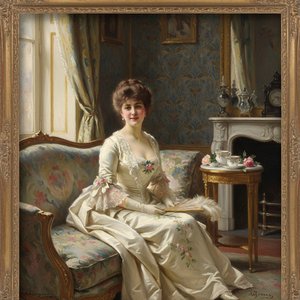
Alfred Stevens: Capturing Parisian Elegance & Fin-de-Siècle Intimacy
Discover the captivating world of Alfred Stevens, master of Parisian elegance & intimate portraiture. Explore his techniques, influences, and legacy – a prized collection for discerning art enthusiasts.