切换至版画销售渠道
 展开全文
展开全文







































 对于任何边长超过 105 厘米(约 41 英寸)的艺术品或复制品,画框将以拆解后的组件形式发货。此方法可确保安全送达并防止运输过程中的损坏。


The Quiet Ritual of Community: An Encounter with Adriaen van Ostade's "Saying Grace"
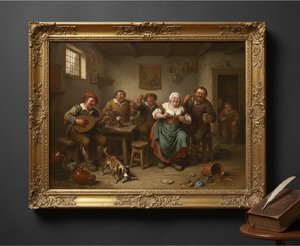
To gaze upon Adriaen van Ostade’s Saying Grace is not merely to observe a painting; it is to step across the threshold and into the warm, intimate glow of a Dutch Golden Age hearth. This scene captures that profound, suspended moment just before sustenance—the collective pause where gratitude takes precedence over appetite. The composition centers around a sturdy dining table, laden with the promise of a shared meal, yet the true focus lies in the human connection surrounding it. Van Ostade masterfully renders a gathering of souls, their postures suggesting familiarity and deep-rooted community bonds. It speaks to a time when domestic life was not just about survival, but about ritual, fellowship, and the quiet acknowledgment of blessings.
Mastery in Genre Detail: Technique and Atmosphere
Van Ostade’s technique is a testament to the meticulous observation characteristic of Dutch genre painting. While his early work flirted with the looser brushwork of masters like Frans Hals, here we see a refinement that lends an almost tangible weight to every fold of cloth and every expression on a face. The black and white nature of this print only heightens our appreciation for the tonal subtlety—the interplay between deep shadows pooling in the corners and the soft illumination catching the polished wood of the table. Notice how the light seems to emanate from an unseen source, bathing the central group in a gentle, almost sacred glow. This attention to atmospheric detail transforms what could be a simple depiction of dinner into a profound study of human interaction.
Symbolism of the Shared Table
The dining table itself functions as a powerful symbolic anchor within the painting. It is the nexus point where disparate lives momentarily converge under the banner of shared experience. The act of "saying grace" transcends mere religious observance; it symbolizes gratitude for provision, for family, and for the simple gift of time together. In the context of 17th-century Dutch life, such gatherings were vital social affirmations. Every figure, whether seated or standing, contributes to a tapestry of quiet devotion. The bowl upon the table is not just food; it represents bounty, the tangible result of labor and providence.
Bringing the Golden Age Home: Decorating with Narrative
For the collector or designer seeking to infuse a space with the rich narrative depth of history, a reproduction of Saying Grace offers unparalleled emotional resonance. It moves beyond mere decoration; it becomes a focal point for contemplation. Imagine this scene gracing your wall—it invites conversation, prompting viewers to pause and consider their own moments of grace. The style speaks to an appreciation for the domestic sublime, suggesting that true artistry can be found not in grand historical epics, but in the quiet dignity of everyday life shared among loved ones.
常见问题与解答
"Saying Grace" 的整体色调有多明亮?
阿德里安·范·奥斯塔德 的《Saying Grace》 的视觉亮度为 bright,能够与目标空间的灯光完美融合。
我可以使用增强现实技术在我的房间里预览 阿德里安·范·奥斯塔德 的《Saying Grace》 吗?
“Saying Grace” 支持增强现实(AR)预览:通过作品的 AR 效果预览 页面,您可以在兼容设备上查看该作品呈现在您专属空间的效果。
阿德里安·范·奥斯塔德 的《Saying Grace》 描绘了怎样的场景,又传达了怎样的意境?
阿德里安·范·奥斯塔德 的《Saying Grace》 描绘了 genre scene, dining table, family meal, dutch life, still life, gathering,营造出 Serene 的意境。其主题与氛围共同构成了这件作品的精髓。
 分享
分享 分享
分享
 详情
详情 指南
指南

 下载作品
下载作品
 相似作品
相似作品 幻灯片播放
幻灯片播放 问答
问答 统计数据
统计数据