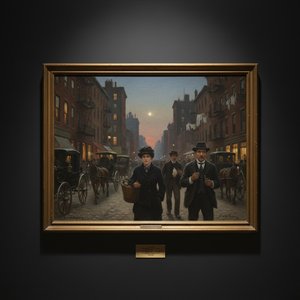
油画原件
 关于 Second Class - the parting: 的详情







































 对于任何边长超过 105 厘米(约 41 英寸)的艺术品或复制品,画框将以拆解后的组件形式发货。此方法可确保安全送达并防止运输过程中的损坏。


From the early 1800s, the British were encouraged to emigrate to Australia and become wealthy by working the land or, from the 1850s, by trying their luck on the goldfields. This work represents the changing popular response to emigration to Australia.When Abraham Solomon painted Second Class in 1854, circumstances in England and Australia had changed dramatically. Gold had been discovered in Australia, transportation had virtually ceased and the political print had lost its popularity in England. Solomon’s painting shows a young man leaving for the goldfields, his family accompanying him on the train journey. The work is aimed at a sentimental middle-class market – when will the mother see her son again?This painting forms part of a wider genre presenting free settlers (and gold rush emigrants) to Australia and other British empire colonies. After receiving accolades at the Royal Academy, Second Class, together with its counterpart First Class 1954, became popular through printed reproductions,being produced as a lithographic print both in England and Germany.Roger ButlerText © National Gallery of Australia, Canberra 2010From: Anne Gray (ed), Australian art in the National Gallery of Australia, National Gallery of Australia, Canberra, 2002
常见问题与解答
Second Class - the parting: 是手绘的还是印刷的?
手工绘制:由专业画家在亚麻画布上,以油画形式临摹 Second Class - the parting: 。
Second Class - the parting: 我该选择什么尺寸?
原作尺寸为 966 x 694 cm。 尺寸从 25.8 x 38.7 cm (¥1336) 到 164.8 x 246.8 cm (¥10153) 不等;本页表格列出了主要步骤及其价格。
物流配送需要多长时间?
送货时间为 4 至 5 周,并提供全球免费快递服务;本页面还提供加急制作选项。您可以在 100 天内无条件退货并获得全额退款。
《Second Class - the parting: 》的原作在哪里?
原作收藏于堪培拉的澳大利亚国立美术馆。
 实景预览

 分享
 分享
 详情
 作品详情表


 下载作品
 相似作品
 X射线
 幻灯片播放
 问答

 统计数据