Портрет William Garl Brown

5 найвідоміших картин William Garl Brown, кожна з яких є унікальною

Оновлено Листопад 2026 · за рейтингом нашої популярності (кількість пошукових запитів, переглядів та замовлень для кожної роботи) · 5 робіт William Garl Brown у нашому каталозі

Коротко кажучи

William Ellery (1835) — це картина William Garl Brown, яка привертає найбільше уваги; оригінал зберігається в Метрополітен-музей, Нью-Йорк. Після цього погляд переходить на Zachary Taylor at Walnut Springs (1847) та John Buchanan Floyd (1800). Серед 5 робіт William Garl Brown у нашому каталозі ці 5 є найвідомішими: кожна з них — унікальний оригінал із зазначенням року створення, музею та причини її безсмертя.

1823 – 1894, Leicester Найбільше робіт: Library of Virginia

Топ-10 картин William Garl Brown крізь призму галереї

1
William Ellery (1835) авторства William Garl Brown

William Ellery

1835 · Watercolor · Метрополітен-музей, Нью-Йорк

A quiet presence emerges from the pale, mottled background. This portrait miniature captures William Ellery in a moment of stillness, his gaze fixed directly upon the viewer. The light falls from the upper left, carving the architecture of his face with soft shadows. It is a study of bone and skin rendered in a monochromatic palette. Deep blacks define the heavy fabric of his clothing, while luminous whites catch the…

2
Zachary Taylor at Walnut Springs (1847) авторства William Garl Brown

Zachary Taylor at Walnut Springs

1847 · Oil On Canvas · Національна портретна галерея, Вашингтон, округ Колумбія

Zachary Taylor at Walnut Springs by William Garl Brown presents a wide, landscape-oriented view of an organized military encampment. On the right, a group of military officers gathers around a large canvas tent, their presence anchored by the structural poles of the shelter. To the left, the composition finds balance through a white horse tethered near several smaller tents, where a soldier stands nearby. The arrangement emphasizes a sense of…

3
John Buchanan Floyd (1800) авторства William Garl Brown

John Buchanan Floyd

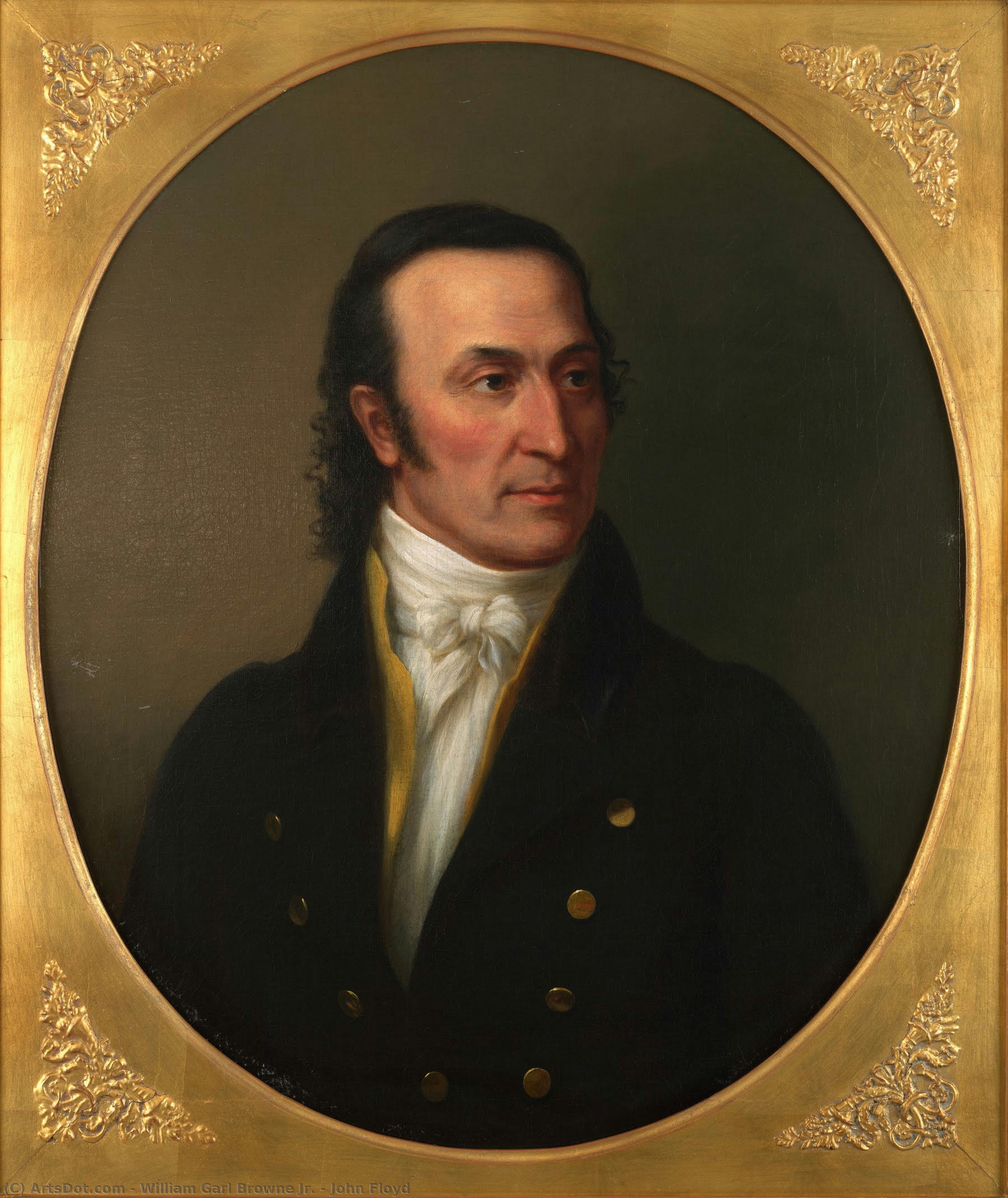
1800 · Oil · Library of Virginia, Річмонд

In the quiet dignity of this masterful portrait, we encounter the commanding presence of John Buchanan Floyd, the 34th Governor of Virginia. Painted by the skilled hands of William Garl Browne Jr., the work transcends a mere photographic likeness to become an evocative study of leadership and historical weight. The subject, an elder statesman with a meticulously groomed beard and mustache, gazients directly at the viewer, establishing an immediate and…

4
Rutherford B. Hayes (1878) авторства William Garl Brown

Rutherford B. Hayes

1878 · Oil On Canvas · The Abraham Lincoln Foundation of The Union League of Philadelphia, Філадельфія

This full-length, life-size portrait on canvas presents Rutherford B. Hayes, the 19th President of the United States. Painted by William Garl Brown in 1878, the work captures the statesman in a moment of quiet, formal presence. The scale of the canvas meets the man in his early fifties, offering a direct encounter with the figure of the presidency.

5
John Floyd (1872) авторства William Garl Brown

John Floyd

1872 · Oil · Library of Virginia, Річмонд

William Garl Brown painted this portrait of John Floyd, a man who held the office of governor from March 4, 1830, to March 31, 1834. The work, dating from about 1872, captures a significant figure from Virginia's political history. Brown, who lived from 1823 to 1894, was a prolific chronicler of the American South, often focusing on the leadership and social hierarchies of the nineteenth century.

Теми, що привертали увагу William Garl Brown

Чотири сюжети, які найчастіше зустрічаються в цих оригіналах, кожен із найкращим прикладом.

Музеї, у яких зберігаються оригінали William Garl Brown

4 музеїв, у яких зберігається більшість картин із цього списку.

Музей Місто Твори William Garl Brown Картини зі цього списку
Library of Virginia, РічмондLibrary of Virginia Річмонд 2 John Buchanan Floyd, John Floyd
Метрополітен-музей, Нью-ЙоркМетрополітен-музей Нью-Йорк 1 William Ellery
Національна портретна галерея, Вашингтон, округ КолумбіяНаціональна портретна галерея Вашингтон, округ Колумбія 1 Zachary Taylor at Walnut Springs
The Abraham Lincoln Foundation of The Union League of Philadelphia, ФіладельфіяThe Abraham Lincoln Foundation of The Union League of Philadelphia Філадельфія 1 Rutherford B. Hayes

William Garl Brown крізь десятиліття: одна унікальна оригінальна робота для кожного

Роботи за десятиліттями

Оберіть десятиліття, щоб побачити оригінальний твір, який його визначає.

Картини William Garl Brown: запитання до галереї

Яка найвідоміша робота William Garl Brown?Дізнатися відповідь

William Ellery (1835), Метрополітен-музей, Нью-Йорк. Далі йдуть Zachary Taylor at Walnut Springs (1847) та John Buchanan Floyd (1800).

У якому віці William Garl Brown створив(ла) William Ellery?Дізнатися відповідь

12 років: William Ellery датована 1835 роком, а William Garl Brown народився(-лася) у 1823.

Скільки відомих робіт належить William Garl Brown?Дізнатися відповідь

Наш каталог містить 5 робіт William Garl Brown, датованих періодом з 1835 по 1878.

Де можна побачити найвідоміші оригінали William Garl Brown?Дізнатися відповідь

Переважно в Library of Virginia (Річмонд), Метрополітен-музей (Нью-Йорк) та Національна портретна галерея (Вашингтон, округ Колумбія). У таблиці музеїв вище наведено їхній повний перелік.

У який період William Garl Brown створив свої найвідоміші картини?Дізнатися відповідь

У 1870s: 2 із 5 робіт на цій сторінці були створені тоді, серед них Rutherford B. Hayes.

Яка з найвідоміших картин William Garl Brown була написана найраніше, а яка — найпізніше?Дізнатися відповідь

На цій сторінці найдавніша робота датована William Ellery (1835), а найновіша — Rutherford B. Hayes (1878).

Яким сюжетам віддавав перевагу William Garl Brown?Дізнатися відповідь

Man (3), Portrait (3) та Suit (2), у 5 роботах на цій сторінці.

Якими матеріалами найчастіше користувався William Garl Brown?Дізнатися відповідь

Oil On Canvas, для 2 із 5 робіт на цій сторінці.

Які оригінальні роботи William Garl Brown можна побачити в Library of Virginia?Дізнатися відповідь

John Buchanan Floyd та John Floyd: Library of Virginia, Річмонд зберігає 2 робіт із цієї сторінки.

William Garl Brown: портрет художника

A Legacy of Likeness: The Life and Art of William Garl Browne Jr.

In the grand tapestry of nineteenth-century portraiture, few threads are as intricately woven into the fabric of American history as those left by William Garl Browne Jr. Born in Leicester, England, in October 1823, Browne was a man whose artistic destiny was inextricably linked to the shifting landscapes of both continents. He did not merely paint faces; he captured the very essence of an era defined by expansion, conflict, and the burgeoning identity of the American South. His journey from the traditional artistic circles of the United Kingdom to the battlefields and parlors of the United States allowed him to develop a style that was as much about psychological depth as it was about technical precision.

The foundations of his mastery were laid under the watchful eye of his father, William G. Browne Sr., an accomplished landscape and genre painter. This early immersion in the meticulous traditions of English art instilled in the younger Browne a profound reverence for detail and a luminous approach to color. As he traveled with his father to the United States, the young artist began to absorb the rugged vitality of the New World. His early exhibitions, including a notable appearance at the National Academy in 1840, hinted at a burgeoning talent that would soon transcend mere imitation, moving toward a realism that could convey the weight of command and the quiet dignity of civilian life.

The Crucible of Fame: From Mexico to the American South

The defining moment of Browne’s career arrived amidst the smoke and fervor of the Mexican-American War. In 1847, at the remarkably young age of twenty-four, Browne undertook a commission that would cement his place in the annals of historical art. Stationed at the U.S. Army headquarters in Mexico, he painted a series of portraits featuring General Zachary Taylor and his staff. These works were far more than mere military records; they were vibrant, breathing documents of leadership. When these portraits were exhibited in Washington, New York, and Baltimore, they ignited a national sensation. Critics were captivated by the lifelikeness of the subjects, noting how Browne managed to capture the moral fortitude and commanding presence of Taylor—a man who embodied the republican virtues of the age.

Following this meteoric rise to fame, Browne made a deliberate choice that would shape his entire oeuvre: he turned his gaze toward the American South. While his contemporaries might have sought the established art markets of the North, Browne found inspiration in the complex social hierarchies and storied landscapes of the Southern states. His itinerant career took him through North Carolina, Virginia, and beyond, where he became a prolific chronicler of the region's most influential figures. It is estimated that during his time in North Carolina alone, he produced over a thousand portraits, creating a vast, though often fragmented, visual record of Southern society.

Artistic Mastery and Historical Significance

The technique of William Garl Browne Jr. was characterized by a sophisticated use of light and a palette that felt both rich and naturalistic. Drawing inspiration from the meticulousness of artists like John Smart, he possessed an uncanny ability to render textures—the heavy wool of a military uniform, the delicate lace of a lady's gown, or the weathered skin of a veteran. His work often bridged the gap between formal portraiture and narrative storytelling, imbuing his subjects with a sense of their own personal histories.

Beyond the aesthetic beauty of his canvases, Browne’s historical significance lies in his role as a visual biographer of a vanishing world. His portraits of political leaders, such as Rutherford B. Hayes and John Buchanan Floyd, serve as windows into the character of the nineteenth-century leadership. Through his brush, we see the faces of those who navigated the turbulent waters of American politics and war. Though much of his work remains scattered due to his wandering life, the surviving pieces stand as a testament to a painter who possessed the rare gift of capturing not just the likeness of a person, but the very spirit of an age.