Портрет George Henry

55 найвідоміших картин George Henry, кожна з яких є унікальною

Оновлено Жовтень 2026 · за рейтингом нашої популярності (кількість пошукових запитів, переглядів та замовлень для кожної роботи) · 55 робіт George Henry у нашому каталозі

Коротко кажучи

Japanese Lady with a Fan (1894) — це картина George Henry, яка привертає найбільше уваги. Після цього погляд переходить на A Galloway Landscape (1889) та The Druids Bringing in the Mistletoe (1890). Серед 55 робіт George Henry у нашому каталозі ці 55 є найвідомішими: кожна з них — унікальний оригінал із зазначенням року створення, музею та причини її безсмертя.

1828 – 1895 Impressionism Найбільше робіт: Шотландська національна галерея

Топ-10 картин George Henry крізь призму галереї

1
Japanese Lady with a Fan (1894) авторства George Henry

Japanese Lady with a Fan

1894 · Oil On Canvas

The oil painting presents a close-up portrait of a woman dressed in traditional Japanese attire. The subject is positioned vertically, with the focus centered on her headwear, face, and upper body. She holds a fan, which is integrated into the arrangement of her robes and posture. The color palette relies on warm browns, ochres, and muted purples, accented by touches of red and gold. A sense of depth is achieved…

2
A Galloway Landscape (1889) авторства George Henry

A Galloway Landscape

1889 · Oil

The canvas presents a wide valley under a blue sky populated by scattered clouds. A river winds through the center of the landscape, cutting through the terrain to provide a sense of depth. In the foreground and middle ground, numerous cows graze upon the green grass. These animals are distributed across the field, with some positioned near the viewer and others appearing as smaller forms in the distance. The scene…

3
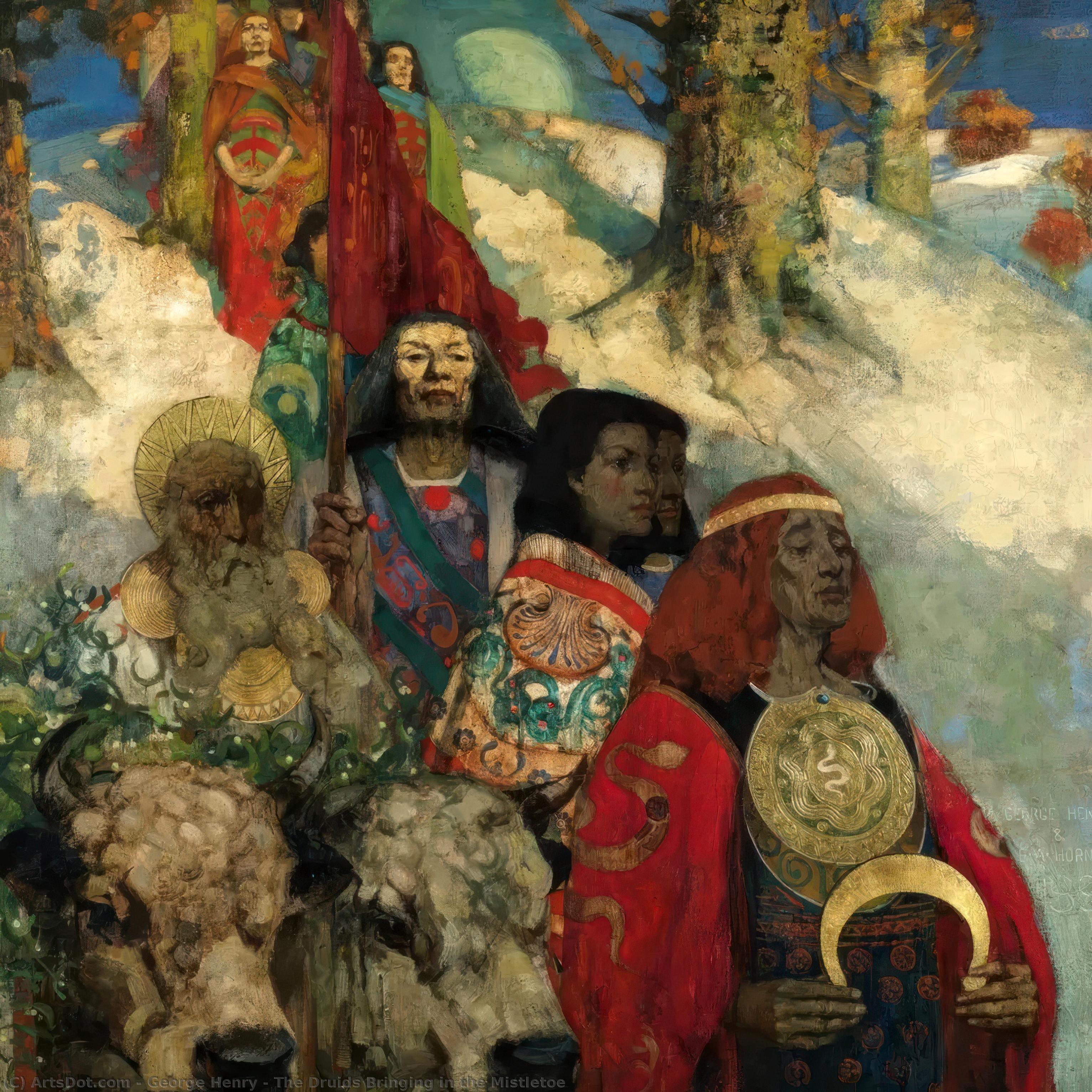
The Druids Bringing in the Mistletoe (1890) авторства George Henry

The Druids Bringing in the Mistletoe

1890 · Oil On Canvas

In this 1890 collaboration, George Henry and Edward Atkinson Hornel present a scene of profound solemnity. The composition captures a procession of Celtic priests descending a steep, rugged hillside. There is a rhythmic, almost ceremonial weight to the movement of the figures. At the center of this ritual, a chief druid uses a golden sickle to harvest mistletoe from a sacred oak. The figures are draped in robes adorned with…

Знамениті картини George Henry, з 11 по 55

Знамениті картини George Henry за періодами творчості

Late Medieval

1889 – 1894 · 3 робіт у цьому списку

Теми, що привертали увагу George Henry

Чотири сюжети, які найчастіше зустрічаються в цих оригіналах, кожен із найкращим прикладом.

Музеї, у яких зберігаються оригінали George Henry

7 музеїв, у яких зберігається найбільша кількість картин із цього списку.

Музей Місто Твори George Henry Картини зі цього списку
Шотландська національна галерея, ЕдінбургШотландська національна галерея Едінбург 2 Geisha Girl, East and West
Sheffield City Art Galleries, ШеффілдSheffield City Art Galleries Шеффілд 1 Hikers at Goodwood Downs, West Sussex
Mcmanus: Dundee's Art Galleries And Museums, DundeeMcmanus: Dundee's Art Galleries And Museums Dundee 1 The Feather Boa
The Royal Conservatoire of Scotland, EdinburghThe Royal Conservatoire of Scotland Edinburgh 1 The Grey Hat
Laing Art Gallery, New South WalesLaing Art Gallery New South Wales 1 Lady Margaret Sackville
Atkinson Art Gallery Collection, SouthportAtkinson Art Gallery Collection Southport 1 The Lark
Манчестерська картинна галерея, МанчестерМанчестерська картинна галерея Манчестер 1 Landscape with Rainbow

George Henry крізь роки: унікальні оригінали кожного твору

14 років розділяють першу та останню датовані оригінальні роботи George Henry, представлені тут, 1882 та 1895: кожен рік має своє місце нижче.

Роботи за роками

Оберіть рік, щоб переглянути оригінали.

Картини George Henry: запитання до галереї

Яка найвідоміша робота George Henry?Дізнатися відповідь

Japanese Lady with a Fan (1894). Далі йдуть A Galloway Landscape (1889) та The Druids Bringing in the Mistletoe (1890).

У якому віці George Henry створив(ла) Japanese Lady with a Fan?Дізнатися відповідь

66 років: Japanese Lady with a Fan датована 1894 роком, а George Henry народився(-лася) у 1828.

Які десять найвідоміших картин George Henry?Дізнатися відповідь

Japanese Lady with a Fan, A Galloway Landscape, The Druids Bringing in the Mistletoe, The Hedgecutter, Marion N. Parker, Lieutenant Colonel Sir Cecil Bingham Levita, Hikers at Goodwood Downs, West Sussex, The Geisha Girl, Head of the Holy Loch та Eyemouth. У рейтингу вище вказано рік створення та музей для кожної картини.

Скільки відомих робіт належить George Henry?Дізнатися відповідь

Наш каталог містить 55 робіт George Henry, датованих періодом з 1882 по 1895.

Де можна побачити найвідоміші оригінали George Henry?Дізнатися відповідь

Переважно в Шотландська національна галерея (Едінбург), Sheffield City Art Galleries (Шеффілд) та Mcmanus: Dundee's Art Galleries And Museums (Dundee). У таблиці музеїв вище наведено їхній повний перелік.

У який період George Henry створив свої найвідоміші картини?Дізнатися відповідь

У 1894: 7 із 55 робіт на цій сторінці були створені тоді, серед них Japanese Lady with a Fan.

Яка з найвідоміших картин George Henry була написана найраніше, а яка — найпізніше?Дізнатися відповідь

На цій сторінці найдавніша робота датована Head of the Holy Loch (1882), а найновіша — In a Tokyo Garden (1895).

Яким сюжетам віддавав перевагу George Henry?Дізнатися відповідь

Elegant woman (4), Landscape (3) та Portraiture (2), у 55 роботах на цій сторінці.

Якими матеріалами найчастіше користувався George Henry?Дізнатися відповідь

Oil On Canvas, для 2 із 55 робіт на цій сторінці.

До якого напряму належить творчість George Henry?Дізнатися відповідь

Impressionism та Post-impressionism, судячи з оригіналів на цій сторінці.

Які оригінальні роботи George Henry можна побачити в Шотландська національна галерея?Дізнатися відповідь

Geisha Girl та East and West: Шотландська національна галерея, Едінбург зберігає 2 робіт із цієї сторінки.

George Henry: портрет художника

The Visionary of the Glasgow Style

George Henry stands as a luminous figure in the annals of British art, a painter whose brush captured the shifting light and soulful atmosphere of the late nineteenth century. Born in Irvine, Scotland, in 1858, Henry became a cornerstone of the influential Glasgow Boys movement, a group of rebellious young artists who sought to break free from the stifling constraints of academic realism. His journey was one of profound transformation, moving away from traditionalist rigidity toward a more emotive, sensory experience of the world. Through his work, the rugged beauty of the Ayrshire landscape and the quiet dignity of his subjects were elevated into something much more poetic and enduring.

The foundations of Henry’s aesthetic were laid during his formative years at the Glasgow School of Art. It was here that he forged deep connections with contemporaries such as John Singer Sargent, creating a shared intellectual space where new ideas could flourish. His training was not merely technical but deeply philosophical, as he began to absorb the revolutionary currents of Impressionism and the delicate, flattened perspectives of Japonisme. This fascination with Japanese art prints introduced a decorative elegance to his compositions, allowing him to balance the raw energy of light with a structured, almost rhythmic sense of design.

A Symphony of Light and Color

Henry’s mastery lay in his ability to translate the ephemeral qualities of nature into permanent pigment. His landscapes are far more than mere topographical records; they are psychological evocations of place. He utilized loose, expressive brushstrokes and a vibrant palette to capture the fleeting moments of the day, from the golden warmth of afternoon sun to the melancholic descent of dusk. One of his most evocative triumphs, "Gloamin'" (1889), serves as a masterclass in atmosphere, where the artist uses color and texture to invite the viewer into a state of quiet contemplation and intimacy.

Beyond the sweeping vistas of the Scottish countryside, Henry’s portraiture revealed a different facet of his genius. In his depictions of individuals, he moved beyond simple likeness to capture an inner essence. His portraits are characterized by:

  • A sensitive approach to light that softens the features and emphasizes mood.
  • An empathetic gaze that honors the psychological depth of his subjects.
  • A seamless integration of subject and setting, often using decorative elements to frame the sitter.
This duality—the ability to be both a bold experimentalist and a meticulous observer—is what defines his unique contribution to the Glasgow Style.

Legacy and Historical Significance

While George Henry may have experienced periods of relative obscurity during his lifetime, the historical significance of his work has undergone a profound resurgence. He is now recognized not just as a regional painter, but as a pioneer who helped bridge the gap between traditional Scottish painting and the modern European avant-garde. His ability to fuse the ruggedness of his native landscape with the sophisticated decorative motifs of international trends created a visual language that was entirely his own.

Today, the legacy of George Henry lives on through the enduring charm of his canvases, which continue to resonate with modern audiences seeking beauty, emotion, and a connection to the natural world. His life’s work remains a testament to the power of artistic rebellion—a reminder that by challenging the conventions of the past, one can illuminate the path toward a new and breathtaking way of seeing.