A Renaissance Visionary of Toledo
The life of Pedro Machuca remains partially veiled by the mists of history, yet his enduring legacy is etched into the very stone and canvas of the Spanish Renaissance. Born in Toledo, Spain, Machuca emerged from a period of profound cultural transformation, where classical ideals began to intertwine with the burgeoning humanism of the age. While he is celebrated for his evocative paintings, he was also a master architect whose vision helped redefine the Spanish landscape. His journey took him far beyond the borders of his homeland, as he traveled to Italy, an experience that would fundamentally alter the trajectory of his artistic development and infuse his work with a sophisticated, international flair.
During his time in Italy, Machuca became deeply immersed in the vibrant artistic currents of the era. His style suggests a profound connection to the Raphael workshop, particularly through the influence of the frescoes found within the Vatican Stanze. This exposure to the masters of the Italian Renaissance allowed him to absorb the elegance of classical composition and the emotive power of Venetian color. Traces of this period can be seen in his ability to synthesize these foreign influences into a uniquely Spanish aesthetic, creating a bridge between the traditions of his birth and the revolutionary techniques of the Italian masters.
The Intersection of Architecture and Art
Beyond the realm of painting, Machuca holds a position of immense historical significance as an architect. He is most notably remembered for his monumental contribution to the Palace of Charles V in Granada. This ambitious project, which began in 1528, stands as a landmark of architectural history, representing likely the first major classic Renaissance style building in Spain. Through this work, Machuca sought to introduce a new architectural language that challenged the prevailing Moorish hegemony in the recently acquired province of Granada, utilizing classical elements to reflect the power and cultural ambitions of the Spanish court.
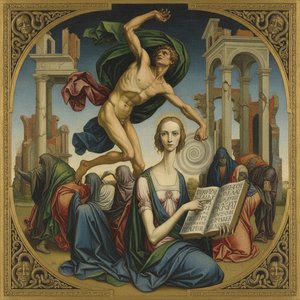
His architectural sensibilities were not separate from his painterly pursuits but rather complemented them. The meticulous craftsmanship seen in the frames of his artworks often reflects his deep understanding of structural design and classical proportion. This dual mastery allowed him to approach both canvas and stone with a unified vision of harmony and grandeur, making him a pivotal figure in the transition toward a more classicized Renaissance identity within the Iberian Peninsula.
Mastery of Emotion and Light
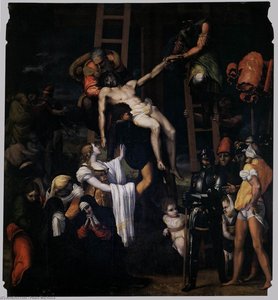
The paintings of Pedro Machuca are profound meditations on the human condition, often exploring themes of faith, loss, and divine grace. His works, such as the Deposition and the Descent from the Cross, demonstrate a remarkable ability to capture visceral emotion through the use of light and shadow. In these compositions, he masterfully employs techniques that anticipate the dramatic flourishes of later movements, utilizing deep shadows to amplify somber moods while highlighting key figures with a luminous intensity.
His artistic development is characterized by several defining elements:
- Emotional Depth: A capacity to render the agonizing weight of grief and the spiritual tension of biblical narratives.
- Stylistic Synthesis: The seamless blending of Spanish tradition with the influence of Italian Mannerism and Venetian color.
- Architectural Precision: An integration of classical proportions and structural elegance into his visual compositions.
- Dramatic Lighting: The use of light to reveal the soul of his subjects, creating a sense of transcendence and movement.
Through his contributions to both architecture and painting, Machuca left an indelible mark on the Spanish Golden Age. His ability to navigate the complexities of different artistic movements—from the classical Renaissance to the early stirrings of Mannerism—ensures that his work remains a vital subject of study for those seeking to understand the profound cultural shifts of the sixteenth century.
Запитання та відповіді
Звідки родом Pedro Machuca?
Pedro Machuca народився у Spain.
Де можна переглянути роботи Pedro Machuca, згруповані за художніми напрямами?
Сторінка Усі напрями групує твори Pedro Machuca за художніми напрямами.
Як мені знайти роботи Pedro Machuca у певній палітрі кольорів?
Сторінка За палітрами групує роботи Pedro Machuca за їхніми колірними палітрами.