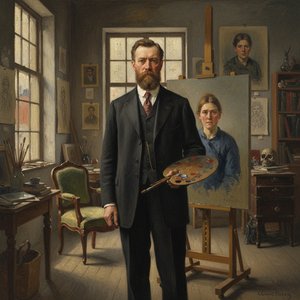
A Life Rooted in Norway
Oscar Arnold Wergeland entered the world on 12 October 1844 in Christiania, Norway. He grew up within a family deeply connected to the intellectual and political fabric of his nation. His father, Sverre Nicolai Wergeland, moved to America around 1860, leaving Oscar to navigate his early years in a changing landscape. While some of his siblings passed away young, others found their own paths, such as his sister Agnes Mathilde Wergeland, who later became an author in the United States.
His education was shaped by several hands and institutions. He studied under David Arnesen and attended the Norwegian National Academy of Craft and Art Industry between 1865 and 1867. Later, he sought further instruction at the art school run by Johan Fredrik Eckersberg and traveled to the Copenhagen Royal Danish Academy of Fine Arts in 1869. These years of formal training provided the foundation for a career defined by precision and historical weight.
The Weight of History and Realism
Wergeland found his true footing in Munich, where he lived from 1874 to 1889. It was here that he focused on the demanding discipline of history painting. His most significant achievement remains his large-scale depiction of the Constituent Assembly at Eidsvoll, known as Riksforsamlingen på Eidsvoll 1814. This work was a massive undertaking of research and patience; he reportedly copied more than 60 portraits to ensure each figure in the assembly was rendered with accuracy. The final painting includes 55 distinct portraits of the constitutional fathers.
The impact of this specific work reached far beyond the walls of a gallery. It eventually found a place in the Norwegian Parliament, positioned behind the speaker's platform and the presidential podium. Its presence was so central to Norwegian identity that it appeared on the reverse side of 100 kroner banknotes from 1962 to 1977 and was featured on postage stamps during the centenary of the assembly in 1918.
A Legacy of Teaching and Artistry
Beyond his historical canvases, Wergeland explored other facets of the Realist movement. He produced genre paintings and landscapes that captured the quiet moments of Norwegian life. One such work, Woman and Child in the Woods, shows a different side of his technique, using thick paint to depict sunlight filtering through evergreen trees onto a child and their caregiver. This ability to balance heavy historical subjects with the softer textures of nature defined his range.
In his later years, he returned to his roots in teaching. From 1889, he shared his knowledge at the Norwegian National Academy of Craft and Art Industry in Kristiania. He remained a figure of importance in the Norwegian art scene until his death on 20 May 1910. His works continue to be preserved in important collections, including two pieces held within the National Gallery of Norway.
Питання та відповіді
Які роботи Oscar Wergeland мають найбільшу кількість переглядів?
Статистика про роботи Oscar Wergeland доступна на сторінці Статистика відвідувань митця.
До якого історичного періоду належить творчість Oscar Wergeland?
Oscar Wergeland працював у період 19th Century. Цей період визначає місце творчості митця в історії.
Під якими ще іменами відомий Oscar Wergeland?
Oscar Wergeland також відомий під іншими іменами: Oskar Arnold Wergeland, Oscar Arnold Wergeland, Oscar A. Wergeland, ოსკარ ვერგელანდი, 오스카르 베르겔란.
Де я можу переглянути роботи Oscar Wergeland у хронологічному порядку?
Перегляньте хронологію робіт Oscar Wergeland: на сторінці Хронологія творів твори митця впорядковані за датою створення.