Портрет Ludwig Meidner

19 найвідоміших картин Ludwig Meidner, кожна з яких є унікальною

Оновлено Листопад 2026 · за рейтингом нашої популярності (кількість пошукових запитів, переглядів та замовлень для кожної роботи) · 22 робіт Ludwig Meidner у нашому каталозі

Коротко кажучи

Max Herrmann-Neisse (1913) — це картина Ludwig Meidner, яка привертає найбільше уваги; оригінал зберігається в Art Institute of Chicago, Чикаго. Після цього погляд переходить на Despair (III) (1914) та Blowing the Shofar (1937). Серед 22 робіт Ludwig Meidner у нашому каталозі ці 19 є найвідомішими: кожна з них — унікальний оригінал із зазначенням року створення, музею та причини її безсмертя.

1884 – 1966 Expressionism Найбільше робіт: Єврейський музей у Франкфурті

Топ-10 картин Ludwig Meidner крізь призму галереї

1
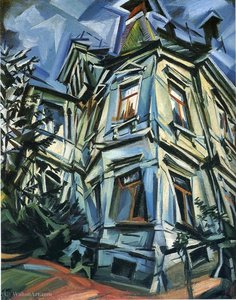
Max Herrmann-Neisse (1913) авторства Ludwig Meidner

Max Herrmann-Neisse

1913 · Oil On Canvas · Art Institute of Chicago, Чикаго

The gaze of the subject meets us in this 1913 portrait, a moment frozen in oil by the hand of Ludwig Meidner. This work captures Max Herrmann-Neisse, a figure who moved through the intellectual circles of Berlin as a poet and theater critic. The artist, Ludwig Meidner, finds his way into the inner lives of the city's literati, and here he settles upon the face of this specific writer. There…

2
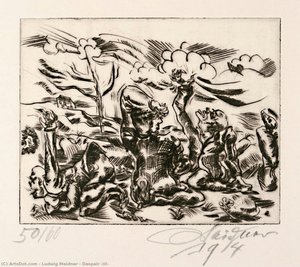
Despair (III) (1914) авторства Ludwig Meidner

Despair (III)

1914 · Woodcut · Єврейський музей у Франкфурті, Франкфурт

Despair (III) by Ludwig Meidner is a monochromatic woodcut print created about 1914. The composition is tightly cropped, focusing the viewer's attention on a central group of figures situated within a desolate landscape. These figures are depicted in a state of distress, their forms conveying a sense of suffering or abandonment. In the background, a small building is visible, providing a solitary point of reference within the empty surroundings. The…

3
Blowing the Shofar (1937) авторства Ludwig Meidner

Blowing the Shofar

1937 · Drawing · Єврейський музей у Франкфурті, Франкфурт

In the evocative depths of Ludwig Meidner’s 1937 work, Blowing the Shofar, we are transported to a moment of profound spiritual and auditory intensity. This striking black and white drawing captures more than just a ritualistic act; it captures the very breath of a culture. The subject, a man draped in a heavy, hooded robe, is caught in the visceral moment of exhaling into the shofar—a ram’s horn instrument central…

4
Gas Chamber (1945) авторства Ludwig Meidner

Gas Chamber

Meidner’s charcoal drawing of a gas chamber was probably produced prior to the spring of 1945. Following the liberation of the extermination camps, numerous photos and eyewitness accounts circulated documenting the fact that in the majority of the death camps the gas chambers were disguised as shower blocks, complete with shower heads, in order to prevent panic among those being sent to their deaths. This detail, intriguing in its perfidy,…

Знамениті картини Ludwig Meidner, з 11 по 19

Теми, що привертали увагу Ludwig Meidner

Чотири сюжети, які найчастіше зустрічаються в цих оригіналах, кожен із найкращим прикладом.

Музеї, у яких зберігаються оригінали Ludwig Meidner

2 музеїв, у яких зберігається більшість картин із цього списку.

Музей Місто Твори Ludwig Meidner Картини зі цього списку
Єврейський музей у Франкфурті, ФранкфуртЄврейський музей у Франкфурті Франкфурт 13 Despair (III), Blowing the Shofar, Gas Chamber
Art Institute of Chicago, ЧикагоArt Institute of Chicago Чикаго 1 Max Herrmann-Neisse

Ludwig Meidner крізь десятиліття: одна унікальна оригінальна робота для кожного

Роботи за десятиліттями

Оберіть десятиліття, щоб побачити оригінальний твір, який його визначає.

Картини Ludwig Meidner: запитання до галереї

Яка найвідоміша робота Ludwig Meidner?Дізнатися відповідь

Max Herrmann-Neisse (1913), Art Institute of Chicago, Чикаго. Далі йдуть Despair (III) (1914) та Blowing the Shofar (1937).

У якому віці Ludwig Meidner створив(ла) Max Herrmann-Neisse?Дізнатися відповідь

29 років: Max Herrmann-Neisse датована 1913 роком, а Ludwig Meidner народився(-лася) у 1884.

Які десять найвідоміших картин Ludwig Meidner?Дізнатися відповідь

Max Herrmann-Neisse, Despair (III), Blowing the Shofar, Gas Chamber, Untitled (327), Ecstatic Figure, Male Head, Male Head with Kippah and Tallit, Male Portrait with Kippah та Two Praying Jews. У рейтингу вище вказано рік створення та музей для кожної картини.

Скільки відомих робіт належить Ludwig Meidner?Дізнатися відповідь

Наш каталог містить 22 робіт Ludwig Meidner, датованих періодом з 1913 по 1950.

Де можна побачити найвідоміші оригінали Ludwig Meidner?Дізнатися відповідь

Переважно в Єврейський музей у Франкфурті (Франкфурт) та Art Institute of Chicago (Чикаго). У таблиці музеїв вище наведено їхній повний перелік.

У який період Ludwig Meidner створив свої найвідоміші картини?Дізнатися відповідь

У 1930s: 5 із 19 робіт на цій сторінці були створені тоді, серед них Blowing the Shofar.

Яка з найвідоміших картин Ludwig Meidner була написана найраніше, а яка — найпізніше?Дізнатися відповідь

На цій сторінці найдавніша робота датована Max Herrmann-Neisse (1913), а найновіша — The Sacrifice of Manoah (1950).

Яким сюжетам віддавав перевагу Ludwig Meidner?Дізнатися відповідь

Portrait (3), Man (2) та Tallit (2), у 19 роботах на цій сторінці.

Якими матеріалами найчастіше користувався Ludwig Meidner?Дізнатися відповідь

Drawing, для 5 із 19 робіт на цій сторінці.

До якого напряму належить творчість Ludwig Meidner?Дізнатися відповідь

Expressionism, судячи з оригіналів на цій сторінці.

Які оригінальні роботи Ludwig Meidner можна побачити в Єврейський музей у Франкфурті?Дізнатися відповідь

Despair (III), Blowing the Shofar та Gas Chamber: Єврейський музей у Франкфурті, Франкфурт зберігає 13 робіт із цієї сторінки.

Ludwig Meidner: портрет художника

A Life Shaped by Change

Born in Bernstadt, Germany, in 1884, Ludwig Meidner began his adult life far from the canvas. He first followed his parents' wishes by taking up an apprenticeship as a stonemason, though he did not complete this training. His path eventually led him to the Royal School of Art in Breslau and later to Paris, where he studied at the Académie Julian and Cormon Academies. During these years in Paris, he met Amedeo Modigliani, a connection that placed him at the center of a changing artistic landscape. After returning to Berlin, he worked as a fashion illustrator and draftsman, finding his footing within the city's growing avant-garde circles.

The years leading up to the First World War brought a profound shift in his vision. In 1912, he began creating what are often called his apocalyptic landscapes. These works featured chaotic scenes of urban life, with comets crossing skies like shells and buildings appearing on the verge of collapse. While some saw these images as predictions of the coming war, they were also reflections of the intense energy and social unrest present in the modern metropolis. His involvement with the Die Pathetiker group further solidified his place in the German expressionist movement.

Faith and Displacement

The devastation of the First World War changed Meidner deeply. Having served in the German military as an infantry soldier and a French interpreter, he emerged from the conflict with a different perspective on life and art. He turned toward Orthodox Judaism, finding a new source of meaning through religious themes. His work began to include portraits of prophets and scenes of Jewish ritual, such as his 1937 drawing, Blowing the Shofar. This period saw him moving away from pure expressionist chaos toward more structured, religious imagery that explored the inner experience of faith.

The rise of the Nazi party forced another period of movement and hardship. In 1935, Meidner moved to Cologne to teach at a Jewish school, but the increasing pressure in Germany became impossible to ignore. His work was included in the 1937 Degenerate Art exhibition in Munich, an event that marked him as a target of the regime. In August 1939, he and his wife, Else Meidner, fled to England. Life in London was difficult; he was interned at Huyton Camp and later on the Isle of Man. During these years of exile, he lived in near poverty, often relying on the support of the local Jewish community while continuing to draw and paint from his observations of the world around him.

A Return to Germany

After many years in England, Meidner chose to return to Germany in 1953. He settled in Frankfurt, a city that offered him both a sense of stability and a connection to his heritage. This later period of his life was marked by a renewed recognition within the German art scene. In 1964, he received the Order of Merit of the Federal Republic of Germany and became a member of the Berlin Academy of Fine Arts. His late works continued to reflect his lifelong engagement with both the physical world and the spiritual realm.

Meidner passed away in Darmstadt in 1966. His legacy remains visible in major institutions such as the Jewish Museum Frankfurt, the Museum of Modern Art in New York, and the Metropolitan Museum of Art. Through his varied roles as a painter, printmaker, and writer, he left behind a body of work that documented the turbulent transitions of the twentieth century.