Абрахам Волковиц: портрет художника
A Pioneer of American Modernism: The Life and Art of Abraham Walkowitz
Abraham Walkowitz, a name perhaps less familiar than some of his contemporaries in the early American modernist movement, nevertheless played a crucial role in bridging European artistic innovation with the burgeoning identity of American art. Born in 1878 in Tyumen, Russia – a city far removed from the bustling metropolis he would eventually call home – Walkowitz’s life was marked by displacement and a relentless pursuit of artistic expression. His early years were shaped by his mother's emigration to America, an experience that instilled within him a deep sensitivity to movement, change, and the human condition—qualities that would profoundly inform his art. He received formal training at the National Academy of Design in New York City, mastering traditional techniques before embarking on a transformative journey into the uncharted territories of modernism.
Early Influences and Parisian Awakening
Walkowitz’s artistic trajectory was fundamentally shaped by his association with Alfred Stieglitz's 291 Gallery, a vibrant hub for avant-garde artists in New York City. This wasn’t merely a professional connection; it was an immersion into a community of visionaries—Arthur Dove, Marsden Hartley, and John Marin among them—who were boldly challenging the established norms of artistic representation. The gallery became his crucible, fostering experimentation and pushing him to explore new ways of seeing and depicting the world. A particularly significant moment occurred during the 1907 memorial exhibition dedicated to Paul Cézanne in Paris. This encounter proved profoundly transformative, deeply influencing his approach to abstraction and solidifying his commitment to exploring form and structure beyond mere imitation of reality. He absorbed the spirit of European modernism—the emphasis on subjective experience, flattened perspectives, and a willingness to break from traditional representation—but crucially, he resisted becoming a mere imitator. Walkowitz sought to synthesize these influences with his own unique sensibility, forging an authentically American voice within the burgeoning modernist movement. This period also witnessed the genesis of his extraordinary series of drawings depicting Isadora Duncan, the revolutionary dancer whose dynamic movements captivated him and became a central focus of his artistic exploration for decades.
The Dance of Motion: The Isadora Duncan Drawings
Over five thousand charcoal and watercolor drawings document Walkowitz’s fascination with Isadora Duncan—a figure who embodied liberation, innovation, and a radical departure from traditional ballet. These weren't simply portraits; they were explorations of her very essence, capturing the spirit of her revolutionary dance style and its profound impact on the artistic landscape. The drawings are characterized by their fluid lines, dynamic compositions, and evocative use of light and shadow—a testament to Walkowitz’s ability to translate movement into a visual language. He didn't aim for photographic realism but rather sought to capture the *feeling* of Duncan’s performances, her energy, and her unique way of interacting with space and time. These drawings stand as a monumental achievement—not just representations of the dancer’s physical form but profound explorations of her spirit and artistic innovation.
Cityscapes and Abstract Visions
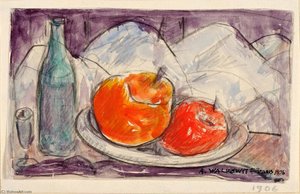
Beyond his celebrated portraits of Isadora Duncan, Walkowitz produced a diverse body of work encompassing cityscapes, still lifes, and increasingly abstract compositions. His New York Skyline (1913) is a particularly compelling example—a hazy watercolor depiction of the city that captures both its grandeur and its underlying dynamism. The painting utilizes linear perspective and atmospheric depth to create a sense of space and movement, hinting at the energy and vitality of urban life. Later works, such as Metropolis, No. 1 (1919), reveal a darker, more Expressionistic sensibility, reflecting themes of destruction and loss through dramatic charcoal renderings. Throughout his career, Walkowitz’s style evolved from representational depictions to increasingly abstract forms, yet he consistently retained a distinctive American character—a blend of European influences filtered through his own unique vision. His still lifes demonstrate a similar exploration of form and color, pushing the boundaries of traditional genre painting towards modernist abstraction.
A Legacy in the Making: Historical Significance
Abraham Walkowitz’s contribution to early American Modernism is often understated, yet it was undeniably significant. He served as a crucial bridge between the avant-garde ideas emanating from Europe and the emerging artistic identity taking root in America. His involvement with Alfred Stieglitz's 291 Gallery was instrumental in establishing a platform for modern art, introducing European artists to an American audience and fostering a community of like-minded innovators. The watershed moment of the Armory Show in 1913—where Walkowitz exhibited alongside other groundbreaking artists—marked a turning point in the acceptance of modern art within the United States. His extensive drawings of Isadora Duncan provide invaluable insights into both her artistic practice and his own evolving style, offering a unique window into a pivotal period of American cultural development. While he may not have achieved the same level of widespread fame as some of his contemporaries, Abraham Walkowitz’s legacy endures—a testament to his pioneering spirit, his innovative vision, and his enduring contribution to the evolution of American art.