Перейти до друку
 Розгорнути текст







































 Для творів мистецтва або репродукцій, розмір яких перевищує 105 см (приблизно 41 дюйм) з будь-якого боку, рама доставляється у вигляді розібраного комплекту. Такий метод гарантує безпечну доставку та запобігає пошкодженням під час транспортування.


Victor Vasarely: Pioneering Op Art & Democratizing Visual Experience
Victor Vasarely (1906-1997), born Győző Vásárhelyi in Pécs, Croatia, stands as a monumental figure in the history of 20th-century art. Often hailed as “the grandfather” of Op Art – Optical Art – he fundamentally reshaped our understanding of perception and artistic expression, transforming geometric abstraction into a captivating exploration of illusion and dynamism.
Vasarely’s journey began with an initial foray into medicine at Eötvös Loránd University in Budapest. However, his innate fascination for visual arts quickly superseded academic pursuits, propelling him toward painting and ultimately establishing him as one of the foremost innovators of Kinetic Art. His formative years were deeply influenced by the Bauhaus movement, fostering a conviction that art should serve practical function alongside aesthetic beauty – a philosophy that would permeate his entire artistic practice.
The Birth of Op Art: Geometry Meets Illusion
The pivotal moment in Vasarely’s artistic evolution arrived with his enrollment at Sándor Bortnyik’s Műhely workshop, where he encountered the groundbreaking ideas championed by Bauhaus. This encounter cemented his belief in the power of geometric abstraction to generate visual effects that defied conventional representation. He meticulously developed a systematic approach—a “mathematical system”—designed to produce images that stimulate retinal movement and create an illusion of depth without relying on traditional perspective.
Vasarely’s technique involved layering colored squares and rectangles onto canvases, creating patterns that appeared to shift and shimmer as viewers moved their eyes. This deceptively simple method yielded astonishing results—complex visual illusions that challenged the viewer's senses and questioned the very nature of reality. His work wasn’t merely decorative; it was a deliberate provocation, inviting contemplation on how our brains interpret visual information.
Notable Works & Lasting Influence
Among Vasarely’s most iconic creations are “Blue Study” and “Green Study,” masterpieces that exemplify the core principles of Op Art. These paintings demonstrate his masterful control over color and form, capturing the essence of optical illusion with remarkable precision.
Furthermore, Vasarely's influence extends far beyond the realm of painting. His aesthetic vision permeated graphic design, interior decoration, and even fashion, establishing him as a visionary who anticipated the trends of the latter half of the 20th century. He democratized visual experience by making complex geometric concepts accessible to a wider audience, leaving an indelible mark on the cultural landscape.
Today, reproductions of Vasarely’s artworks continue to inspire artists and designers alike. OriginalUniqueArt.com offers exceptional quality prints that allow you to immerse yourself in the captivating world of Op Art—a testament to Victor Vasarely's enduring legacy as a pioneer of perceptual art.
Питання та відповіді
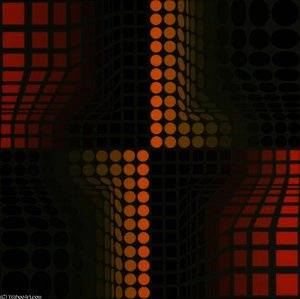
Чи є путівник до «Пauk 101» роботи Віктор Вазарелі?
Сторінка Довідка для студентів для твору «Пauk 101» роботи Віктор Вазарелі пропонує двосторінковий інформаційний лист для друку: зображення твору з таблицею ідентифікації, часову шкалу, що розміщує його в межах життя митця, інші роботи автора, виміряну палітру кольорів та готові до копіювання цитати у чотирьох стилях.
Хто є автором "Пauk 101"?
Автором твору «Пauk 101» є Віктор Вазарелі. Робота внесена до каталогу під іменем Віктор Вазарелі.
До якого етапу кар'єри Віктор Вазарелі належить «Пauk 101», враховуючи дату її створення?
Дата 1968 дозволяє віднести «Пauk 101» до Mature Period творчого розвитку Віктор Вазарелі.
 Переглянути в інтер'єрі
 Надіслати як листівку
 Поділитися
 Деталі витвору
 Посібник

 Завантажити
 Схожі екземпляри
 Рентгенівське дослідження
 Слайд-шоу
 Питання та відповіді
 Статистика