Переглянути в інтер'єрі
 Надіслати
 Поділитися
 Деталі
 Посібник

 Завантажити
 Схожі предмети колекціонування
 Рентгенівське дослідження
 Слайд-шоу
 Статистика переглядів
Seven Sacraments (central panel)
 Олія на полотні
- Настінний декор
- Early Netherlandish Renaissance
 1445
1445- — Відродження
 200.0 x 97.0 cm
 Королівський музей мистецтв Антверпену
 Читати далі
Гікле / Художній принт
Музейна якість друку جيкле або на полотні з оперативним виготовленням та різноманітними варіантами фінішної обробки. ( Купити картину ручної роботи Перейти до цифрових зображень)




P118B ₴10

P118H ₴10

P118W ₴10

P438Z ₴10

P508JH ₴12

P508YH ₴12

P805H ₴10

P805Z ₴10

P919BZ ₴10

P919G ₴10

P919XJ ₴10

P959ZH ₴10

P968JZ ₴12

W106C ₴8

W218G ₴10

W218JH ₴8

W218Y ₴10

W307PJ ₴10

W316G ₴10

W316PJ ₴8

W316Y ₴10

W398PJ ₴8

W4111J ₴10

W500HY ₴15

W500JH ₴15

W692G ₴12

W849H ₴8

W940BG ₴15

W953PJ ₴8




Обирайте з наших стандартних розмірів, що відповідають оригінальним пропорціям твору мистецтва.

Введіть необхідну ширину та висоту, щоб принт ідеально підійшов до вашої рами або стіни. Принт можна лише обрізати, але не можна зробити більшим за оригінал, тому при зміні пропорцій частина зображення буде втрачена. Перед друком ми надсилаємо вам цифровий макет для затвердження. Зображення на цій сторінці не відображає реальну обрізку — її можна побачити лише на макеті.
Доставка по всьому світу () за 2 тижні замість стандартних 4/5 тижнів. (22 Жовтень)

Безкоштовна експрес-доставка по всьому світу

Високоякісне лляне полотно

Повне страхове покриття доставки

Гарантія повернення митних зборів

Гарантія точного відтворення кольорів

Політика повернення протягом 100 днів (лише у разі виявлення дефектів)

Гарантія повернення 100% коштів

Знижка на оптові замовлення
 Скляний варіант доступний лише для розмірів до 110 см

Seven Sacraments (central panel)
Гікле / Художній принт
Розмір репродукції
-


Загальна вартість
₴ 3589
Seven Sacraments (central panel) by Rogier van der Weyden
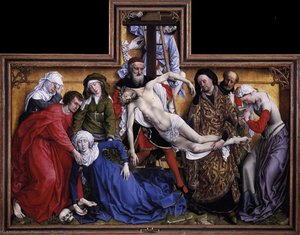
Rogier van der Weyden’s Seven Sacraments (central panel), completed in 1445 and housed at the Koninklijk Museum voor Schone Kunsten in Antwerp, Belgium, stands as a monumental achievement of Early Netherlandish painting and embodies the profound spiritual convictions of its time.
The painting depicts Jesus Christ crucified, surrounded by figures representing the seven sacraments – Baptism, Confirmation, Eucharist, Penance, Holy Orders, Marriage, and Extreme Unction. This composition wasn’t merely decorative; it was intended to convey a complex theological narrative, reflecting the dominant religious beliefs of the fifteenth century.
The Composition and Architectural Setting
Van der Weyden skillfully crafted an interior church scene mirroring St Gudule's Cathedral in Brussels, utilizing architectural elements like vaulted ceilings and colonettes to create depth and grandeur. The central crucifix dominates the composition, flanked by attendants who symbolize faith and devotion. Notably, the artist employed a technique known as *contrapposto*, positioning figures with asymmetrical stances to convey dynamism and emotion—a hallmark of Renaissance art.
Artistic Significance and Technique
Oil paint on panel allowed for unparalleled detail and luminosity, capturing the textures of fabric, skin, and wood with remarkable accuracy. Van der Weyden’s meticulous brushwork is evident in every aspect of the painting, from the folds of Christ's drapery to the expressions on the faces of the mourners. The artist’s masterful use of light—particularly the dramatic illumination of Jesus’ body—intensifies the emotional impact of the scene.
Symbolism and Emotional Resonance
The Seven Sacraments transcends mere representation; it communicates profound spiritual truths about redemption and divine grace. The sorrowful expressions of the mourners underscore the universality of human suffering alongside the hope offered by Christ’s sacrifice. This painting continues to inspire artists and viewers alike, serving as a testament to Van der Weyden's artistic genius and enduring legacy.
For those seeking to experience the beauty and power of this masterpiece firsthand, OriginalUniqueArt.com offers exceptional reproductions crafted by skilled artisans—bringing the spirit of Renaissance art into your home.
Запитання та відповіді
Яке місце в історії мистецтва посідає «Seven Sacraments (central panel)» Рогорій ван дер Вейден?
Мистецтвознавча класифікація «Seven Sacraments (central panel)» Рогорій ван дер Вейден — це Early Netherlandish Renaissance, період — Відродження.
Чи можу я побачити «Seven Sacraments (central panel)» Рогорій ван дер Вейден при іншому освітленні?
«Seven Sacraments (central panel)» можна досліджувати шар за шаром на сторінці Рентгенівське дослідження твору — це інтерактивний візуалізатор, натхненний освітлювальним столом реставратора, що пропонує одинадцять оптичних пластів зображення.
Який розмір друку «Seven Sacraments (central panel)» Рогорій ван дер Вейден підійде для рекомендованої кімнати?
Для Вітальня рекомендований розмір друку для «Seven Sacraments (central panel)» Рогорій ван дер Вейден становить Великий формат.
Біографія митця
A Master of Emotion: The Life and Legacy of Rogier van der Weyden
Rogier de la Pasture – known to history as Rogier van der Weyden – emerged from the bustling city of Tournai, Belgium, around 1400, as a pivotal figure in the burgeoning world of Early Netherlandish painting. While the details of his early life remain somewhat shrouded in mystery, it’s believed he initially honed his skills not with brush and pigment alone, but through a rigorous apprenticeship as a goldsmith. This formative training instilled within him an unwavering dedication to meticulous detail and a refined sensibility for craftsmanship – qualities that would become instantly recognizable hallmarks of his artistic style. The precision demanded by working with precious metals undoubtedly translated into the exquisite rendering of textures, fabrics, and expressions that define his most celebrated masterpieces. He wasn’t merely depicting reality; he was meticulously recreating it, imbued with an almost reverent attention to detail, striving to capture not just what *was*, but how it *felt*.From Tournai to Brussels: A Rising Star
By 1427, van der Weyden had ascended to the rank of master within the esteemed Guild of Saint Luke in Tournai – a significant milestone that solidified his position as a professional artist and opened doors to prestigious commissions. His rise continued dramatically when he entered the service of Philip the Good, Duke of Burgundy, in 1435 – a patronage that would profoundly shape his career for the remainder of his life. Serving as court painter afforded him not only financial security and access to an elite circle of influence but also exposure to some of the most discerning eyes of the era. It was during this period, amidst the opulent courts of Burgundy, that van der Weyden’s artistic vision truly began to mature, moving away from the somewhat rigid conventions of earlier Netherlandish painters towards a more emotionally resonant and naturalistic approach. He wasn't simply painting religious scenes; he was striving to evoke genuine feeling in the viewer, to create an experience that transcended mere observation – a profound shift in the way art engaged with its audience.The Language of Feeling: Style and Technique
Rogier van der Weyden’s artistic signature is immediately recognizable through several defining characteristics. His palette was remarkably rich and diverse, a vibrant tapestry of colors carefully chosen to avoid repetition and create depth and complexity within his compositions. He possessed an extraordinary ability to convey profound emotion – *pathos* – particularly in depictions of religious subjects like the *Lamentation*, where grief and sorrow are palpable. This emotional intensity wasn’t achieved through dramatic gestures or exaggerated expressions; rather, it was subtly woven into the very fabric of the painting, conveyed through delicate nuances of facial expression, body language, and composition. His figures, while adhering to the conventions of the time – often depicted with a dignified, almost sculptural quality – demonstrate a growing interest in realistic representation – not just in anatomy and drapery, but also in capturing the psychological states of his subjects. They possess an air of solemnity and reverence, lending them a timeless quality. He masterfully employed oil paint, building up layers of translucent glazes to achieve luminous effects and create a sense of depth and realism that was revolutionary for its time. The use of *chiaroscuro* – the dramatic interplay of light and shadow – further heightened the emotional impact of his works.Notable Works and Enduring Masterpieces
Throughout his prolific career, van der Weyden produced numerous works that stand as testaments to his artistic prowess. *St Luke Drawing a Portrait of the Madonna*, housed in the Museum of Fine Arts, Boston, showcases his mastery of oil on panel and meticulous observation. The *Lamentation*, residing in the Musée des Beaux-Arts Tournai, Belgium, is perhaps his most celebrated work – a powerfully emotive depiction of Christ’s mourning, renowned for its dramatic use of *chiaroscuro* and its ability to evoke profound sorrow in the viewer. Multiple versions of *The Deposition* exist, each demonstrating his skill in conveying grief and drama with breathtaking sensitivity. The *Annunciation*, a masterpiece of refined style and attention to detail, exemplifies his ability to imbue even the most traditional subjects with a sense of freshness and vitality. And finally, the intricate and richly detailed *Bladelin Triptych* stands as a monumental achievement – a complex altarpiece that showcases the full range of van der Weyden’s artistic abilities. These works, and many others, continue to captivate audiences today, solidifying his position as one of the most important painters of the 15th century.Lasting Influence: A Legacy Forged in Paint
Van der Weyden's influence extended far beyond the borders of his native Flanders. His works were highly sought after throughout Europe, particularly in Italy and Spain, where they introduced a new level of emotional depth and naturalism to local artistic traditions. Although his fame experienced a period of relative decline in the 17th century, a rediscovery during the 19th century cemented his place as one of the most important painters of the 15th century. He stands alongside Jan van Eyck and Robert Campin as one of the “three great” Early Flemish masters, each contributing uniquely to the development of Northern Renaissance art. His innovative techniques and emotionally charged compositions paved the way for future generations of artists, inspiring countless imitators and influencing the course of Western painting for centuries to come. He helped establish oil painting as the dominant medium and elevated the status of the artist within society, transforming them from skilled craftsmen into revered creators. Rogier van der Weyden’s legacy continues to resonate today, a testament to his enduring genius and his profound understanding of the human condition.
Рогорій ван дер Вейден
1400 - 1464 , Бельгія
Довідкова інформація
- Artistic Movement Or Style: Ранньонідерландське живопис
- Artists Or Movements Influenced By This Artist:
- Італьянський Ренесанс
- Іспанська живопис
- Artists Who Influenced This Artist:
- Робер Кампін
- Ян ван Ейк
- Date Of Birth: c. 1400
- Date Of Death: 1464
- Full Name: Rogier van der Weyden
- Nationality: Бельгійський
- Notable Artworks:
- Скорбна сцена
- Плачуща Діва
- Поховання Христа
- Place Of Birth: Tournai, Бельгія
Схожі статті

Рембрандт ван Рейн: Топ-25 шедеврів для вашого дому | OriginalUniqueArt
Пориньте у світ Рембрандта ван Рейна! 25 культових шедеврів бароко, портретів та біблійних сцен. Купіть високоякісні репродукції картин Рембрандта для вашого дому на OriginalUniqueArt.com – музейне мистецтво онлайн!

Топ-10 шедеврів раннього нідерландського живопису: мистецтво для вашого дому від OriginalUniqueArt
Відкрийте для себе 10 шедеврів раннього нідерландського живопису! Дізнайтесь історії ван Ейка, ван дер Вейдена та інших майстрів. Купіть високоякісні репродукції картин на OriginalUniqueArt.com і додайте елегантності вашому дому.

Rogier van der Weyden: Emotion, Innovation & the Early Netherlandish Renaissance
Explore the revolutionary art of Rogier van der Weyden, a pivotal figure of the Early Netherlandish Renaissance. Discover his emotional realism, innovative compositions, and lasting impact on painting history.

Hugo van der Goes: Devotion, Innovation & the Psychological Depth of Early Netherlandish Painting
Explore the revolutionary art of Hugo van der Goes – a master of Early Netherlandish painting renowned for his dramatic realism, psychological depth & profound influence on Renaissance artists. Discover his iconic works and lasting legacy.

Топ-10 шедеврів Раннього Нідерландського Відродження: мистецтво для вашого дому | OriginalUniqueArt
Відкрийте для себе 10 шедеврів Раннього Нідерландського Відродження! Історія ван Ейка, Рогіра ван дер Вейдена та інших майстрів. Картини епохи Ренесансу для вашого дому – придбайте розкішні репродукції на OriginalUniqueArt.com.