Minimalism · 1968
Untitled (Robert Morris, 1968)
Robert Morris (1931–2018) створив Untitled. Дата створення — 1968. Він належить до напряму Minimalism. Виконано в Acrylic. Екземпляр зберігається в Тейт Модерн у Лондон, Сполучене Королівство.
- 1968
- Acrylic
- Тейт Модерн, Лондон

 Переглянути в інтер'єрі

 Картина олією ручної роботи
 Надіслати як листівку
 Поділитися
 Посібник


 Завантажити
 Схожі екземпляри
 Рентгенівське дослідження
 Слайд-шоу
 Питання та відповіді

 Статистика
Untitled: основні характеристики
- Назва
- Untitled
- Художник
- Robert Morris (1931–2018)
- Рік народження митця
- Kansas City, United States
- Дата
- 1968
- Матеріал
- Acrylic
- Де подивитися
- Тейт Модерн, Лондон, Сполучене Королівство
- Рух
- Minimalism
- Сюжет
- sculpture, minimalism, organic, form, space, suspension
Що зображено на Untitled?
Robert Morris’s “Untitled”: A Meditation on Absence and Form
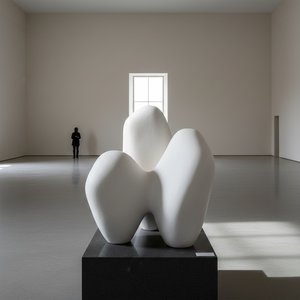
Robert Morris’s “Untitled,” created in 1968, stands as a cornerstone of Minimalism and a profound exploration into the very nature of perception within art. More than simply a sculpture, it's an invitation to contemplate the space between object and viewer, a deliberate rejection of representational imagery in favor of pure form and process. The piece, often realized in cast concrete or resin – though variations exist – presents a single, elongated form suspended from the ceiling, seemingly adrift within a stark white void. This simplicity is deceptive; it’s precisely this lack of overt narrative that generates such a powerful emotional response.
The sculpture's design deliberately avoids any immediately recognizable reference. It’s an organic curve, reminiscent perhaps of a fossilized stone or the attenuated form of a stretched root system – a subtle nod to the natural world without resorting to direct depiction. The surface is rarely smooth; instead, it bears the marks of its creation: subtle undulations, slight variations in tone, and even traces of the casting process itself. These imperfections aren’t flaws but integral elements of the work's philosophy, emphasizing the inherent materiality of the object and rejecting the illusionistic qualities of traditional sculpture. The deliberate roughness invites a tactile engagement, prompting us to consider the physicality of the piece and its relationship to our own bodies within the space.
The Philosophical Undercurrents of Minimalism
“Untitled” is deeply rooted in the burgeoning philosophical currents of the late 1960s. Minimalist artists like Morris were reacting against the perceived excesses of Abstract Expressionism, rejecting subjective emotion and personal expression in favor of a more objective approach to art-making. They sought to strip away all unnecessary elements – color, texture, narrative – leaving only the essential form and its relationship to space. Morris’s work directly engages with questions of perception: how do we see? How does our mind construct meaning from visual information? The sculpture's stark simplicity forces us to confront our own assumptions about art and representation.
Crucially, Morris wasn’t simply creating a visually pleasing object. He was interested in the *experience* of seeing – the way the form interacts with the surrounding space, the effect it has on the viewer’s perception of reality. The work's placement within a white room is deliberate; it isolates the sculpture and forces us to focus entirely on its shape and presence. This creates a sense of quiet contemplation, inviting viewers to slow down and engage with the artwork in a more mindful way.
Materiality and Process: A Key to Understanding
The choice of materials – typically cast concrete or resin – is significant. These durable, industrial substances lend an air of solidity and permanence to the sculpture, yet their inherent imperfections subtly undermine this sense of stability. The casting process itself becomes part of the artwork’s narrative; the marks left by the mold are not concealed but deliberately revealed, emphasizing the labor involved in its creation. This transparency – a key characteristic of Minimalism – invites us to consider the artist's hand and the physical processes that shaped the final form.
Morris often experimented with different casting techniques, manipulating the pour to create variations in texture and surface quality. These subtle differences contribute to the sculpture’s overall sense of ambiguity and complexity. The work is not about achieving a perfect, idealized form; it's about exploring the possibilities inherent within the materials and processes themselves.
Symbolism and Emotional Resonance
While “Untitled” resists easy interpretation, it evokes a powerful sense of stillness and contemplation. The elongated form suggests a reaching gesture – perhaps towards an unknown horizon or a deeper understanding – while its suspended position conveys a feeling of vulnerability and precariousness. The work’s simplicity can be surprisingly unsettling, prompting us to confront our own anxieties about the world and our place within it.
Ultimately, “Untitled” is not a statement but an experience. It's a reminder that art doesn't always need to tell a story; sometimes, its power lies in its ability to simply *be* – a quiet meditation on form, space, and the mysteries of perception. It remains a profoundly influential work, continuing to challenge our assumptions about what constitutes art and how we engage with it.
У якому музеї зберігається Untitled?
Тейт Модерн
Лондон, Сполучене Королівство
Історія та витоки Тейт Модерн Присутність Тейт Модерн у Лондоні, Сполучене Королівство, глибоко вкорінена в індустріальній історії горизонту Саутварка. Це місце спочатку займала електростанція Банксайд — велична споруда, що функціонувала протягом трьох десятиліть, перш ніж остаточно вибула з експлуатації. Економічні зрушення, зокрема різке зростання цін на нафту, призвели до того, що 31 жовтня 1981 року станцію було закрито.


Untitled у високій роздільній здатності

Захищено авторським правом: зображення представлене лише для ознайомлення.
Більше розмірів, варіантів кадрування та цитат →Robert Morris, Untitled (1968), Тейт Модерн.
Питання про Untitled
Як стиль твору "Untitled" відображає епоху його творця?
«Untitled» належить до течії Minimalism, а її автор працював у епоху Modern.
З якої країни походить твір у стилі Minimalism під назвою "Untitled"?
Твір у стилі Minimalism «Untitled» був створений художником, який народився в United States.
Чому статус авторського права на "Untitled" саме такий?
Статус авторського права на твір "Untitled" — все ще перебуває під захистом авторського права — визначається датою смерті митця у 2018.
Які емоції викликає "Untitled"?
Емоційний тон, зафіксований для «Untitled» роботи Robert Morris, — Reflective. Він узагальнює почуття, які виражає цей твір.
Яка палітра та домінуючий колір визначають "Untitled"?
У творі «Untitled» роботи Robert Morris використана палітра Neutrals, де домінуючим кольором є Celadon (#b3b5a7).
Чи можу я побачити «Untitled» роботи Robert Morris при іншому освітленні?
«Untitled» можна досліджувати шар за шаром на сторінці Рентгенівське дослідження твору — це інтерактивний візуалізатор, натхненний освітлювальним столом реставратора, що пропонує одинадцять оптичних пластів зображення.
Для чого рекомендується використовувати репродукцію «Untitled»?
Рекомендований спосіб використання «Untitled» роботи Robert Morris — це Reflective. Також він може слугувати для інших цілей.
Яке місце посідає «Untitled» у творчому дорозі Robert Morris?
У творчому спадку Robert Morris твір "Untitled" витриманий у стилі Minimalism та перегукується з темами minimalist abstraction, process-oriented, conceptual space, perceptual inquiry, deconstructed form, reduced elements, systematic approach, formal exploration.
Чи можу я побачити «Untitled» роботи Robert Morris на власній стіні перед покупкою?
Для твору "Untitled" доступна функція попереднього перегляду в доповненій реальності: на сторінці Перегляд в AR ви можете побачити його у власному інтер'єрі за допомогою сумісного пристрою.
Про художника Robert Morris

1931–2018, United States
Robert Morris
The Architect of Perception: The Life and Legacy of Robert Morris In the vast, often turbulent landscape of twentieth-century American art, few figures cast as long or as intellectually profound a shadow as Robert Morris. Born in 1931 in Kansas City, Missouri, Morris did not merely participate in the movements of his time; he provided the theoretical and physical scaffolding upon which much of contemporary art was built. His journey began with a rigorous multidisciplinary foundation, blending the precision of engineering with the expressive potential of fine art. This unique duality—the ability to dissect a form through a technical lens while simultaneously questioning its philosophical essence—became the hallmark of his career.
Також за участю Robert Morris
 Document
 Bull Wall
Есе до твору Untitled
 Тріумф Трьох Палітр: Емоційний Резонанс та Ідентичність у Виборі Мистецького ВіддзеркаленняДослідіть психологію мистецтва та зв'язок між вашими уподобаннями і особистістю. Відкрийте, як соціальний контекст та історія впливають на …
 The Subtlety of Form: Exploring Minimalism’s Evolution & Enduring InfluenceExplore the evolution of Minimalism with OriginalUniqueArt. Discover key artists like Judd & Martin, core principles, collecting insights, …
 The Subtlety of Form: Exploring Emotional Resonance in Minimalist ArtExplore the emotional depth of minimalist art with OriginalUniqueArt. Discover key artists like Agnes Martin & Donald Judd, investment pote…