() ·

A painting made for you, by hand

Still-Life

Олійная репродукція ручної роботи

Написана вручну олією на полотні у вашому розмірі та рамі, виготовлена на замовлення нашими художниками. ( Перейти до друку Перейти до цифрових зображень)

Опис експоната

Discover Pieter Aertsen's 1552 still life, a masterful glimpse into domestic narrative art from the Northern Renaissance; bring this rich scene home.

Біографія митця

Пітер Артзен (1508-1575) – нідерландський художник, що створив революційні жанрові сцени з натяками на біблійні історії. Його роботи вплинули на розвиток голландського живопису та стали передісторією для Брюгеля.

from ·

Chapter 1

How large should it be?

Slide to change the size; the picture on the left shows the frame at its real width. The proportions of the original are kept.

Стандартний розмір
індивідуальний розмір
CM
INCH

Обирайте з наших стандартних розмірів, що відповідають оригінальним пропорціям твору мистецтва.

ширина
висота

Введіть необхідну ширину та висоту, щоб картина підійшла до вашої рами або стіни. Оскільки це ручний розпис, для зміни пропорцій художник може дописати трохи більше по краях або дещо обрізати композицію — вибір за вами. Перед початком роботи ми надішлемо вам цифровий макет для затвердження. Зображення, показане на цій сторінці, не є реальним результатом — лише макет відображає майбутній вигляд.

Chapter 2

How should it arrive?

Choose the edges of the stretched canvas

Choose your frame

Corner sample of the WhiteWrap canvas edge finish, stretched on масив дерева bars
White ₴1
Corner sample of the BlurSideWrap canvas edge finish, stretched on масив дерева bars
Blurside ₴1
Corner sample of the ExtendedWrap canvas edge finish, stretched on масив дерева bars
Extended ₴1
Corner sample of the P118B picture frame: формований полістирол, 5 cm wide and 3 cm thick
P118B ₴10
Corner sample of the P118H picture frame: формований полістирол, 5 cm wide and 3 cm thick
P118H ₴10
Corner sample of the P118W picture frame: формований полістирол, 5 cm wide and 3 cm thick
P118W ₴10
Corner sample of the P438Z picture frame: формований полістирол, 5.5 cm wide and 3.5 cm thick
P438Z ₴10
Corner sample of the P508JH picture frame: формований полістирол, 7 cm wide and 3.5 cm thick
P508JH ₴12
Corner sample of the P508YH picture frame: формований полістирол, 7 cm wide and 3.5 cm thick
P508YH ₴12
Corner sample of the P805H picture frame: формований полістирол, 5 cm wide and 3.5 cm thick
P805H ₴10
Corner sample of the P805Z picture frame: формований полістирол, 5 cm wide and 3.5 cm thick
P805Z ₴10
Corner sample of the P919BZ picture frame: формований полістирол, 7 cm wide and 3.5 cm thick
P919BZ ₴10
Corner sample of the P919G picture frame: формований полістирол, 7 cm wide and 3.5 cm thick
P919G ₴10
Corner sample of the P919XJ picture frame: формований полістирол, 7 cm wide and 3.5 cm thick
P919XJ ₴10
Corner sample of the P959ZH picture frame: формований полістирол, 5 cm wide and 3 cm thick
P959ZH ₴10
Corner sample of the P968JZ picture frame: формований полістирол, 6 cm wide and 4 cm thick
P968JZ ₴12
Corner sample of the W106C picture frame: масив дерева, 5 cm wide and 3 cm thick
W106C ₴8
Corner sample of the W218G picture frame: масив дерева, 5 cm wide and 3 cm thick
W218G ₴10
Corner sample of the W218JH picture frame: масив дерева, 5 cm wide and 3 cm thick
W218JH ₴8
Corner sample of the W218Y picture frame: масив дерева, 5 cm wide and 3 cm thick
W218Y ₴10
Corner sample of the W307PJ picture frame: масив дерева, 6 cm wide and 3 cm thick
W307PJ ₴10
Corner sample of the W316G picture frame: масив дерева, 6 cm wide and 3 cm thick
W316G ₴10
Corner sample of the W316PJ picture frame: масив дерева, 6 cm wide and 3 cm thick
W316PJ ₴8
Corner sample of the W316Y picture frame: масив дерева, 6 cm wide and 3 cm thick
W316Y ₴10
Corner sample of the W398PJ picture frame: масив дерева, 5 cm wide and 3 cm thick
W398PJ ₴8
Corner sample of the W4111J picture frame: масив дерева, 6.5 cm wide and 3.5 cm thick
W4111J ₴10
Corner sample of the W500HY picture frame: масив дерева, 7 cm wide and 5 cm thick
W500HY ₴15
Corner sample of the W500JH picture frame: масив дерева, 7 cm wide and 5 cm thick
W500JH ₴15
Corner sample of the W692G picture frame: масив дерева, 8 cm wide and 4 cm thick
W692G ₴12
Corner sample of the W849H picture frame: масив дерева, 5 cm wide and 3 cm thick
W849H ₴8
Corner sample of the W940BG picture frame: масив дерева, 7.5 cm wide and 4.5 cm thick
W940BG ₴15
Corner sample of the W953PJ picture frame: масив дерева, 6 cm wide and 3.5 cm thick
W953PJ ₴8
Corner sample of the H24-GOLD picture frame: різьблене дерево з левкасом, 10 cm wide and 6 cm thick
H24-GOLD ₴30
Corner sample of the H24-SILVER picture frame: різьблене дерево з левкасом, 10 cm wide and 6 cm thick
H24-SILVER ₴30
Corner sample of the H36-GOLD picture frame: різьблене дерево з левкасом, 15 cm wide and 6.5 cm thick
H36-GOLD ₴45
Corner sample of the H36-SILVER picture frame: різьблене дерево з левкасом, 15 cm wide and 6.5 cm thick
H36-SILVER ₴45

Moulding: . Overall size with the frame: .

Chapter 3

Who paints it, and should anything change?

Examples of what can be changed: Replace face with customer photo; Add pet (e.g., replace cat with dog); Include hidden message in background; Change background landscape or elements.
After order, OriginalUniqueArt.com team will email client for instructions and provide a mockup preview

Доставка по всьому світу () за 3–4 тижні замість стандартних 5 тижнів. (2 Листопад). Без жодних компромісів у якості.

Chapter 4

The finishing touches

A nameplate, as in a museum?

Деталі гравірування на бронзовій табличці

This elegant plaque features the artist's name and the title of the artwork, finely engraved for a timeless presentation.

It is made from bronze with a refined, elegant finish. The text is precisely laser-engraved for a sharp and permanent result. Measuring 9x2 cm, the plaque is compact yet easy to read. It's built to be durable and scratch-resistant, offering a professional, museum-quality look. Mounting is simple thanks to the included adhesive backing.

Деталі прозорої акрилової таблички

The plaque includes essential engraved details such as the artist's name, the title of the artwork, the date it was created, the type of media used-like oil on canvas or watercolor-a brief description of the piece, and a QR code that links to the complete artwork information.

It is crafted from clear acrylic, offering a sleek, modern appearance. The text is UV-engraved in black to ensure strong visual contrast. With a size of 10x15 cm, it ensures optimal readability. It comes equipped with two metal hooks for secure wall mounting. The plaque is designed to be weather-resistant, making it suitable for various environments, and it includes interactive features that work seamlessly with smartphone scanning.

Деталі чорної акрилової таблички

This elegant plaque includes engraved information such as the artist's name, the title of the artwork, the date it was created, the type of media used (like oil on canvas or watercolor), a short description of the artwork, and a QR code for quick access to more information.

The plaque itself is made from refined black acrylic with a premium finish. The text is laser-engraved in white for high contrast and readability. Its size is 10x15 cm, designed to be easy to read. It comes with two metal hooks for professional mounting. The design is sleek and fits any interior style. It is also weather-resistant and durable, with built-in digital integration for mobile compatibility.

A protective varnish?

When do you need it?

Chapter 5

Your painting, as you ordered it

Still-Life

Матеріал репродукції

Розмір репродукції

-

Видатний майстер-художник

Більше деталізації, витонченості та додаткового часу на створення твору

-

Рама для репродукції

-

-

Для творів мистецтва або репродукцій, розмір яких перевищує 105 см (приблизно 41 дюйм) з будь-якого боку, рама доставляється у вигляді розібраного комплекту. Такий метод гарантує безпечну доставку та запобігає пошкодженням під час транспортування.

Потребує професійного збирання — це не продукт для самостійного виготовлення (DIY).
Комплект має бути зібраний, а полотно натягнуте досвідченим майстром багетних робіт із використанням клейового дерева (не входить у комплект), щипців для натягування полотна та затискачів, щоб підрамник залишався рівним під час висихання клею. Неправильне збирання або нерівномірне натягування полотна може призвести до незворотного пошкодження твору мистецтва, що не підпадає під дію нашої гарантії.

  • У комплект входять усі бруски з цільного дерева, точно вирізані за розміром.

  • Збирається за допомогою гвинтів, що входять до комплекту, а також клейового розчину для кутових з'єднань, який не входить до комплекту і має бути підготовлений вашим майстром.

  • Потрібні професійні інструменти, які не входять до комплекту: щипці для натягування полотна (натягувач) та затискачі, щоб утримувати рейки рівно під час висихання клею.

Важливо:
Для з'єднання кутів потрібен клей для дерева, перекладини необхідно затиснути струбцинами до повного висихання клею, а для натягування полотна на зібрану раму знадобляться щипці для натягування полотна. Жоден із цих інструментів не входить до комплекту. Будь ласка, проконсультуйтеся з досвідченим майстром багетного оформлення перед замовленням рами такого розміру.

Етикетка експоната

-

-

Захисний лак

Глянцевий лак (підсилює яскравість кольорів, захищає від світла та вологи)

-

Персоналізувати мій витвір

Приклади можливих змін: заміна обличчя на фото клієнта; додавання домашньої тварини (наприклад, заміна кота на собаку); додавання прихованого повідомлення на фоні; зміна пейзажу або елементів фону.

-

Прискорено

Доставка по всьому світу () за 3–4 тижні замість стандартних 5 тижнів. (2 Листопад). Без компромісів у якості.

-

Експрес-доставка

Доставка по всьому світу () протягом 5 тижнів. (9 Листопад).

Включено в ціну

Підсумкова вартість

₴ 13535

Загальна вартість ₴ 13535

Скляний варіант доступний лише для розмірів до 110 см

Included with every order

  • Безкоштовна експрес-доставка по всьому світу
  • Високоякісне лляне полотно
  • Повне страхове покриття доставки
  • Гарантія повернення митних зборів
  • Гарантія точного відтворення кольорів
  • Політика повернення протягом 100 днів (лише у разі виявлення дефектів)
  • Гарантія повернення 100% коштів
  • Пропозиція на оптові замовлення

A Quiet Arrangement of Objects

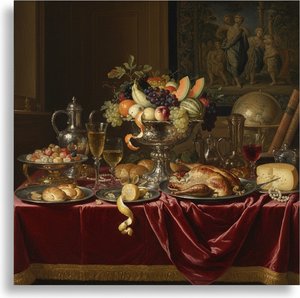
In this 1552 composition, we find ourselves looking closely at a collection of everyday items that seem to occupy the immediate foreground. A vase rests on the left, balanced by a bowl situated in the middle of the scene. Near the center-left area, a bottle is placed alongside a cup toward the right. At the top left corner, a piece of meat provides a heavy, tactile presence among the more delicate vessels. The arrangement feels deliberate, almost as if the objects were set down moments ago for our inspection.

Beyond these inanimate subjects, several people are present within the scene. Two individuals are located on the left side, while another person can be seen near the center-right area. A fourth person is visible towards the right edge of the painting. Their presence introduces a sense of life and depth to the composition, suggesting that this collection of objects exists within a larger, inhabited space.

Technique and Symbolic Resonance

The artist utilizes an oil on panel medium to render these textures with great care. The light catches the surfaces of the ceramic and glass, creating a sense of weight and volume. This approach belongs to the Northern Renaissance style, where the focus remains on the tangible reality of the physical world. Each object is rendered with enough detail to invite a closer look at its form and material. There is an underlying tension in how these elements are organized. The arrangement of items within such a still life often carries weight, representing the relationship between earthly possessions and deeper meanings. By placing human figures alongside these domestic objects, the work blurs the lines between a simple depiction of goods and a narrative involving the people who interact with them. It is a quiet study of presence and absence.

Питання та відповіді

Як можна використати «Still-Life» роботи Пітер Артзен в інтер'єрі дому?

«Still-Life» чудово підійде для Accent, а найкращим місцем для його розміщення стане Living Room.

Чи має "Still-Life" виражений світлотіньовий контраст?

Рівень контрасту твору «Still-Life» роботи Пітер Артзен становить Statement.

У якій кімнаті рекомендується розмістити «Still-Life», враховуючи її палітру?

Завдяки своїй палітрі Earthy, роботу «Still-Life» роботи Пітер Артзен рекомендується розміщувати в Living Room. Саме кольори є однією з причин такої поради.

More about this painting

Переглянути в інтер'єрі Перегляд в AR Перейти до друку Перейти до цифрових зображень Надіслати як листівку
Деталі витвору Посібник Додати до улюблених Завантажити Схожі екземпляри Рентгенівське дослідження Слайд-шоу Q&A Статистика

In numbers

  • 1552the year it was painted
  • 29frames to choose from
  • standard sizes, in its own proportions
  • 5weeks to paint and deliver it
Пітер Артзен

Пітер Артзен

1508 - 1575, Нідерланди

Quick facts about Пітер Артзен

  • Artistic Movement Or Style: Північний маньєризм
  • Artists Or Movements Influenced By This Artist:
    • Йохім Патінер
    • Фемінійський барокко
  • Artists Who Influenced This Artist: ['Алларерт Кляйс']
  • Date Of Birth: 1508, Амстердам
  • Date Of Death: 1575, Амстердам
  • Full Name: Pieter Aertsen
  • Nationality: Нідерландський
  • Notable Artworks:
    • Бульвар з втечею на Єгипет
    • Різник...
    • Різноманітні альтерписи
  • Place Of Birth: Амстердам, Нідерланди

Біографія митця

Pieter Aertsen: The Weaver of Everyday Worlds

Pieter Aertsen, a name that resonates within the halls of art history as one of the most innovative and influential figures of the Northern Renaissance, was far more than just a painter. He was a storyteller, a meticulous observer, and a revolutionary who fundamentally shifted the way artists approached depicting human experience. Born in Amsterdam around 1508 and tragically passing away in the same city in 1575, Aertsen’s legacy isn't defined by grand religious commissions or heroic portraits, but rather by his audacious elevation of the commonplace – everyday life, imbued with layers of symbolism, narrative depth, and a profound understanding of human nature. He didn’t simply paint scenes; he constructed miniature worlds, inviting viewers into intricate tapestries where the mundane became extraordinary and the familiar revealed hidden meanings.

Aertsen's early artistic training under Allaert Claesz provided him with a solid foundation in the established techniques of Flemish painting – a mastery of perspective, color, and detail. However, it was his relocation to Antwerp, the vibrant heart of artistic innovation during the mid-16th century, that truly ignited his creative spirit and shaped his distinctive style. Antwerp’s bustling atmosphere, its diverse population representing a confluence of European cultures, and its position as a crucial hub for trade and intellectual exchange fostered an environment ripe with experimentation – a stark contrast to the more rigidly defined conventions of religious painting prevalent in other parts of Europe. Here, he joined the esteemed Guild of Saint Luke, earning the moniker “Langhe Peter,” or Tall Peter, a testament to his imposing stature which frequently appeared within his portraits.

The Birth of Monumental Genre

Aertsen’s most groundbreaking contribution to art lies in his pioneering work – the creation of what is now recognized as monumental genre scenes. Unlike earlier depictions of domestic life that were often relegated to smaller, secondary spaces within religious compositions, Aertsen boldly placed everyday activities—market scenes, butcher shops, still lifes— squarely at the forefront of his canvases. This wasn’t merely a shift in subject matter; it represented a fundamental transformation in artistic priorities. He deliberately blurred the lines between different genres – still life, landscape, and narrative – creating complex compositions that demanded active engagement from the viewer, inviting them to contemplate not just what was being depicted but *why* and *how*.

His most celebrated example, *The Butcher’s Shop with the Flight into Egypt* (1551), exemplifies this revolutionary approach. The scene is dominated by a meticulously rendered butcher's stall overflowing with meat, vegetables, tools, and various domestic objects – an astonishingly detailed still life that immediately captures the viewer’s attention. Yet, subtly interwoven within this seemingly mundane setting are elements of biblical narrative: the Holy Family fleeing into Egypt, depicted in miniature on a small panel above the counter. This masterful layering of realities—the tangible world of commerce juxtaposed with the spiritual realm of faith—became a defining characteristic of Aertsen’s work and profoundly influenced generations of artists to come.

A Language of Objects: Symbolism and Narrative

Aertsen's scenes are not merely visually arresting; they are rich in symbolic meaning. Each object, each gesture, each carefully arranged detail carries significant weight and contributes to a larger narrative or moral commentary. The arrangement of items within a still life, for instance, could represent earthly pleasures versus spiritual rewards, wealth versus poverty, or even the fleeting nature of time. *The Butcher’s Shop* is particularly laden with symbolism: the abundance of food represents worldly prosperity, while the presence of oysters and mussels – often associated with lust and indulgence – serves as a cautionary tale against excess. Aertsen's work demonstrates an acute awareness of the symbolic potential inherent in everyday objects.

Furthermore, Aertsen drew inspiration from earlier artists like Joachim Patinir, who had pioneered the use of landscape elements within religious scenes to create atmospheric depth and visual interest. Aertsen adopted this technique, integrating miniature landscapes—a church window, a pastoral scene—into his genre compositions, further expanding the scope of his narratives and inviting viewers to contemplate multiple realities simultaneously. This blending of genres and perspectives created a complex and layered viewing experience, demanding active interpretation from the audience.

Influence and Legacy

Pieter Aertsen’s influence on subsequent generations of artists is undeniable. His innovative approach to genre painting paved the way for the rise of Dutch still life as a distinct artistic genre, influencing figures like Jan Sanders van Hemessen and, crucially, his son, Pieter Pietersz the Elder. Aertsen's emphasis on realistic detail, combined with his masterful use of symbolism and narrative layering, set a precedent for later artists who sought to capture the complexities of everyday life. His work anticipated developments in Italian painting as well; Hadrianus Junius (Adriaen de Jonghe), a Renaissance humanist, compared Aertsen to Peiraikos, an ancient Greek painter celebrated for his ability to depict ordinary subjects with extraordinary realism and symbolic depth.

Despite the devastating iconoclasm of the Beeldenstorm (the Protestant Reformation’s icon-smashing movement) in Amsterdam, which resulted in the destruction of many of his works, Aertsen's legacy endures. His paintings continue to fascinate art historians and viewers alike, offering a glimpse into a world where the mundane becomes profound and everyday life is transformed into a rich tapestry of meaning. He remains a pivotal figure, bridging the gap between Northern Mannerism and the burgeoning realism of the Dutch Golden Age – a testament to the power of observation, symbolism, and artistic innovation.

Основна інформація

  • Subject or theme: Still life with figures
  • Year: 1552
  • Artist: Pieter Aertsen
  • Artistic style: Northern Mannerism/Realism

Квіз про мистецтво

У кожному запитанні лише одна правильна відповідь.

Запитання 1:
What is the primary subject matter of this artwork?
Запитання 2:
Which artist is credited with creating this piece?
Запитання 3:
The presence of multiple people in the scene, alongside still life objects, suggests a departure from purely traditional still life painting by incorporating:
Запитання 4:
Pieter Aertsen is known for elevating which genre in his work?
Запитання 5:
The date of the artwork, 1552, places it within which artistic period?
Досліджуйте твори мистецтва, впорядковані за темами, стилями та характеристиками.