

 Переглянути в інтер'єрі
 Надіслати як листівку
 Поділитися
 Деталі витвору
 Посібник

 Завантажити
 Схожі екземпляри
 Рентгенівське дослідження
 Слайд-шоу
 Статистика
Path through the Dunes
 Oil
Oil- WallArt
- Dutch Golden Age
 Early Modern
 35.0 x 43.0 cm
 Державні музеї Берліна
 Розгорнути текст
Гікле / Художній принт
Друк جيкле або на полотні музейної якості з оперативним виготовленням та різноманітними варіантами фінішної обробки. ( Замовити картину ручної роботи Перейти до цифрових зображень)




P118B ₴10

P118H ₴10

P118W ₴10

P438Z ₴10

P508JH ₴12

P508YH ₴12

P805H ₴10

P805Z ₴10

P919BZ ₴10

P919G ₴10

P919XJ ₴10

P959ZH ₴10

P968JZ ₴12

W106C ₴8

W218G ₴10

W218JH ₴8

W218Y ₴10

W307PJ ₴10

W316G ₴10

W316PJ ₴8

W316Y ₴10

W398PJ ₴8

W4111J ₴10

W500HY ₴15

W500JH ₴15

W692G ₴12

W849H ₴8

W940BG ₴15

W953PJ ₴8




Обирайте з наших стандартних розмірів, що відповідають оригінальним пропорціям твору мистецтва.

Введіть необхідну ширину та висоту, щоб принт ідеально підійшов до вашої рами або стіни. Принт можна лише обрізати, але не можна зробити більшим за оригінал, тому при зміні пропорцій частина зображення буде втрачена. Перед друком ми надсилаємо вам цифровий макет для затвердження. Зображення на цій сторінці не відображає реальну обрізку — її можна побачити лише на макеті.
Доставка по всьому світу () за 2 тижні замість стандартних 4/5 тижнів. (26 Жовтень)

Безкоштовна експрес-доставка по всьому світу

Високоякісне лляне полотно

Повне страхове покриття доставки

Гарантія повернення митних зборів

Гарантія точного відтворення кольорів

Політика повернення протягом 100 днів (лише у разі виявлення дефектів)

Гарантія повернення 100% коштів

Пропозиція на оптові замовлення
 Скляний варіант доступний лише для розмірів до 110 см

Path through the Dunes
Гікле / Художній принт
Розмір репродукції
-


Підсумкова вартість
₴ 3591
A Journey Through Golden Age Serenity
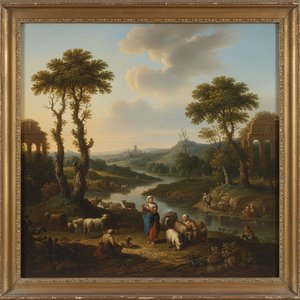
In the quiet expanse of Philips Wouwerman’s "Path through the Dunes," viewers are invited to step into a world where time seems to suspend itself within the rolling contours of the Dutch landscape. Painted during the height of the Dutch Golden Age, between approximately 1650 and 1668, this masterpiece is far more than a mere topographical record; it is an evocative window into a bygone era of tranquility. The composition centers on a winding path that meanders through sun-drenched dunes, acting as a visual guide that draws the eye deep into the heart of the scene. As one follows this trail, a solitary figure emerges—a subtle, human heartbeat within the vastness of nature—reminding us of our own small yet profound place within the grandeur of the earth.
The atmosphere of the painting is defined by a masterful interplay of light and shadow. Wouwerman, a virtuoso of the era, utilizes a dramatic sky filled with soft, drifting clouds to cast a shifting mosaic of light across the landscape. This luminosity breathes life into the textures of the dunes, where the artist’s loose, confident brushstrokes capture the tactile quality of sand, scrub, and wild vegetation. The horizon is graced by a tranquil body of water, reflecting the overcast heavens and providing a sense of infinite depth that expands the viewer's perspective far beyond the immediate foreground.
Mastery of Technique and Earthy Elegance
To behold this work is to witness the technical brilliance of one of Haarlem’s most celebrated sons. Wouwerman’s approach to the medium of oil on oak allows for a remarkable level of detail that remains grounded in a naturalistic realism. Unlike the more idealized landscapes of his contemporaries, Wouwerman embraced an earthy palette dominated by ochre yellows, deep browns, and muted greens. These tones do not merely represent the landscape; they embody its very essence, creating a harmonious visual experience that feels both organic and timeless.
The artist’s technique is particularly noteworthy in his ability to balance precision with movement. While he possesses a keen eye for the minute details of trees and shrubs, his brushwork remains fluid enough to convey the subtle dynamism of a coastal breeze. This duality creates a sense of "atmospheric perspective," where the distant horizon feels soft and ethereal, contrasting beautifully with the more textured, tangible elements of the path in the foreground. For the collector or interior designer, this painting offers a sophisticated balance of complexity and calm, making it an ideal centerpiece for spaces that require a touch of historical prestige and organic warmth.
An Invitation to Timeless Reflection
Beyond its technical merits, "Path through the Dunes" carries a profound emotional resonance. It evokes a sense of nostalgia for a simpler, more contemplative existence. The painting does not demand attention through loud colors or chaotic action; instead, it seduces the viewer through subtlety and grace. There is a certain melancholy in the solitary figure’s journey, yet it is balanced by the enduring peace of the landscape itself. It is a work that speaks to the soul, offering a sanctuary of stillness in an increasingly frenetic modern world.
For those seeking to adorn a curated collection or a refined living space, a high-quality reproduction of this Wouwerman classic serves as more than decoration. It acts as an invitation to pause, to breathe, and to wander through the dunes of history. Whether placed in a sunlit study or a grand gallery, the painting brings with it the enduring spirit of the Dutch Golden Age—a legacy of observation, emotion, and unparalleled artistic innovation.
Питання та відповіді
Для якої нагоди «Path through the Dunes» роботи Філіпс Вуерман рекомендується як подарунок?
«Path through the Dunes» роботи Філіпс Вуерман рекомендується як подарунок для Anniversary. Як презент можна обрати репродукцію цього витвору мистецтва.
Які емоції викликає "Path through the Dunes"?
«Path through the Dunes» роботи Філіпс Вуерман передає Tranquil емоційний настрій.
Яку атмосферу передає "Path through the Dunes"?
Загальний настрій «Path through the Dunes» роботи Філіпс Вуерман — Serene. Цей настрій передає загальну атмосферу твору.
Біографія митця
Philips Wouwerman: A Master of Dutch Life and Movement
Philips Wouwerman, born in Haarlem on May 24, 1619, and passing away on May 19, 1668, stands as a pivotal figure within the vibrant artistic landscape of the Dutch Golden Age. More than just a painter, he was a keen observer of human activity, a master of capturing movement and atmosphere, and a remarkably prolific artist whose works continue to captivate viewers today. His legacy rests not only on his technical skill but also on his ability to weave compelling narratives into scenes ranging from bustling hunting parties to quiet moments of rural life.
Early Influences and Artistic Training
Details surrounding Wouwerman’s early artistic training remain somewhat elusive, shrouded in the mists of history. He was the son of Pouwels Joostsz Wouwerman, a painter himself, though his father's work didn’t achieve widespread renown. While it’s believed he received some instruction from Frans Hals (1581/85–1666), Haarlem’s celebrated portraitist—Hals’ distinctive style didn’t profoundly shape Wouwerman’s mature oeuvre, the foundational training undoubtedly provided a crucial starting point. Initially, Wouwerman was deeply influenced by the *bamboccianti* tradition, a movement originating in Rome that focused on depicting scenes of everyday life – peasants playing dice, soldiers relaxing, and laborers engaged in various tasks. The works of Pieter van Laer (1592/99–after 1642), known for his lively depictions of these commoners, served as a significant model during this early phase of his artistic development.
The Emergence of a Distinct Style
As Wouwerman’s career progressed through the mid-1640s, a recognizable stylistic shift began to emerge. He moved beyond simple genre scenes and developed a characteristic compositional technique that would become instantly identifiable with his work. This involved frequently employing a diagonal slope of land – often incorporating a tree acting as a repoussoir (a device used to create depth and drama) – alongside figures, predominantly accompanied by horses. These dynamic compositions captured the essence of movement and space in a way that resonated deeply with viewers. His subjects expanded beyond everyday life, encompassing cavalry battles, military encampments, festive gatherings of peasants, and landscapes populated by travelers. This period marked a significant departure from his earlier *bamboccianti* influences, establishing Wouwerman’s own unique artistic voice.
Mastery of the Horse – A Defining Characteristic
Perhaps Wouwerman's most enduring legacy lies in his unparalleled skill in depicting horses. Art historians widely acknowledge him as “undoubtedly the most accomplished and successful 17th-century Dutch painter of horses,” a title earned through decades of dedicated observation and masterful execution. He didn’t simply paint horses; he captured their power, grace, and movement with breathtaking realism. His paintings showcase an astonishing range of breeds – from sturdy warhorses to elegant hunters – each rendered with meticulous detail and a profound understanding of equine anatomy. Frederik J. Duparc famously noted this exceptional talent, recognizing Wouwerman's ability to convey the very spirit of these magnificent animals.
A Flourishing Career and Lasting Impact
Wouwerman joined the Haarlem Guild of St. Luke in 1640, marking a significant step in his professional life. He quickly established himself as a successful painter, commanding considerable demand for his works throughout Europe. His paintings were highly sought after by wealthy collectors and princely houses alike – from Dresden to St. Petersburg, evidence of his enduring popularity remains. Beyond his artistic achievements, Wouwerman was also involved in estate management within Haarlem, reflecting the multifaceted nature of a successful artist during that era. While many works attributed to him were created by his brothers, Jan (1629–1666) and Pieter (1623–1682), often influenced by Philips’ style, they each developed their own distinct artistic identities. Wouwerman's influence extended beyond his immediate family; he inspired numerous artists who followed in his footsteps, solidifying his place as a cornerstone of the Dutch Golden Age art scene.
A Legacy Enduring Through Time
Philips Wouwerman’s contribution to the artistic heritage of the Netherlands is undeniable. His ability to capture the dynamism of life – whether it be the thrill of the hunt, the bustle of a marketplace, or the drama of a battlefield – continues to resonate with audiences today. His paintings offer a captivating glimpse into the world of 17th-century Dutch society, revealing not only artistic brilliance but also a keen understanding of human nature and the beauty of the natural world. The retrospective exhibition in Kassel and The Hague (2009/2010) served as a powerful testament to his enduring legacy, ensuring that his remarkable talent would continue to be appreciated for generations to come.

Філіпс Вуерман
1619 - 1668 , Нідерланди
Короткі факти
- Artistic Movement Or Style: Голландський Золотий вік
- Artists Or Movements Influenced By This Artist: ['Ян ван Хутченбург']
- Artists Who Influenced This Artist:
- П’єр ван Лаер
- Франс Галс
- Date Of Birth: 24 травня 1619
- Date Of Death: 19 травня 1668
- Full Name: Philips Wouwerman
- Nationality: Німецький
- Notable Artworks:
- Два коней
- Двоє вершників на ціптарнику
- Піщаний ландшафт із сигнальним стовпом
- Place Of Birth: Гаальна, Нідерланди
Пов'язані статті

Golden Light & Dutch Skies: Bringing the Magic of Dutch Golden Age Landscapes into Your Home
Transform your home with the breathtaking light of Dutch Golden Age landscapes. Discover how hand-painted oil reproductions of masterworks like Ruisdael and Vermeer bring timeless elegance, atmosphere, and soulful texture to modern interiors. Elevate your space with museum-quality art.

Mastering Light & Shadow: A Journey Through the Dutch Golden Age's Luminous Legacy
Embark on a cultural journey through the Dutch Golden Age. Explore the masterful interplay of light and shadow in 17th-century masterpieces, from Rembrandt to Vermeer, and discover how this era of profound realism continues to inspire fine art collectors today.

Golden Light & Dutch Skies: The Timeless Magic of Dutch Golden Age Landscapes
Discover the breathtaking beauty of Dutch Golden Age landscapes. Explore the mastery of light, chiaroscuro, and 17th-century realism through an expert art history lens, celebrating the enduring legacy of the Dutch Masters for discerning collectors and art lovers.
Nicolaes Berchem: Dutch Golden Age Pastoralism & the Evolution of Landscape Painting
Explore the captivating world of Nicolaes Berchem, a leading Dutch Golden Age painter. Discover his idyllic landscapes, masterful technique & lasting influence on art history. Learn more at OriginalUniqueArt.

Топ-10 шедеврів Золотої доби нідерландського мистецтва | OriginalUniqueArt.com
Відкрийте для себе 10 шедеврів Золотої доби нідерландського мистецтва! Рембрандт, Вермеєр та інші майстри. Історія створення, унікальні техніки та натхнення для вашого інтер'єру. Репродукції картин високої якості – OriginalUniqueArt.com

