Cubism
L (Хуан Ґріс)
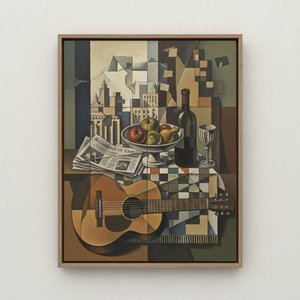
Хуан Ґріс (1887–1927) створив L. Він належить до напряму Cubism. Виконано в Oil On Canvas. Екземпляр зберігається в Biennale Internazionale dell'Antiquariato di Firenze у Флоренція, Італія.

 Переглянути в інтер'єрі

 Картина олією ручної роботи
 Надіслати як листівку
 Поділитися
 Інформаційна картка


 Завантажити
 Схожі екземпляри
 Рентгенівське дослідження
 Слайд-шоу
 Питання та відповіді

 Статистика
L коротко
- Назва
- L
- Художник
- Хуан Ґріс (1887–1927)
- Рік народження митця
- Мадрид, Іспанія
- Матеріал
- Oil On Canvas
- Де подивитися
- Biennale Internazionale dell'Antiquariato di Firenze, Флоренція, Італія
- Рух
- Cubism
- Період
- Modern
- Сюжет
- guitar, music paper, man, geometric abstraction, monochrome, picasso influence
Що зображено на L?
The Architect of Cubism: The Visionary World of Juan Gris
In the vibrant, avant-garde heart of early 20th-century Paris, a new visual language was being forged—one that dismantled the familiar to reveal a deeper, more structured truth. At the center of this revolution stood Juan Gris, a Spanish master whose analytical mind and poetic soul converged to create some of the most enduring icons of Synthetic Cubism. While contemporaries like Picasso and Braque often focused on the fragmentation of form, Gris brought a unique sense of mathematical precision and crystalline clarity to the movement. His work does not merely break objects apart; it reconstructs them into a harmonious symphony of geometric planes, where every line and shadow serves a deliberate, architectural purpose.
To encounter a piece like "Guitar & Music Paper" is to step into a world where reality is distilled into its most essential elements. The composition is a masterful dance of interlocking rectangles and cubes, creating a rhythmic interplay that guides the eye across the canvas. Gris utilized a sophisticated technique of layering textures and subtle gradations, allowing light to play across the surface as if through a prism. His palette, often characterized by earthy, muted tones, avoids the distraction of bright colors to focus instead on the profound relationship between shape and space. This deliberate restraint creates an atmosphere of contemplative stillness, inviting the viewer to linger within the complexity of the design.
A Symphony of Form and Symbolism
Beyond the technical brilliance lies a deep, symbolic resonance that continues to captivate collectors and decorators alike. The recurring motifs in Gris’s oeuvre—the guitar, the musical score, the newspaper—are not merely objects of study but symbols of the modern era's sensory richness. In "Guitar & Music Paper," the fusion of the instrument with the sheet music suggests a blurring of boundaries between the physical and the ephemeral, between sound and sight. The way the geometric shapes overlap creates an illusion of depth that feels both modern and timeless, making such works incredibly versatile for contemporary interior design.
For the discerning art lover or interior designer, a high-quality reproduction of a Juan Gris masterpiece offers more than just decoration; it provides a focal point of intellectual and aesthetic sophistication. The structured nature of his Cubist compositions lends itself beautifully to modern, minimalist, or mid-century modern environments, where the artwork can act as an anchor of stability and elegance. The emotional impact of his work is one of profound balance—a sense that even in a fragmented world, there is an underlying order and beauty waiting to be discovered. Owning a piece inspired by Gris is an invitation to celebrate the intersection of logic and lyricism, bringing a touch of Parisian avant-garde history into the sanctuary of the home.
У якому музеї зберігається L?
Biennale Internazionale dell'Antiquariato di Firenze
Флоренція, Італія
Переосмислений флорентійський Ренесанс: занурення у світ BIAF Флоренція дихає мистецтвом; це не просто місто, яке *має* мистецтво, а місто, що саме *є* мистецтвом, вплетеним у кожен його камінь і відгуком лунаючим у палацо. В цій атмосфері невмирущої краси живе Міжнародна бієнале антикваріату у Флоренції (BIAло), подія, що виходить за межі звичайної антикварної ярмарку, перетворюючись на кураторське паломництво до самого серця італійського майстерства. Проводячись у величних палацо Corsini, що саме по собі є шедевром бароко, BIAF пропонує не просто перегляд експонатів, а справжнє занурення — шанс доторкнутися до століть ремесла та багатого культурного спадщини Італії.


Зображення високої роздільної здатності L

Суспільне надбання: художник помер у 1927 році.
Інші розміри, кадри та цитування →Хуан Ґріс, L, Biennale Internazionale dell'Antiquariato di Firenze. Суспільне надбання
Відповіді на запитання про L
У якому музеї зберігається оригінал «L»?
«L» роботи Хуан Ґріс експонується в Biennale Internazionale dell'Antiquariato di Firenze, Флоренція, Італія. У описі музею йдеться про оригінальний твір, а не про репродукції.
Яка техніка використана у творі "L"?
Які сюжети зображені у «L» роботи Хуан Ґріс?
Чи є «L» роботи Хуан Ґріс суспільним надбанням?
Щодо авторського права, «L» є є суспільним надбанням — термін дії авторського права закінчився.
До якого художнього напряму належить «L» роботи Хуан Ґріс?
До якого періоду творчості Хуан Ґріс належить твір "L"?
Чому статус авторського права на "L" саме такий?
Про художника Хуан Ґріс

1887–1927, Іспанія
Хуан Ґріс
Early Life, Family and Training Born José Victoriano González-Pérez on March 23, 1887, in Madrid, Spain, the man who would become known as Juan Gris grew up in a large, busy household. He was the thirteenth of fourteen children. His father, Gregorio Gonzalez, was a prosperous businessman, and the family environment provided a stable foundation during his formative years in the Spanish capital. His early education took a technical turn at the Madrid School of Arts and Sciences, where he studied engineering.
Також за участю Хуан Ґріс
 Портрет мадам Жозе́тт Гріс1916
 Гірлянди з персиків та виноградин на столі1913
 Світловий вікно1915
 Сніданок1915

Есе до твору L
 Spontaneity and Matter: Distinguishing CoBrA from Art InformelMaster the differences between CoBrA and Art Informel with our expert guide. Learn to identify these post-war movements today.
 Juan Gris: Cubist Deconstruction & Synthesis – A Comprehensive ExplorationExplore the revolutionary art of Juan Gris – a master of Cubism. Discover his unique approach to deconstruction, vibrant Synthetic Cubist w…
 Understanding the Difference Between Analytical and Synthetic CubismMaster the differences between Analytical and Synthetic Cubism with our expert guide. Learn to identify these iconic art movements now.