Олія на полотні
 Все про Thomas Witter







































 Для творів мистецтва або репродукцій, розмір яких перевищує 105 см (приблизно 41 дюйм) з будь-якого боку, рама доставляється у вигляді розібраного комплекту. Такий метод гарантує безпечну доставку та запобігає пошкодженням під час транспортування.


Identification of the Portrait of Thomas Witter
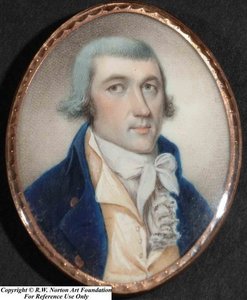
The gaze of Thomas Witter meets the viewer through this intimate watercolor portrait, a work that captures a quiet moment of reflection. Painted by John Ramage in 1786, the piece presents a man caught in a state of contemplation. He appears as a gentleman of his era, his presence rendered with a delicate touch that suggests a life of dignity and perhaps a touch of melancholy. The portrait focuses closely on his head and shoulders, creating a sense of immediate, personal encounter.
This small-scale watercolor painting offers a glimpse into the character of the subject. Ramage, an artist known for his ability to capture individual presence, uses the medium to define the contours of Witter's face and the subtle textures of his attire. The man's white hair and prominent mustache are rendered with precision, framing a face that seems to hold a silent story. Every line and shade works to preserve the likeness of Thomas Witter, ensuring his image remains present and palpable.
Composition and Visual Elements
The portrait centers on the head and shoulders of the subject, all contained within the gentle curves of an oval frame. He gazes downward, his eyes cast toward something unseen, wearing an expression of quiet melancholy or deep contemplation. His white hair is styled with neat precision, and a prominent mustache defines his face. He wears a formal suit, the details of which are anchored by a tie or cravat wrapped carefully around his neck.
A grayscale palette governs the entire scene, moving through a full range of tones from the deepest blacks to the brightest whites. This monochromatic approach creates a sense of stillness. Soft, diffused lighting washes over the man, illuminating his features evenly and avoiding any harsh or jarring shadows. The light settles upon his face, revealing the subtle contours of his features and the texture of his clothing without disrupting the calm atmosphere of the moment.
Technique and Artistic Materials
The artist works within a delicate 4 x 4 cm space, utilizing watercolor on paper to build a quiet, grayscale world. Through the careful layering of gray paint washes, a sense of volume emerges from the flat surface. These tonal variations create a soft, diffused light that settles across the subject, building depth through subtle shifts in shadow rather than harsh lines. The monochromatic palette relies entirely on these gradations to define the form of the man's face and the structure of his attire.
Fine, deliberate lines define the character of the portrait. The artist uses precise strokes to render the details of the mustache and the subtle wrinkles of the skin, capturing a sense of lived experience. These same linear techniques extend to the clothing, where lines trace the heavy folds of the fabric. A tactile contrast exists between the different surfaces; the skin appears smooth under the light, while the texture of the clothing feels slightly more rugged and coarse.
Питання та відповіді
Thomas Witter — це ручна робота чи принт?
Написано вручну: професійний художник відтворює Thomas Witter олією на лляному полотні.
Який розмір мені обрати для Thomas Witter?
Розмір оригіналу — 4 x 4 cm. Розміри варіюються від 32.5 x 30.7 cm (₴9109) до 246.6 x 232.8 cm (₴94327); у таблиці на цій сторінці наведено доступні варіанти та їхню вартість.
Скільки триває доставка?
Доставка займає від 4 до 5 тижнів із безкоштовною експрес-доставкою по всьому світу; на цій сторінці також доступна опція термінового виготовлення. Ви можете повернути товар протягом 100 днів і отримати повне відшкодування без жодних додаткових умов.
Де знаходиться оригінал Thomas Witter?
Оригінал зберігається в колекції Метрополітен-музей, Нью-Йорк.
Яку техніку використав(ла) Джон Рамедж для створення Thomas Witter?
Watercolor
 Переглянути в інтер'єрі

 Надіслати як листівку
 Поділитися
 Деталі витвору
 Інформаційна картка


 Завантажити
 Схожі екземпляри
 Рентгенівське дослідження
 Слайд-шоу
 Питання та відповіді

 Статистика