Переглянути в інтер'єрі
 Надіслати
 Поділитися
 Деталі
 Посібник

 Завантажити
 Схожі предмети колекціонування
 Рентгенівське дослідження
 Слайд-шоу
 Статистика переглядів
Poachers in the Snow
 Олія на полотні
- Настінне мистецтво
- Realism
 1867
1867- — XIX століття
 65.0 x 81.0 cm
 Musée des Beaux-Arts
 Читати далі
Олійная репродукція ручної роботи
Написана вручну олією на полотні у вашому розмірі та рамі, виготовлена на замовлення нашими художниками. ( Перейти до друку Перейти до цифрових зображень)




P118B $10

P118H $10

P118W $10

P438Z $10

P508JH $12

P508YH $12

P805H $10

P805Z $10

P919BZ $10

P919G $10

P919XJ $10

P959ZH $10

P968JZ $12

W106C $8

W218G $10

W218JH $8

W218Y $10

W307PJ $10

W316G $10

W316PJ $8

W316Y $10

W398PJ $8

W4111J $10

W500HY $15

W500JH $15

W692G $12

W849H $8

W940BG $15

W953PJ $8




Обирайте з наших стандартних розмірів, що відповідають оригінальним пропорціям твору мистецтва.

Ви можете вказати власні розміри, щоб репродукція ідеально підійшла до конкретної рами або інтер'єру. Якщо вибраний вами розмір не відповідає пропорціям оригіналу, ми або обріжемо полотно, або доповнимо картину додатковими елементами, промальованими вручну. Цифровий макет буде надіслано вам на затвердження перед початком виробництва.
Зверніть увагу, що попередній перегляд на екрані не відображає фактичне обрізання або розширення зображення. Тільки макет точно покаже остаточну композицію.
Хоча ми можемо виготовити виріб у нестандартному розмірі, для збереження оригінальних пропорцій рекомендуємо обирати варіанти зі встановленого списку.
Після оформлення замовлення команда OriginalUniqueArt.com зв'яжеться з клієнтом електронною поштою для отримання інструкцій та надасть попередній макет
Доставка по всьому світу () за 3–4 тижні замість стандартних 5 тижнів. (26 Вересень). Без жодних компромісів у якості.

Безкоштовна експрес-доставка по всьому світу

Високоякісне лляне полотно

Повне страхове покриття доставки

Гарантія повернення митних зборів

Гарантія точного відтворення кольорів

Політика повернення протягом 100 днів (лише у разі виявлення дефектів)

Гарантія повернення 100% коштів

Знижка на оптові замовлення
 Скляний варіант доступний лише для розмірів до 110 см

Poachers in the Snow
Техніка репродукції
Розмір репродукції
-


Загальна вартість
$ 300
A Stark Winter Tableau: Gustave Courbet’s “Poachers in the Snow”
Gustave Courbet's "Poachers in the Snow," painted in 1867, isn’t merely a depiction of a winter scene; it’s a profound statement about humanity’s relationship with nature and the realities of rural life. This oil-on-canvas masterpiece, now housed within the Musée des Beaux-Arts et d’archéologie de Besançon, France, stands as a cornerstone of the Realist movement, demanding viewers confront the often uncomfortable truths of everyday existence without romantic glossing. Measuring 65 x 81 cm, the painting immediately draws the eye with its muted palette – predominantly whites and browns – mirroring the harshness and unforgiving beauty of a snow-laden landscape. Yet, within this seemingly simple composition lies a complex narrative woven through careful observation and deliberate artistic choices. The scene unfolds with two figures, clad in heavy coats and hats, trudging purposefully through the deep snow. Their postures suggest both weariness and determination, hinting at the difficult labor involved in their pursuit. The man on the left, leading a dog, embodies a cautious approach, while his companion, wielding a stick, exudes a more assertive energy – a clear indication of the illicit activity taking place. Courbet masterfully utilizes light and shadow to create a sense of depth and atmosphere, emphasizing the cold, biting wind that whips across the snow-covered ground. The dogs themselves are integral to the composition, not merely accessories but active participants in this stark drama, their presence adding a layer of companionship amidst the isolation of the scene. The background landscape—a blurred expanse of trees and distant hills—further reinforces the sense of vastness and solitude, underscoring the vulnerability of these figures against the raw power of nature. Courbet’s commitment to Realism is evident in every brushstroke. He eschewed idealized forms and vibrant colors, opting instead for a direct, unvarnished portrayal of reality. The loose application of paint, characteristic of his style, lends a sense of immediacy and spontaneity to the scene, as if captured in a fleeting moment. This deliberate rejection of academic conventions was revolutionary at the time, challenging the prevailing artistic norms that prioritized beauty and grandeur over truth and authenticity. The painting’s subject matter—poaching—was itself controversial, reflecting the social tensions and economic hardships prevalent in rural France during the 19th century. Courbet's choice to depict this illicit activity head-on was a bold statement about his commitment to portraying the lives of ordinary people, regardless of their moral standing. Beyond its immediate subject matter, “Poachers in the Snow” carries significant symbolic weight. The winter landscape can be interpreted as a metaphor for the harsh realities of life—the struggle for survival, the isolation of rural existence, and the conflict between humanity and nature. The figures themselves represent the complexities of human behavior – ambition, desperation, and perhaps even a degree of moral ambiguity. Courbet doesn’t offer judgment; he simply presents the scene as it is, inviting viewers to contemplate its implications. The painting's enduring power lies in its ability to evoke a sense of both melancholy and resilience, reminding us of our shared humanity and our connection to the natural world. It’s a testament to Courbet’s genius that this seemingly straightforward depiction continues to resonate with audiences today, prompting reflection on timeless themes of survival, morality, and the human condition.The Artist's Context: Gustave Courbet and the Rise of Realism
To fully appreciate “Poachers in the Snow,” it’s essential to understand the broader context within which Gustave Courbet was working – the rise of Realism in 19th-century France. Born in Ornans, France, in 1819, Courbet initially trained at the École des Beaux-Arts in Paris, but quickly grew disillusioned with the rigid conventions and idealized subjects favored by the Academy. He rejected the romanticism and historical narratives that dominated the Salon system, instead seeking to depict the world as he saw it – truthfully and without embellishment. Courbet’s artistic development was profoundly influenced by artists like Eugène Delacroix and Théodore Géricault, but he ultimately distanced himself from their Romantic ideals, prioritizing direct observation and a commitment to portraying everyday life. His early works explored landscapes and portraits, gradually shifting towards scenes of rural labor and the lives of working-class individuals. This shift was driven by a desire to break free from the constraints of academic art and to create paintings that reflected the realities of contemporary society. Courbet’s decision to paint subjects considered “unworthy” of artistic attention—such as peasants, laborers, and even criminals—was a deliberate act of rebellion against the established order. The painting "Poachers in the Snow" exemplifies this commitment to Realism. It's not a heroic depiction of hunters; it’s a stark portrayal of individuals engaged in an illegal activity, stripped of any romantic or idealized qualities. Courbet’s focus on detail—the texture of the snow, the weariness of the figures’ faces, the ruggedness of the landscape—creates a powerful sense of immediacy and authenticity. His rejection of traditional artistic techniques—such as smooth brushstrokes and carefully composed backgrounds—further emphasizes his commitment to portraying reality in its rawest form. Courbet's work was often met with criticism and controversy during his lifetime. Many critics dismissed his paintings as crude, vulgar, or lacking in aesthetic merit. However, he remained steadfast in his artistic vision, continuing to produce works that challenged the conventions of the art world and paved the way for future generations of artists. His influence on modern art is undeniable, establishing Realism as a dominant movement and inspiring countless artists to embrace direct observation and social commentary in their work.Technical Details & Artistic Techniques
The execution of “Poachers in the Snow” reveals Courbet’s mastery of oil painting techniques and his meticulous attention to detail. The canvas measures 65 x 81 cm, providing ample space for the artist to capture the vastness of the winter landscape and the physicality of the figures. Courbet employed a technique known as *alla prima*, meaning “at first sight,” which involved completing the painting in a single session without extensive underpainting or sketching. This approach resulted in a sense of spontaneity and immediacy, capturing the fleeting effects of light and shadow with remarkable precision. The color palette is deliberately muted—dominated by shades of white, brown, and gray—to evoke the cold, bleak atmosphere of the winter scene. Courbet skillfully used *chiaroscuro*, the contrast between light and dark, to create a sense of depth and volume, emphasizing the figures’ forms and the texture of the snow-covered ground. The brushstrokes are loose and expressive, contributing to the painting's overall sense of realism and immediacy. Courbet’s technique is characterized by a directness and honesty that reflects his commitment to portraying reality without idealization or embellishment. The composition itself is carefully constructed, with the two figures positioned diagonally across the canvas to create a dynamic and engaging visual arrangement. The use of perspective—particularly in the depiction of the distant hills—adds depth and realism to the scene. Courbet’s attention to detail extends beyond the main subjects to include subtle elements such as the texture of the snow, the folds of the figures’ clothing, and the reflections of light on the ground. These small details contribute significantly to the painting's overall sense of authenticity and immediacy. The artist’s ability to capture these nuances demonstrates his exceptional skill and his unwavering commitment to portraying reality with remarkable accuracy.A Legacy of Realism: Courbet and Beyond
“Poachers in the Snow” stands as a pivotal work in Gustave Courbet’s oeuvre and a defining example of the Realist movement. Its impact extended far beyond its immediate context, influencing generations of artists who followed. Courbet's rejection of academic conventions and his commitment to portraying everyday life without romanticization paved the way for future movements such as Impressionism and Social Realism. Artists like Jean-François Millet, Édouard Manet, and Honoré Daumier were deeply influenced by Courbet’s work, adopting his techniques and exploring similar themes of rural labor and social injustice. Manet's "Le Déjeuner sur l'herbe" (1863), for example, challenged traditional notions of beauty and morality, mirroring Courbet’s own rebellious spirit. Furthermore, Courbet’s legacy extends beyond the realm of painting. His commitment to depicting reality in its rawest form influenced other art forms, including photography and sculpture. The rise of Realism as a dominant movement in 19th-century France marked a significant shift in the history of art, challenging established conventions and opening up new possibilities for artistic expression. For those interested in exploring more of Courbet’s works or delving deeper into the world of Realist art, we recommend visiting the Musée des Beaux-Arts et d’archéologie de Besançon, France, where “Poachers in the Snow” is proudly displayed. Additionally, examining the work of Eugène-Louis Decisy, another prominent figure in the Realist movement, offers a valuable perspective on the diverse range of artistic approaches within this influential movement.Біографія митця
Gustave Courbet (1819-1877): Pioneer of Realism
Jean Désiré Gustave Courbet, born in Orléans, France, on June 10, 1819, stands as a monumental figure in the history of art – a rebel who irrevocably altered the course of nineteenth-century painting. His artistic journey transcends mere pigment and canvas; it’s a chronicle steeped in social critique, unwavering conviction, and an uncompromising dedication to portraying reality exactly as he perceived it: unvarnished, visceral, and profoundly truthful. Growing up within a relatively prosperous bourgeois household, Courbet benefited from his mother's encouragement to pursue his artistic inclinations – a nurturing that would propel him toward a revolution within the art world itself. His formal education commenced at the École des Beaux-Arts in Paris in 1839, yet he swiftly recognized the stifling limitations imposed by academic conventions and Romantic idealism. While acknowledging influences from Eugène Delacroix and Théodore Géricault – artists who wrestled with grand narratives of heroism and emotion – Courbet forged his own path, prioritizing observation over imagination and veracity above tradition.The Birth of Realism: Challenging Artistic Conventions
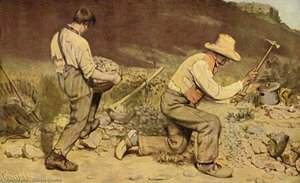
Courbet’s artistic trajectory was defined by a deliberate repudiation of prevailing aesthetic standards. He eschewed mythological tales or heroic allegories; his gaze remained fixed on the everyday lives of ordinary individuals – particularly those engaged in labor and rural existence. This commitment to depicting the world without embellishment—what would soon become known as Realism—encountered initial scorn from critics accustomed to more polished, idealized representations. Early canvases explored landscapes and portraits, but swiftly pivoted toward scenes of working-class life, rendered on a monumental scale traditionally reserved for historical or religious paintings. This purposeful choice wasn’t merely stylistic; it was an assertion about the inherent dignity and importance of subjects often overlooked by artistic discourse. The Stone Breakers (completed in 1849), tragically destroyed during World War II, exemplifies this approach—a stark portrayal of two laborers toiling away under oppressive conditions, their faces obscured by exhaustion and despair. Critics deemed it vulgar and lacking in aesthetic merit, reflecting the prevailing prejudices of the time. Yet, Courbet steadfastly defended his artistic vision, arguing that art should reflect the realities of human experience.Influences and Artistic Development
Courbet’s formative years were marked by exposure to influential artists like Eugène Delacroix and Théodore Géricault—artists who grappled with grand narratives of heroism and emotion. However, Courbet deliberately distanced himself from Romantic idealism, prioritizing observation over imagination and truth over convention. He recognized the legacy of Caravaggio – particularly his masterful use of chiaroscuro (light and shadow) – as a source of inspiration for dramatic realism. This influence is palpable in his later works, where he skillfully manipulated light to heighten emotional impact and convey psychological depth. His artistic development progressed through meticulous study and experimentation, culminating in a distinctive technique characterized by thick impasto—applying paint thickly onto the canvas—that emphasized the materiality of the medium itself.Major Works and Artistic Philosophy
Courbet’s oeuvre encompasses a remarkable range of subjects – landscapes, portraits, still lifes, and genre scenes depicting everyday life. Among his most celebrated paintings are A Burial at Ornans (1850-51), a monumental canvas portraying a provincial funeral that provoked considerable controversy upon its exhibition. Its sheer scale—typically reserved for historical canvases—combined with its unflinching realism and absence of sentimental embellishment shocked audiences accustomed to idealized depictions of piety and nobility. Courbet’s artistic philosophy extended beyond subject matter; he championed the notion that art should serve as a conduit for social commentary, mirroring the realities of human existence without resorting to moralizing pronouncements. He famously declared, “I paint what I see.” This uncompromising stance resonated deeply with fellow artists who sought to challenge established norms and explore new avenues of artistic expression.Legacy and Historical Significance
Gustave Courbet’s impact on subsequent art movements is undeniable. While he acknowledged influences from earlier masters like Caravaggio for their dramatic realism and masterful use of light, his contribution transcended mere imitation. He fundamentally reshaped the landscape of nineteenth-century painting by liberating artists from the constraints of Romantic idealism—encouraging them to embrace observation and strive for truthful representation. His unwavering advocacy for artistic freedom cemented his position as a champion of revolutionary ideas during a period marked by social upheaval. Courbet’s participation in the Salon des Refusés in 1863 – an exhibition showcasing artworks rejected by the official Salon – symbolized defiance against academic dogma and reaffirmed his commitment to artistic integrity. He died peacefully in Paris on December 31, 1877, leaving behind a legacy that continues to inspire artists and scholars alike—a testament to the transformative power of art to confront societal injustices and elevate human experience. His enduring influence can be seen in movements like Impressionism and Post-Impressionism, where artists sought to capture fleeting moments of sensory perception and express subjective emotion with unprecedented boldness.
Гюстав Курбе
1819 - 1877 , Франція
Довідкова інформація
- Artistic Movement Or Style: Реалізм
- Artists Or Movements Influenced By This Artist:
- Імпресіонізм
- Пост-імпресіонізм
- Artists Who Influenced This Artist:
- Ежен Делакруа
- Теодор Жерико
- Караваджо
- Date Of Birth: 10 червня 1819
- Date Of Death: 31 грудня 1877
- Full Name: Gustave Courbet
- Nationality: Француз
- Notable Artworks:
- «Заливна брама в Оптевозі»
- Гра зі шахівницями
- Жінка в білих панчохах
- Place Of Birth: Орланс, Франція
Схожі статті

Evocations of Place: A Historical Journey Through Landscape Art
Explore the rich history of landscape art with OriginalUniqueArt. Discover renowned artists, movements like Impressionism & Romanticism, and expert guidance for collecting timeless pieces. Find your perfect serene escape today!

Топ-10 шедеврів романтичного пейзажу: мистецтво, що захоплює дух | OriginalUniqueArt
Відкрийте для себе 10 шедеврів романтичного пейзажу! Каспар Давид Фрідріх, Тернер та інші майстри. Історія мистецтва, емоційні кольори природи та ідеї декору з OriginalUniqueArt.com. Дослідіть колекцію онлайн!

Romantic Realism's Finest: 10 Masterpieces for Your Home | OriginalUniqueArt
Explore 10 defining masterpieces of Romantic Realism! Discover Courbet, Millet & Daumier's powerful paintings—capturing emotion and social realities. Find museum-quality reproductions for your home at OriginalUniqueArt.com.
Топ-10 шедеврів реалізму: картини, що змінили мистецтво | OriginalUniqueArt.com
Відкрийте для себе 10 шедеврів реалізму від Курбе, Мілле та інших видатних художників! Історія створення, унікальна техніка та вплив на мистецтво. Репродукції картин преміум-класу для вашого дому – OriginalUniqueArt.com
Топ-10 знаменитих картин у сніжних тонах: мистецтво та декор для вашого дому
Пориньте у світ снігових пейзажів! Топ-10 знаменитих картин зими від Моне, Фрідріха та інших майстрів. Історія мистецтва, техніки живопису та ідеї декору для вашого дому на OriginalUniqueArt.com. Відкрийте всю колекцію онлайн!