Переглянути в інтер'єрі
 Надіслати як листівку
 Поділитися
 Деталі витвору
 Посібник

 Завантажити
 Схожі екземпляри
 Рентгенівське дослідження
 Слайд-шоу
 Питання та відповіді
 Статистика
The Three Ages


 Розгорнути текст
Гікле / Художній принт
Друк جيкле або на полотні музейної якості з оперативним виготовленням та різноманітними варіантами фінішної обробки. ( Замовити картину ручної роботи Перейти до цифрових зображень)




P118B ₴10

P118H ₴10

P118W ₴10

P438Z ₴10

P508JH ₴12

P508YH ₴12

P805H ₴10

P805Z ₴10

P919BZ ₴10

P919G ₴10

P919XJ ₴10

P959ZH ₴10

P968JZ ₴12

W106C ₴8

W218G ₴10

W218JH ₴8

W218Y ₴10

W307PJ ₴10

W316G ₴10

W316PJ ₴8

W316Y ₴10

W398PJ ₴8

W4111J ₴10

W500HY ₴15

W500JH ₴15

W692G ₴12

W849H ₴8

W940BG ₴15

W953PJ ₴8




Обирайте з наших стандартних розмірів, що відповідають оригінальним пропорціям твору мистецтва.

Введіть необхідну ширину та висоту, щоб принт ідеально підійшов до вашої рами або стіни. Принт можна лише обрізати, але не можна зробити більшим за оригінал, тому при зміні пропорцій частина зображення буде втрачена. Перед друком ми надсилаємо вам цифровий макет для затвердження. Зображення на цій сторінці не відображає реальну обрізку — її можна побачити лише на макеті.
Доставка по всьому світу () за 2 тижні замість стандартних 4/5 тижнів. (5 Листопад)

Безкоштовна експрес-доставка по всьому світу

Високоякісне лляне полотно

Повне страхове покриття доставки

Гарантія повернення митних зборів

Гарантія точного відтворення кольорів

Політика повернення протягом 100 днів (лише у разі виявлення дефектів)

Гарантія повернення 100% коштів

Пропозиція на оптові замовлення
 Скляний варіант доступний лише для розмірів до 110 см

The Three Ages
Гікле / Художній принт
Розмір репродукції
-


Підсумкова вартість
₴ 3644
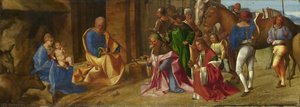
A Renaissance Dialogue: Unveiling Giorgione’s “The Three Ages”
“The Three Ages”, attributed to the enigmatic Venetian master Giorgione (Giorgio Barbarelli da Castelfranco, 1477/78-1510), is a captivating portrait that transcends mere representation, inviting viewers into a world of philosophical contemplation and quiet human connection. Though its precise dating remains debated due to the limited number of definitively attributed works by this artist, it stands as a testament to Giorgione’s innovative approach to Renaissance painting.Subject & Composition: A Study in Human Interaction
The artwork depicts three men engaged in earnest conversation – representing, as the title suggests, youth, maturity, and old age. The composition is skillfully arranged in a triangular form, anchored by the central figure’s head and extending outwards to his companions. This arrangement lends stability and harmony to the scene while subtly directing the viewer's gaze. Each man possesses distinct features that hint at their respective stages of life: the youthful face brimming with potential, the mature countenance reflecting experience, and the aged visage bearing the marks of wisdom and time.Style & Technique: Venetian Lyricalism
“The Three Ages” exemplifies Giorgione’s distinctive style – a hallmark of the emerging Venetian school. Unlike the Florentine emphasis on linear precision, Giorgione prioritized color, atmosphere, and poetic mood. The painting is executed with meticulous brushwork and layered glazes, creating a luminous quality that brings the figures to life. Soft, curved lines contribute to their gentle expressions, while naturalistic shapes accurately depict the human form. Noticeable is the artist’s mastery of texture – from the flowing hair and delicate skin tones to the rich fabrics of their clothing. The dramatic lighting, originating from an unseen source, casts strong shadows that enhance depth and volume.Historical Context: A Bridge Between Eras
Giorgione lived during a pivotal moment in art history—the High Renaissance. He, alongside Titian, laid the foundations for the Venetian painting style, which would profoundly influence generations of artists. His brief career was marked by innovation and a departure from traditional artistic conventions. The early 16th century saw a growing interest in humanism and philosophical inquiry, themes subtly reflected in this artwork. Giorgione’s paintings were not merely decorative; they aimed to evoke emotion and stimulate intellectual curiosity.Symbolism & Interpretation: Wisdom Through the Ages
The symbolism within “The Three Ages” is open to interpretation, adding to its enduring mystique. The three figures can be seen as representing the stages of life – youth’s idealism, maturity’s pragmatism, and old age’s wisdom. Their conversation suggests a transmission of knowledge and experience across generations. Some scholars propose allegorical readings, linking the figures to specific philosophical schools or virtues. Regardless of the precise interpretation, the painting speaks to universal themes of time, mortality, and the pursuit of understanding.Emotional Impact & Aesthetic Appeal
“The Three Ages” evokes a sense of quiet contemplation and intellectual curiosity. The warm color palette and soft lighting create an atmosphere of intimacy and solemnity. The figures’ expressions are nuanced and engaging, inviting viewers to connect with their humanity. This artwork is not merely visually appealing; it resonates on an emotional level, prompting reflection on the human condition. Its timeless quality makes it a compelling addition to any art collection or interior space, offering both aesthetic beauty and intellectual stimulation. It's a piece that invites prolonged viewing and repeated discovery.Питання та відповіді
Який емоційний тон притаманний стилю High Renaissance у творі "The Three Ages"?
У межах течії High Renaissance, «The Three Ages» передано в Меланхолійний тональності.
Які емоції викликає "The Three Ages"?
«The Three Ages» асоціюється з Меланхолійний настроєм. Емоційний тон передає враження, яке справляє цей твір.
Яка насиченість кольорів у творі «The Three Ages» роботи Джорджоне?
«The Three Ages» роботи Джорджоне вирізняється Монохромний насиченістю кольорів.
Біографія митця
Giorgione (1477/8-1510): Venetian Enigma
Giorgio Barbarelli da Castelfranco, known to the world as Giorgione, remains one of the most elusive and captivating figures in Renaissance art. Born in the small town of Castel Franco Veneto near Venice around 1477 or 1478 – the exact year is debated – his tragically short life, ending around 1510 at the age of thirty-two or thirty-three, belies an artistic impact that continues to resonate centuries later. Unlike many of his contemporaries whose lives are well documented, Giorgione’s story is shrouded in mystery, pieced together from scant historical records and the often romanticized accounts of Giorgio Vasari. What we do know suggests a man deeply immersed in the vibrant culture of Venice, a city that fostered both artistic innovation and a sensual appreciation for beauty. He likely apprenticed under Giovanni Bellini, a leading Venetian painter, absorbing the established traditions before forging his own unique path. Early commissions included portraits of prominent figures like Doge Agostino Barbarigo, demonstrating an immediate talent for capturing likeness and status. However, it was in his departure from conventional subject matter and his revolutionary approach to painting that Giorgione truly distinguished himself.Early Life and Artistic Training
Giorgio Barbarelli’s origins are relatively obscure. He hailed from Castelfranco Veneto, a prosperous town known for its textile industry and burgeoning artistic patronage. Little is definitively known about his family life or formative years; Vasari's account paints him as a quiet, unassuming man who possessed an innate talent for drawing and painting from a young age. Crucially, he received instruction under Giovanni Bellini, arguably Venice’s most influential painter of the early Renaissance. Bellini’s workshop served as a crucible for artistic innovation, fostering experimentation with color and technique – qualities that would become hallmarks of Giorgione's distinctive style. This apprenticeship instilled in Giorgione a profound understanding of Venetian painting traditions while simultaneously encouraging him to develop his own independent vision.A Revolutionary Style: Color and Atmosphere
Giorgione’s artistic style marked a significant break from the Florentine preoccupation with linear perspective and meticulous draftsmanship. He championed color, atmosphere, and an evocative moodiness that became foundational to the Venetian school. His technique involved softening outlines, employing subtle gradations of tone – *sfumato* – to create atmospheric effects, and prioritizing overall harmony over detailed representation. This wasn’t merely a technical decision; it reflected a fundamentally different artistic sensibility. Giorgione sought not to replicate reality but to capture its essence, its fleeting emotions, and its poetic resonance. Consider The Tempest (c. 1506-1508). The painting depicts a soldier and his companion contemplating a stormy landscape, bathed in diffused light. There’s no sharp delineation of forms; instead, Giorgione utilizes *sfumato* to blend colors seamlessly, creating an ethereal haze that conveys the drama of the scene without resorting to precise anatomical detail. This approach was revolutionary for its time, prioritizing emotional impact over visual accuracy—a hallmark of Venetian art and a departure from Florentine ideals.Notable Works: Visions of Beauty and Mystery
Giorgione’s oeuvre is remarkably small compared to his contemporaries, yet each painting possesses an unparalleled power to captivate the viewer. Pastoral Concert (Fête champêtre), completed shortly before his death, exemplifies this artistic ethos perfectly. The scene depicts musicians gathered in a tranquil meadow, bathed in golden sunlight. Giorgione eschews narrative complexity, focusing instead on capturing the beauty of the landscape and the serenity of human interaction. The colors are rich and luminous, conveying a sense of idyllic harmony—a testament to Giorgione’s mastery of color symbolism and atmospheric perspective. Other significant works include Sleeping Venus (c. 1509-1510), which portrays the goddess reclining peacefully amidst flowers, embodying Venetian ideals of feminine beauty and sensual grace; and Judith (c. 1504), a dramatic depiction of biblical heroism characterized by its expressive use of color and gesture.Influence and Legacy
Giorgione’s artistic innovations profoundly impacted subsequent generations of Venetian painters. He served as a mentor to Titian, who would become one of the most celebrated artists of the High Renaissance, inheriting Giorgione's stylistic principles and furthering his exploration of color and atmosphere. Giorgione’s legacy extends beyond technique; he instilled in Venetian painting a spirit of poetic contemplation—a willingness to prioritize feeling over form and to capture the elusive beauty of human experience. His influence can be seen throughout the Venetian school, shaping the artistic sensibilities of artists like Tintoretto and Veronese. Giorgione remains an artist whose work continues to inspire awe and admiration, cementing his place as a pivotal figure in Renaissance art history—a testament to the enduring power of vision and innovation.Key Works Revisited
- The Tempest (c. 1506-1508)
- Pastoral Concert (Fête champêtre) (c. 1509)
- Sleeping Venus (c. 1509-1510)
- Judith (c. 1504)

Джорджоне
1477 - 1510 , Італія
Короткі факти
- Artistic Movement Or Style: Високий Ренесанс, Венеціанська школа
- Artists Or Movements Influenced By This Artist: ['Тітіан']
- Artists Who Influenced This Artist:
- Джованні Белліні
- Мантенья
- Date Of Birth: 1477/78 або 1473/74
- Date Of Death: 1510
- Full Name: Giorgio Barbarelli da Castelfranco
- Nationality: Італійський
- Notable Artworks:
- Темпест
- Пасторальна концертна
- Сплющена Венера
- Place Of Birth: Кастельфранко Венеція, Італія
Пов'язані статті

The Golden Light of Innovation: Exploring the Venetian Renaissance Art Movement (1430–1580)
Explore the Golden Age of Venetian art (1430–1580). Discover Giorgione, Titian & Tintoretto's techniques, the 'colorito' revolution, and lasting influence. Expert insights for collectors & enthusiasts.

Venetian Renaissance: The Golden Age of Color, Light, and Luminous Artistry
Embark on a journey through the Venetian Renaissance. Discover how masters like Giorgione and Titian revolutionized art through luminous color and light. Explore the profound legacy of the Venetian School and its enduring influence on the world of fine art.

Giorgione: Enigma and Innovation in Early Venetian Renaissance Painting
Explore the enigmatic world of Giorgione, a pivotal figure in the Venetian Renaissance. Discover his innovative techniques, iconic paintings like 'The Tempest', and lasting influence on art history. Learn more at OriginalUniqueArt.

Venetian Renaissance: The Mastery of Color, Light, and the Art of Colorito
Explore the luminous mastery of the Venetian Renaissance. Discover how masters like Titian and Giorgione revolutionized art through colorito, light, and atmosphere. An expert guide to the golden age of Italian painting for collectors and enthusiasts.

Oil on Panel: The Ultimate Guide to Bold, High-Impact Texture & Depth
Master the art of impact with our expert guide to oil on panel. Discover how impasto textures and heavy-body pigments create 3D depth and bold visual energy for modern interiors. Elevate your space with high-impact, hand-painted masterpieces designed for maximum aesthetic punch.