
 Замовити друк Замовити репродукцію
 Надіслати
 Поділитися
 Деталі витвору
 Додати до улюблених

 Завантажити
 Схожі вироби
 Рентгенівське дослідження
 Слайд-шоу
Strip
 Acrylic On Paper
- Other
- Op Art
 2013
2013- Contemporary
 200.0 x 1000.0 cm
 Розгорнути текст
Придбайте цифрову копію високої роздільної здатності з покращеною якістю, що значно перевершує онлайн-перегляд.
Кожен файл ретельно підготовлений нашими фахівцями за допомогою сучасних інструментів та професійної ручної ретуші. Ми гарантуємо виняткову чіткість, точну передачу кольору та високу деталізацію кожного зображення.
Фінальний файл надсилається електронною поштою протягом 72 годин і оптимізований для негайного використання у професійних виданнях та друкованих матеріалах. Таку якість обирають провідні дизайнерські студії, видавництва та галереї.
Цифрове зображення
Завантажте файл високої роздільної здатності для особистого перегляду, друку та творчих проєктів.
Включено в кожне замовлення цифрових зображень
Експертна цифрова доставка, гарантовано
Обираючи OriginalUniqueArt.com, ви отримуєте не просто зображення — ви отримуєте професійно вдосконалений цифровий витвір мистецтва, створений з надзвичайною точністю та підкріплений гарантією задоволення. Ось усе, що автоматично додається до вашого замовлення:

Швидка доставка на email
Ваш цифровий файл із зображенням високої роздільної здатності буде надісланий вам електронною поштою протягом 72 годин після оформлення замовлення — він буде готовий до негайного використання.

Цифровий файл із покращенням ШІ
Ваш витвір мистецтва професійно оптимізовано за допомогою передових інструментів штучного інтелекту та ручної корекції, що забезпечує максимальну деталізацію, чіткість і точність передачі кольорів.

Безкоштовне повторне надання послуг протягом усього життя
Випадково видалили або втратили файл? Не хвилюйтеся — ми надішлемо його вам повторно в будь-який час безкоштовно.

Без митних зборів — завжди
Насолоджуйтесь вашим витвором мистецтва миттєво без жодних мит, зборів або плати за доставку — цифрові завантаження завжди не оподатковуються.

Гарантія точності кольорів
Ми гарантуємо, що ваше цифрове зображення максимально точно відтворює оригінальні кольори завдяки використанню професійних інструментів та систем управління кольором.

Гарантія задоволення протягом 60 днів
Якщо ви не задоволені придбаним цифровим зображенням, ми відкоригуємо його або повернемо 100% вартості протягом 60 днів — без жодних запитань.

Гарантія повернення 100% коштів
Не задоволені покупкою? Отримайте повне повернення коштів протягом 60 днів після отримання цифрового файлу — без жодних запитань.

Знижки на оптові замовлення
Купуйте 3 зображення — заощаджуйте 10% — Купуйте 5 — заощаджуйте 15% — Купуйте 10+ — заощаджуйте 20%. Чудово підходить для творчих проєктів, галерей та агентств.
Опис колекційного об'єкта
The Enigmatic Strip: A Window into Richter’s World
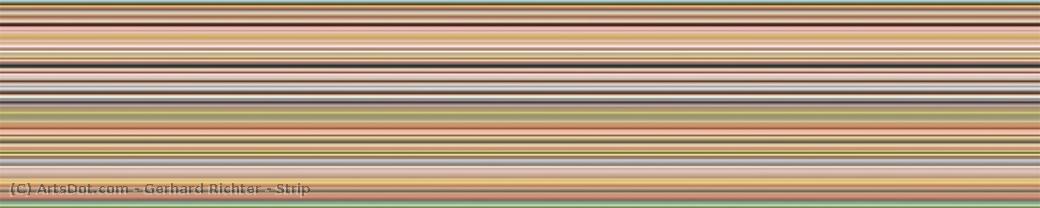
Gerhard Richter's "Strip," a monumental work from 2013, isn’t merely a painting; it’s an invitation to contemplate the very nature of perception and representation. Measuring a substantial 200 x 1000 cm, this acrylic on paper piece immediately commands attention with its bold, almost aggressively simple composition – a series of horizontal bands in varying shades of brown and orange. Yet, beneath this apparent austerity lies a complex interplay of color, texture, and the subtle suggestion of depth that speaks volumes about Richter’s signature style and his ongoing exploration of photographic source material.
The painting firmly places itself within the realm of Op Art, though Richter's approach transcends mere visual stimulation. The stripes aren’t static; they subtly shift and morph depending on the viewer’s perspective, creating a dynamic illusion that plays with our sense of space and form. This effect is achieved through careful manipulation of color intensity and value – a technique rooted in Richter’s decades-long fascination with photography and his method of layering multiple photographic sources to create abstract compositions.
A Legacy Forged in Division
Understanding "Strip" requires acknowledging the profound context of Gerhard Richter's life and career. Born in Dresden, Germany, in 1932, Richter’s early years were profoundly shaped by the political upheavals of post-war Europe. His childhood was marked by displacement and uncertainty, experiences that undoubtedly informed his artistic sensibility – a willingness to question, to deconstruct, and to embrace ambiguity. This formative period instilled within him a deep sense of questioning and a constant negotiation with the fragmented realities of his time.
Richter’s work is inextricably linked to this history of division. His exploration of memory, representation, and the photographic image can be seen as an attempt to grapple with the complexities of German identity in the aftermath of World War II and the subsequent decades of political and social transformation. The painting's restrained palette and deliberate abstraction mirror a certain emotional distance, reflecting Richter’s characteristic refusal to offer easy answers or definitive interpretations.
Decoding the Technique: Layers of Illusion
The seemingly effortless execution of "Strip" belies a meticulous process. Richter typically works with multiple photographic sources, creating composite images that are then translated into abstract paintings. In this instance, he likely employed a technique of layering and blending acrylics to achieve the subtle shifts in color and value that define the work’s visual dynamism. The textured surface – a result of these layered applications – adds another layer of complexity, inviting close inspection and encouraging viewers to lose themselves within its intricate details.
The choice of brown and orange is particularly significant. These earthy tones evoke a sense of warmth and grounding, yet their juxtaposition creates an underlying tension—a subtle discordance that mirrors the complexities of the historical context in which Richter operates. The stripes themselves act as visual anchors, guiding the eye across the canvas and creating a rhythmic pattern that simultaneously draws us in and keeps us at arm’s length.
A Reflection on Perception and Memory
Ultimately, "Strip" is more than just a visually striking composition; it's an invitation to contemplate the nature of perception and memory. Richter’s work consistently challenges our assumptions about representation, forcing us to question how we see and interpret the world around us. The painting’s ambiguous forms and shifting colors create a sense of unease—a feeling that something is just beyond our grasp. It's a testament to Richter's skill as an artist: he doesn’t offer solutions but rather presents us with questions, inviting us to engage in a dialogue with his work and with ourselves.
Біографія митця
A Life Shaped by Division: The Early Years and Artistic Formation of Gerhard Richter
Gerhard Richter’s story is inextricably linked to the fractured history of 20th-century Germany. Born in Dresden in 1932, his childhood unfolded under the shadow of a rising National Socialist regime. This formative period, marked by displacement – his family moved several times during the war years – instilled within him a profound sense of uncertainty and a questioning spirit that would permeate his artistic practice for decades to come. The idyllic landscapes of his early upbringing in Reichenau and Waltersdorf were soon disrupted by conflict, leaving an indelible mark on his psyche. His father, though not a fervent supporter of the Nazi party, navigated the complexities of life under authoritarian rule as a schoolteacher, while his mother fostered a love for literature and music within the family. This duality – a pragmatic acceptance of circumstance alongside a yearning for cultural expression – became a defining characteristic of Richter’s own artistic approach. He began formal training at the Dresden Academy of Fine Arts in 1951, initially immersed in the tradition of socialist realism demanded by the East German state. However, even within this constrained environment, a desire for artistic freedom simmered beneath the surface, fueled by a growing dissatisfaction with ideological constraints and a longing to explore more expansive creative possibilities.Escaping Constraints: Düsseldorf and the Exploration of Style
The year 1961 proved pivotal. Richter, along with his wife Marianne Eufinger, made the daring decision to flee East Germany, seeking refuge in the burgeoning art scene of Düsseldorf. This move marked a radical shift in his artistic trajectory. The West German landscape offered a liberating environment where experimentation and innovation were not only permitted but actively encouraged. In Düsseldorf, he encountered a vibrant community of artists grappling with questions of identity, representation, and the legacy of history. He quickly began to dismantle the rigid stylistic conventions of socialist realism, embarking on a period of intense exploration that would define his early mature work. This era saw him oscillate between seemingly disparate approaches – from photorealism, meticulously recreating photographic images with astonishing precision, to abstract compositions characterized by bold colors and dynamic brushstrokes. His collaboration with Sigmar Polke led to the coining of the term ‘Capitalist Realism,’ a deliberately ambiguous label that reflected their shared skepticism towards established artistic norms and their appropriation of imagery from advertising and mass media. This period wasn’t about finding *a* style, but rather questioning the very notion of stylistic coherence, embracing contradiction as a fundamental principle.Blurring Boundaries: Photorealism, Abstraction, and the Power of Chance
Richter's artistic vocabulary expanded throughout the 1960s and beyond, encompassing a remarkable range of techniques and themes. His photorealistic paintings, often based on family photographs or newspaper images, are not merely copies of reality but rather investigations into the nature of perception and representation. By meticulously rendering these images with an almost clinical detachment, he forces viewers to confront the inherent ambiguity of photographic truth. Simultaneously, Richter delved deeper into abstraction, creating canvases layered with vibrant colors and gestural marks. These abstract works are often created using a unique technique involving squeegees – tools typically used for cleaning windows – which he drags across the surface of the canvas, manipulating the paint in unpredictable ways. This embrace of chance and spontaneity is central to his artistic philosophy, allowing him to relinquish control and invite unexpected outcomes. His ‘Color Charts,’ systematic arrangements of colored squares, further challenge traditional notions of artistic expression, questioning the very definition of painting itself. These works are not about individual aesthetic preferences but rather about exploring the inherent properties of color and its organizational possibilities.The Weight of History: From Dresden to Berlin
Richter’s early life was profoundly shaped by the tumultuous events of mid-20th century Germany. Growing up in Dresden, a city repeatedly devastated during World War II, instilled within him a deep awareness of loss and destruction. The constant rebuilding efforts, the displacement of families, and the pervasive atmosphere of uncertainty left an enduring mark on his psyche. His father’s experience as a teacher under the Nazi regime – navigating a complex and often oppressive system – further contributed to Richter's critical perspective on authority and ideology. This historical context is subtly woven into many of his works, particularly those exploring themes of memory, identity, and the relationship between art and history. The destruction of Dresden in 1945 served as a powerful catalyst for artistic exploration, prompting Richter to grapple with questions about representation, truth, and the impossibility of fully capturing reality on canvas. Later, after moving to West Germany, he continued to confront these themes through his engagement with photographic imagery, often juxtaposing images of destruction with scenes of everyday life.A Legacy of Innovation: Influence and Recognition
Gerhard Richter’s impact on contemporary art is undeniable. His willingness to challenge conventions, his relentless experimentation with technique, and his profound engagement with historical and political themes have established him as one of the most important artists of our time. He has consistently resisted easy categorization, defying attempts to pigeonhole his work into a single stylistic framework. This refusal to be defined, coupled with his technical virtuosity and intellectual rigor, has earned him widespread critical acclaim and commercial success – his paintings regularly fetch record prices at auction. Beyond the market value, however, lies a deeper significance. Richter’s art speaks to the complexities of modern existence, grappling with issues of memory, identity, and the search for meaning in a fragmented world. He doesn't offer answers but rather poses questions, prompting viewers to confront their own preconceptions and engage in critical dialogue. His influence can be seen in the work of countless artists who have followed in his footsteps, drawn to his innovative techniques and his unwavering commitment to artistic exploration. Richter’s legacy is not simply about creating beautiful objects; it's about expanding the possibilities of painting itself. He remains a vital force in contemporary art, continuing to inspire and provoke audiences with his challenging and deeply resonant work.
Герхард Ріхтер
1932 - , Німеччина
Короткі факти
- Artistic Movement Or Style:
- Фотореалізм
- Абстракція
- Капіталіст реалізм
- Artists Or Movements Influenced By This Artist: ['Сучасні художники']
- Artists Who Influenced This Artist:
- Пабло Пікассо
- Сіґмар Полке
- Date Of Birth: 9 лютого 1932
- Full Name: Gerhard Richter
- Nationality: Німецький
- Notable Artworks:
- Абстрактне зображення 610-1
- Gilbert
- S. з дитиною
- Жовтень 18, 1977
- Place Of Birth: Дрезден, Німеччина

